
Gemini 4 Argon Explained: Google's Cybersecurity-First Frontier Model — and Why You Can't Use It Yet
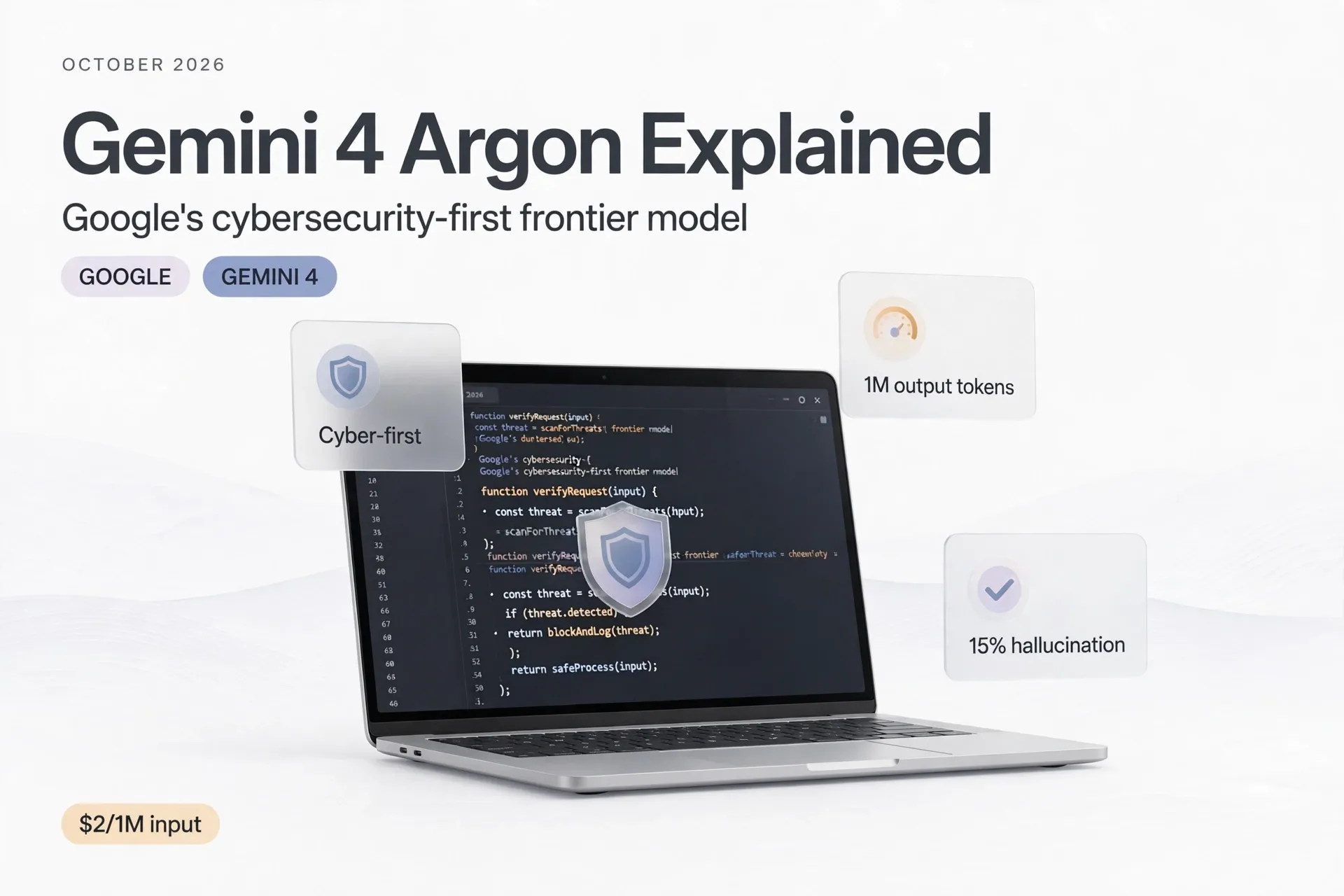
On September 30, 2026, Google announced Gemini 4 Argon, its newest frontier AI model — and did something unusual with it. Instead of opening it to developers or pushing it into the Gemini app for a billion monthly users, Google handed it first to a small group of cybersecurity professionals. Paid API customers and Google AI Ultra subscribers are next in line; everyone else waits, with no date announced.
This is the most deliberate safety-first rollout of a flagship model so far, and it says as much about where the AI industry is heading as the model itself does. Here is what Argon is, what Google claims it can do, what independent tests actually show, and when you might get your hands on it.
What happened
Google unveiled Gemini 4 Argon on September 30, calling it — in the company's own words — its most powerful model yet and "the next era of frontier intelligence." The pitch is real work: long software projects, legal and financial analysis, and, as the headline act, defensive cybersecurity. Google says Argon can "autonomously find, validate, and patch critical software vulnerabilities."
The rollout is staged. First access goes to trusted cyber defenders through Google's Fairwind Program, a security initiative; the U.S. government is also in the loop through a voluntary pre-release model access process. Next come paid Gemini API customers and Google AI Ultra subscribers, then wider availability "as soon as possible." Google has not given a date for any of the later stages.
The timing is worth noting. Rival labs are shipping flagship models at a frantic pace — OpenAI's GPT-6 Astra and Anthropic's Claude Fable 5.1 both arrived with similar best-model-yet rhetoric — even as those same companies warn that advanced AI could spin out of control. Giving the most capable model to defenders first is Google's answer to that tension: let the good guys find the flaws before attackers get the same tool.
Why cybersecurity is the launch story
Argon was trained specifically for defensive cyber work, according to Google. The company frames it as a model built to refuse harmful requests while still helping with legitimate security research — a balance every frontier lab is now trying to strike.
There is already one concrete data point. Security firm Wiz, an early Fairwind partner, said it used Argon through its Scan for Good initiative to find a critical vulnerability in hospital software — the kind of flaw where a miss has human consequences, not just financial ones. It is a single anecdote rather than a controlled study, but it is the most tangible evidence so far that the cyber-first positioning is more than marketing.
Google is also dogfooding Argon at scale. The company says its own staff already rely on the model for daily work, including debugging and large codebase migrations, and cites internal results: quantum computing resource optimization beating the baseline by 40%, more than 300 TiB of memory freed across its data centers, and C/C++-to-Rust migrations including 800,000 lines of the Fuchsia Zircon kernel. Those are Google's own figures, and they read as both product demo and recruiting pitch.
What Google's benchmark chart claims
Google's launch materials put Argon ahead of OpenAI's GPT-6 Astra and Anthropic's Claude Opus 5.5 on most tests. Every figure below is Google's self-reported number — vendor claims, not independent results:
- DeepSWE v1.1 (software engineering): 77.9%, versus 74.1% for Astra and 74.2% for Opus 5.5
- CWE-bench v1 (vulnerability remediation): 68%, tied for first
- AutomationBench (end-to-end business automation): 51.3%, versus 41.4% for Astra and 42.5% for Opus 5.5
- Vals Index (real professional work, from the Vals benchmarking startup): Argon leads
- LVBench (long-video understanding): 91.7%
- Prompt injection resistance: attacks succeeded 0.7% of the time, versus 8.5% for Astra and 1.0% for Opus 5.5
VentureBeat counted the full chart: across 18 tests, Argon leads outright on 12 and ties on 1. But the fine print matters. Astra wins FrontierSWE v2, a harder software engineering test, by more than 10 points, and Opus 5.5 wins Terminal-Bench 4.0 by 9 points. "Best at coding" depends heavily on which coding test you pick — a pattern that repeats with every launch chart.
What independent tests actually show
Outside Google's chart, the picture is more mixed: strong, but not the runaway lead the launch suggests.
On the independent Artificial Analysis Intelligence Index, which averages ten tests, Argon scores 53 at the High setting — effectively tied with GPT-6 Astra (52.7) and Claude Fable 5.1, and behind Claude Opus 5.5 (58) and Claude Sonnet 5.5 (56). Against Opus 5.5 it trails on several individual tests, including Terminal-Bench 4.0 (57.1% vs. 59.6%) and Humanity's Last Exam (57.1% vs. 61.4%).
Where Argon genuinely stands out in independent testing:
- Factual reliability. On the AA-Omniscience test, Argon's hallucination rate is 15% — against 51% for GPT-6 Astra and 54% for GPT-6.1 Sol. That is the lowest hallucination rate among models scoring above 45 on the index. For production work where a wrong fact is expensive — research, finance, support — that may matter more than a few index points.
- Automation. Argon leads Artificial Analysis's AutomationBench at 77.5%, about six points ahead of Claude Sonnet 5.5 at its max setting.
- Human preference. It tops LMArena's text leaderboard at 1,525 points, where people vote blind on which of two answers they prefer.
Then there is the Bloomberg wrinkle. On launch day, Bloomberg reported that some Google employees with direct access to Argon say it performs less well on real coding tasks than the benchmarks suggest; Google told Bloomberg that characterization is inaccurate. One employee countered that there is "large consensus" inside the company that the model is at the frontier. Both can be partly true — benchmarks and daily engineering work measure different things — but it is a useful reminder to treat every launch chart as a hypothesis until you test the model on your own tasks.
The 1-million-token output ceiling
Argon's most unusual spec is not a benchmark at all. A single response can now run to 1 million output tokens, up from 64,000 on the previous generation — the highest output limit in the industry, roughly the length of several long novels in one response.
In principle, that means rewriting very large codebases in a single pass, generating long reports and documentation without stitching together chained calls, or writing out fully converted datasets. Google's own C-to-Rust migrations are the showcase.
The practical caveats are real. At the introductory price, a full million-token response costs $10 in output tokens alone — $20 at the regular price. Very long outputs are slow to generate and hard for a human to review. Treat the limit as a ceiling, not a target: set a maximum output length per task and split huge jobs into pieces you can actually check.
Pricing: a mid-tier price tag, for now
The introductory API price is $2 per million input tokens and $10 per million output tokens, with cached input at just $0.10 — 95% below the standard input rate, which heavily rewards prompts you send again and again. After the introductory window, the price doubles to $4 and $20, and Google has not said when the discount ends.
At launch prices, Artificial Analysis puts Argon's cost at $1.99 per task on its index — about 39% less than GPT-6 Astra's $3.26 and roughly a third of Opus 5.5's $5.98. But two things erode that edge. First, Argon is wordy: it used about 62,000 output tokens per task, versus about 27,000 for Astra. Second, the regular price doubles the bill — at the same token usage, Argon would land near $4 per task, above Astra's $3.26 today. Budget for the regular price, not the launch price.
Who can use it — and when you might
Almost nobody, for now. The access ladder looks like this:
- Trusted cyber defenders in the Fairwind Program (live now), plus the U.S. government via voluntary pre-release access
- Paid Gemini API customers (announced as next, no date)
- Google AI Ultra subscribers (same — next, no date)
- Everyone else ("as soon as possible," no date)
If you are a paid API customer, the practical move is to prepare rather than wait: assemble 50 to 200 real tasks with known answers from your actual work, focus your testing where Argon claims to shine (fact-heavy answers, long code changes, automation tasks), and plan your budget at the regular $4/$20 rates rather than the introductory ones. Keep your prompts and tooling model-agnostic so you can route each job to whichever of Argon, Astra, or Claude does it best for the money. Most people will eventually meet Argon through the consumer Gemini app or the API — but "eventually" is doing a lot of work in that sentence.
The bottom line
Gemini 4 Argon is a serious model with a genuinely distinctive profile: cyber-defense-first training, the lowest hallucination rate among top-tier models in independent testing, and an unprecedented million-token output ceiling, at a launch price that undercuts its rivals. The independent data says "strong contender," not "clear winner" — tied with Astra and Fable 5.1 on the composite index, trailing the Claude 5.5 family, with open questions about how launch-chart coding scores translate to daily engineering work.
The bigger story may be the rollout itself. Staged access — defenders first, governments in the loop, everyone else later — is becoming the industry template for frontier releases. Whether that caution survives contact with competitive pressure is the question to watch. When your turn in the queue comes, test Argon on your own tasks before believing any chart, Google's included.
References
- TechCrunch, "Google releases Gemini 4 Argon, called its most powerful model yet" (Sep 30, 2026): https://techcrunch.com/2026/09/30/google-releases-gemini-4-argon-called-its-most-powerful-model-yet/
- Vanda Research, "Gemini 4 Argon Benchmarks: What Independent Tests Show": https://vandatateam.com/blog/gemini-4-argon
- AI Weekly, "Google's Gemini 4 Argon Rolls Out to Cyber Defenders First": https://aiweekly.co/alerts/googles-gemini-4-argon-rolls-out-to-cyber-defenders-first