
Navigating the September 2026 Frontier AI Surge: GPT-6 Sol & Luna, Claude Fable 5.1, and Gemini 3.8 Flash for Builders
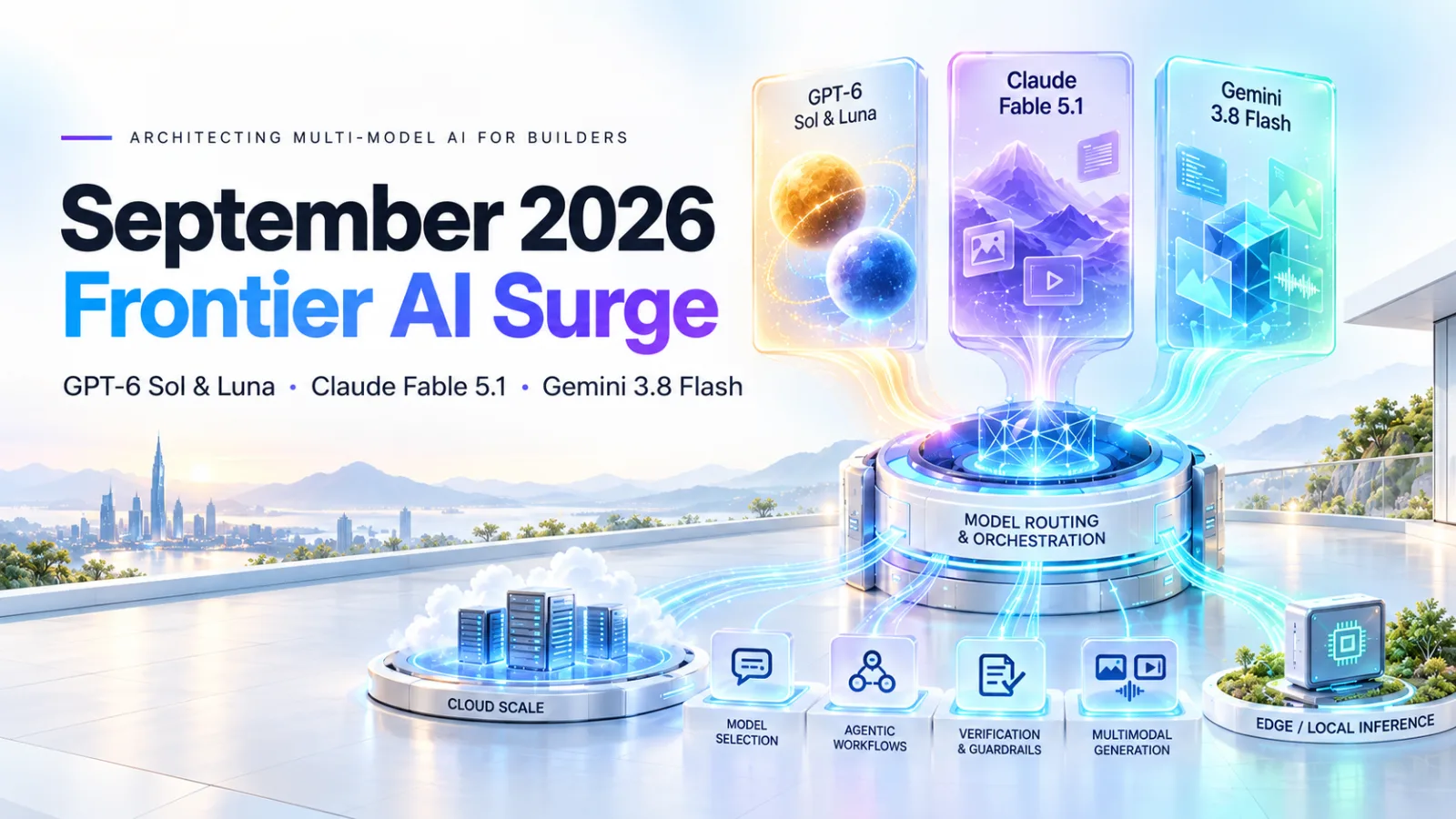
Introduction: The Pace of Frontier AI Has Accelerated
The artificial intelligence landscape in September 2026 has entered a defining phase characterized not merely by incremental benchmark climbs, but by a structural transition toward autonomous, agentic systems and multi-modal tool integration. In recent days, the major frontier AI research labs—OpenAI, Anthropic, and Google—have delivered a coordinated wave of releases that significantly recalibrate what developers and software teams can achieve in production.
From OpenAI's official release notes detailing the deployment of the GPT-6 Sol and Luna architectures into Work and Codex environments, to Anthropic’s deployment of Claude Fable 5.1 and Google’s rollout of Gemini 3.8 Flash, builders now face an abundance of computational choices. Concurrently, broader industry shifts—such as on-device routing breakthroughs and local inference acceleration—demonstrate that efficiency, latency, and agentic autonomy are replacing raw parameter counts as the primary metrics of competitiveness.
For technology leaders, product builders, and independent developers building tools on Navs Site, navigating this release blitz requires looking beyond marketing claims to evaluate latency profiles, tool-calling precision, cost-per-token economics, and architectural resilience.
1. OpenAI’s Dual-Pillar Strategy: GPT-6 Sol and Luna
On September 22, OpenAI updated its ecosystem by introducing two targeted models into ChatGPT Work and Codex: GPT-6 Sol and GPT-6 Luna.
Rather than deploying a monolithic general-purpose model, this bifurcated rollout reflects a distinct architectural strategy:
- GPT-6 Sol (The Heavyweight Reasoner): Engineered for multi-turn cognitive planning, complex system design, and zero-shot code refactoring. Sol integrates deep verification loops that systematically cross-check generated outputs against external schemas before emitting final responses. In software development tasks, Sol handles repository-wide dependency auditing and complex architectural transformations with substantially lower hallucination rates.
- GPT-6 Luna (The Ultra-Fast Agentic Engine): Designed specifically for sub-second agentic loops and high-throughput tool calling. Luna optimizes token generation speeds to allow interactive web applications, real-time code completion, and asynchronous background worker queues to execute without noticeable latency.
Crucially, as outlined in recent platform notes, ChatGPT Work and Codex have enabled native client-side tool integration, permitting models to seamlessly interface with endpoints and tool suites directly provided by client systems. This marks a clear pivot: frontier models are no longer passive chat interfaces; they are active runtime orchestrators.
2. Anthropic’s Claude Fable 5.1: Precision, Guardrails, and Safety Economics
Anthropic’s September rollout of Claude Fable 5.1 and Mythos 5.1 addresses a central paradox in modern AI development: labs are aggressively lowering API pricing while simultaneously confronting mounting enterprise scrutiny around autonomous cybersecurity and data safety.
Fable 5.1 introduces key architectural refinements:
- Deterministic Structured Output: Fable 5.1 dramatically reduces JSON parsing failures and schema drift, achieving near-perfect compliance when generating nested payloads. For developers relying on automated ETL pipelines or building API integrations, this reliability eliminates the need for redundant retry wrappers.
- Granular Cyber & Vulnerability Inspection: Built with specialized threat intelligence telemetry, Fable 5.1 excels at static vulnerability identification and secure code review, flagging unsafe deserialization patterns and subtle permission escalation exploits in modern web stacks.
- Context Retention Over Extended Sessions: With enhanced needle-in-a-haystack recall across 500k+ token windows, Fable 5.1 maintains coherent multi-file state throughout extensive debugging sessions without memory degradation.
3. Google Gemini 3.8 Flash: High-Throughput Multimodality
Google has responded to the September competition by shipping Gemini 3.8 Flash, positioning it as the premier workhorse model for high-frequency agentic tasks, multimodal document ingestion, and enterprise workspace automation.
Gemini 3.8 Flash’s competitive strengths center around:
- Cost Efficiency at Massive Scale: By optimizing token generation costs, Gemini 3.8 Flash provides a compelling economic model for applications requiring continuous indexing of millions of web pages, video files, and codebases.
- Native Multimodal Grounding: Unlike architectures that bolt image and audio processing onto text backbones, Gemini 3.8 Flash natively decodes mixed-media inputs—such as video walk-throughs, UI design schematics, and audio logs—within a unified attention space.
- Enterprise Workspace Integration: Seamless interoperability with cloud file systems, real-time collaboration platforms, and internal document databases makes 3.8 Flash an agile coordinator for enterprise automation pipelines.
4. Edge and Hybrid AI: The Rise of NVIDIA PAIR and Local Inference
While frontier cloud APIs capture the headlines, September 2026 has witnessed an equally significant inflection point on the edge. NVIDIA has recently unveiled PAIR (Personal AI Router) alongside dedicated RTX Spark PCs.
This development transforms how developers structure production applications:
- Intelligent Compute Partitioning: NVIDIA PAIR enables local machines to intelligently route sensitive or latency-critical reasoning tasks to local hardware (leveraging optimized llama.cpp and vLLM runtimes), while selectively dispatching massive synthesis jobs to frontier cloud APIs.
- Data Sovereignty & Local Privacy: PII-sensitive calculations, code secret inspections, and preliminary filtering can now occur locally on developer workstations at zero token cost and zero network latency.
- 1.9x Throughput Gains: Upgraded inference kernels allow models such as Nemotron-3.5 Lightning and GLM-5.3-Flash to run locally at near-cloud speeds, closing the gap between hosted endpoints and workstation environments.
5. Architectural Guide: Building a Resilient Multi-Model Router
In an era where multiple frontier models launch in rapid succession, hardcoding your software stack to a single model provider introduces significant financial and operational risk.
To achieve maximum reliability and performance, engineering teams should implement a Three-Tier Semantic Routing Architecture:
- Tier 1 (Triage & Classification): Use an ultra-low-cost, sub-100ms model (such as Gemini 3.8 Flash or a local quantized engine) to classify incoming prompt complexity, detect intent, and identify required external tools.
- Tier 2 (High-Frequency Execution): Direct real-time UI modifications, summarization tasks, and standard API parameter generation to fast models like GPT-6 Luna.
- Tier 3 (Deep Verification & Heavy Synthesis): Route high-risk operations—such as database schema migrations, financial calculation logic, and security audits—to GPT-6 Sol or Claude Fable 5.1, requiring explicit intermediate self-consistency checks.
6. Summary and Strategic Takeaways
The releases of late September 2026 signal the maturation of the AI industry. The differentiator for modern software products is no longer whether they incorporate AI, but how thoughtfully they architect their model dependencies.
- Avoid Single-Vendor Monoliths: Implement abstraction layers that allow seamless routing between OpenAI, Anthropic, Google, and local backends based on real-time latency and pricing.
- Design for Agentic Tool-Use: Optimize your APIs and schema endpoints for automated consumption; frontier models are increasingly operating as API clients rather than conversational partners.
- Embrace Hybrid Architectures: Leverage edge inference for privacy and immediate feedback, reserving frontier cloud compute for multi-step reasoning.
As these tools continue to evolve, staying adaptable and prioritizing architecture over hype remains the single most effective strategy for builders in 2026 and beyond.