
Grok 4.7 Is Out: xAI's $2/$6 Coding Model Upgrade — and the Catch in the Fine Print
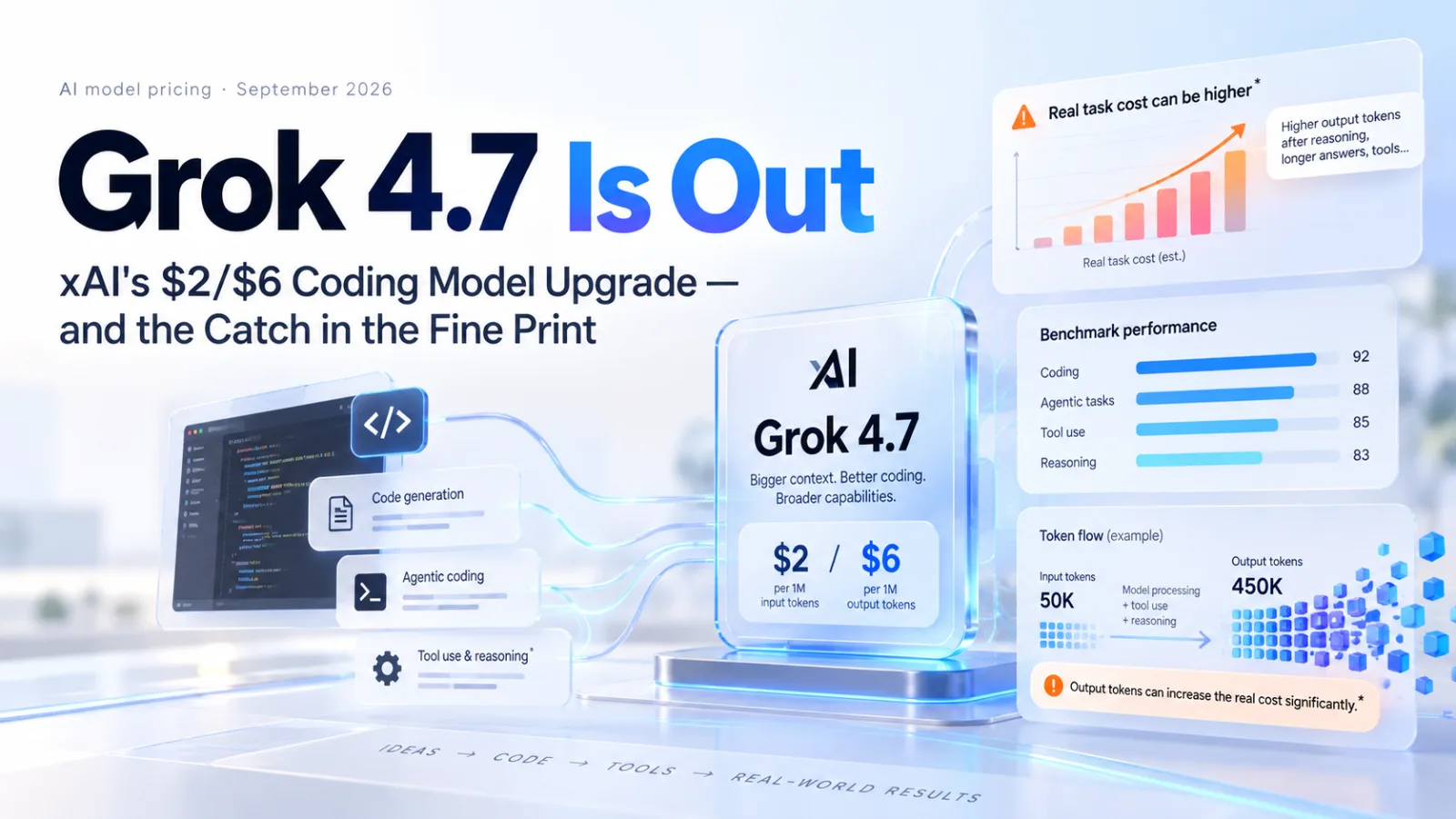
Three days ago, xAI — now calling itself SpaceXAI — released Grok 4.7, its latest model for coding and knowledge work. The headline was deliberately boring: same $2-per-million input tokens and $6-per-million output tokens as Grok 4.6, served at the same speed. A meaningful capability upgrade, the company says, at no extra cost.
The headline is true. But it isn't the whole bill. Independent testing finds that at its highest effort setting, Grok 4.7 burns through more than twice as many output tokens per task as its predecessor, roughly doubling what each completed task costs. Benchmark scores also swing wildly depending on who runs them and under what conditions. For developers deciding whether to switch, those details matter more than the price list.
This article breaks down what actually changed in Grok 4.7, how it performs against its predecessor and its rivals, where it is available, and who should switch — based on xAI's announcement materials, its developer documentation, and independent evaluation.
What happened
On September 21, 2026, xAI officially released Grok 4.7, the successor to Grok 4.6, which had shipped just over a month earlier on August 12. The company describes Grok 4.7 as its most capable model for coding and knowledge work, built on a new, larger base model and trained with a longer reinforcement learning run weighted toward tasks that take many hours to complete.
According to xAI, the new model is better at checking its own work, managing longer context, and working natively with the company's Grok Bot harness — a team of always-on coding agents introduced in August.
The release strategy had two notable features. First, availability was immediate and broad: from day one, Grok 4.7 was live in xAI's own Cursor, in Grok Build (xAI's coding agent, where the company is offering free access to the model), through the Grok API, and via third-party coding harnesses, model routers, and cloud platforms. Second, GitHub began a phased rollout of Grok 4.7 across all GitHub Copilot plans the same day — Pro, Pro+, Max, Business, and Enterprise — putting the model into the model picker in VS Code, Visual Studio, JetBrains IDEs, Xcode, Eclipse, the Copilot CLI, and cloud agents.
The specs, in plain English
For developers evaluating whether the model fits their workflow, the technical profile is straightforward:
- Context window: 500,000 tokens, unchanged from Grok 4.6.
- Knowledge cutoff: May 2026.
- Inputs and outputs: Text and image input; text output only.
- Reasoning effort: Adjustable across low, medium, high, and xhigh, with high as the default.
- Capabilities: Function calling, web search, X search, and code execution, through both the Responses and Chat Completions APIs.
- Pricing: $2 per million input tokens, $0.50 per million cached input tokens, $6 per million output tokens — identical to Grok 4.6. Once a request's prompt reaches 200,000 tokens, every token in that request is billed at the long-context rate of $4 input, $1 cached input, and $12 output per million.
- Grok 4.7 Fast: A variant served on faster infrastructure at double the standard token rates — $4 input and $12 output per million. It is available only in Cursor and Grok Build, is excluded from Grok Build's free tier, and cannot be reached through the public API.
One clarification worth making: xAI's announcement materials describe Grok 4.7 as "twice as fast" — but that comparison is against more expensive rival models, not against Grok 4.6. Grok 4.7 Fast is a genuinely faster serving tier, but it comes at twice the price.
The benchmarks: strong in spots, and sensitive to who runs them
xAI published a benchmark and pricing table comparing Grok 4.7 against Grok 4.6, GPT-5.6 Sol, and Claude Fable 5.1. On the company's own figures, the new model improves substantially over its predecessor:
| Benchmark | Grok 4.7 (xhigh) | Grok 4.6 (high) | GPT-5.6 Sol (max) | Fable 5.1 (max) |
|---|---|---|---|---|
| CursorBench 4.0 (extended coding) | 46.3% | 40.4% | 41.7% | 51.8% |
| DeepSWE v1.1 (software engineering) | 71.0% | 65.2% | 72.7% | 70.0% |
| Terminal-Bench 4.0 (terminal work) | 38.0% | 20.3% | 37.3% | 57.9% |
| EEBench (electrical engineering) | 64.0% | 53.0% | 39.4% | 56.4% |
| Harvey Legal Agent Benchmark | 19.6% | 15.8% | 2.5% | 6.7% |
| HealthBench Professional (clinical reasoning) | 56.7% | 48.5% | 60.5% | 62.1% |
On xAI's figures, Grok 4.7 leads the group on electrical engineering and legal work, beats GPT-5.6 Sol on extended coding tasks, and tops Fable 5.1 on software engineering. But there are two important caveats, and both come from the fine print.
First, xAI compared Grok 4.7 at its xhigh effort setting against Grok 4.6 at high. Part of each gain may come from the higher reasoning setting rather than the new model alone. An effort setting is not free: it changes how many tokens the model generates to reach an answer.
Second, independent results are more modest and, in some cases, materially different. Artificial Analysis gives Grok 4.7 an overall score of 46 on its Intelligence Index — only two points above Grok 4.6 — and finds the two models broadly similar outside agentic knowledge work. Its gains are concentrated in long-horizon work: Grok 4.7 scored 1,657 Elo on AA Briefcase, up 111 points and just behind Claude Opus 5 and Fable 5.1. And Terminal-Bench 4.0 is a case study in how much the testing setup matters: xAI reports 38.0%, Artificial Analysis measured 33% when running Grok 4.7 inside its native Grok Build agent, and under Artificial Analysis's standardized Intelligence Index harness the score was 26%. These are not contradictory — each reflects different conditions — but they mean no single Terminal-Bench figure should be quoted without the setup it was measured in.
The brighter independent signal is the model-plus-tooling combination. With Grok Build, Artificial Analysis scored Grok 4.7 at 56 on its Coding Agent Index — nine points up from Grok 4.6, and fourth among models tested in their native harnesses. That suggests the native harness training is doing real work.
Note that all benchmark figures above should be treated as reported numbers — xAI's own for the official table, and Artificial Analysis's for the independent scores — not as independently settled facts.
The real price: same per token, double per task
The pricing story is where the headline gets tricky. The price list is unchanged from Grok 4.6. The cost of getting work done is not.
Artificial Analysis found that Grok 4.7 at xhigh used roughly 81,000 output tokens per Intelligence Index task, versus 36,000 for Grok 4.6 at high — 125% more. At $6 per million output tokens, that is about $0.49 of output per task against roughly $0.22 for Grok 4.6: the cost of reaching an answer more than doubled at those settings, even though the price list did not move.
- Once a prompt reaches 200,000 tokens, the long-context rate doubles the cost of every token in that request.
- xAI strongly recommends setting a prompt cache key; without one, requests can land on a server without the cached context and pay the full input price instead of the $0.50 cached rate.
- There is no Batch API discount, the US regional endpoint adds a 10% premium, and Priority Processing doubles the standard rate.
The practical takeaway: effort setting and caching discipline will shape real costs far more than the $2/$6 headline. Teams should test Grok 4.7 at high effort before assuming they need xhigh.
Safeguards and cybersecurity
xAI says Grok 4.7 was built with an entirely new safeguard stack and is the strongest model the company has tested on refusals and jailbreak resistance. In dual-use domains such as cybersecurity and biological work, the company says Grok 4.7 leads on both utility for benign tasks and safe refusal of dangerous ones — topping LatchBio's biosafety benchmark at 62.4%. On HackerBench v0.3, xAI's own benchmark for risky and malicious cyber tasks, the company says Grok 4.7 allowed only 3.3% of risky dual-use prompts through while rarely blocking legitimate security work. xAI has also started giving select cybersecurity partners invite-only access to Grok 4.7's red-team capabilities for defensive research. All of these figures come from xAI and have not been independently verified.
Who should switch to Grok 4.7
The clearest case for switching belongs to teams already running Grok inside Cursor or Grok Build, and to anyone doing long agentic coding or knowledge-work tasks — that is where the independent gains are concentrated. The free access inside Grok Build makes trying it essentially costless.
Teams running short, routine tasks on Grok 4.6 have less to gain. Artificial Analysis found the two models broadly similar outside agentic knowledge work, and teams on pinned workflows may want to A/B test before migrating. For raw capability on terminal-heavy coding or clinical reasoning, Fable 5.1, GPT-6 Astra, and Opus 5 still lead — at several times the price.
How to get started
- API: The model ID is
grok-4.7on xAI's API. Check current pricing on xAI's developer docs before building anything on it, since pricing rules around long context, regions, and priority processing can change. - Grok Build: Free access is available inside Grok Build at x.ai/build — the lowest-friction way to evaluate the model.
- GitHub Copilot: Rolling out across all Copilot plans. Select it from the model picker in your IDE. Business and Enterprise admins should check the model policy screen — new models are enabled by default and billed pay-as-you-go.
- Cursor: Available in Cursor as of release day, alongside the Grok 4.7 Fast tier for those willing to pay double for double the output speed.
- Set a prompt cache key: On the API, this is the single most important cost lever. Without it, you can pay the full input rate instead of the $0.50 cached rate.
Summary
Grok 4.7 is a solid, genuinely improved model that xAI is selling at a disruptive price — and the launch's most useful lesson is about how pricing works in the agentic era. Per-token prices are no longer the bill; effort settings, token output, caching, and the testing harness determine what a model actually costs and how well it performs.
xAI deserves credit for the pricing and the distribution: $2/$6 API rates with free access in Grok Build and day-one placement in GitHub Copilot makes this one of the easiest frontier models to try in 2026. But before migrating a production workflow, test at your actual effort setting and measure tokens per task — the headline was never a lie, it was just incomplete.