
ZeroDrift Anchor 3.0 Explained: The First "Enforcement Runtime" Models for AI Compliance — and 5 Tools That Pair With Them
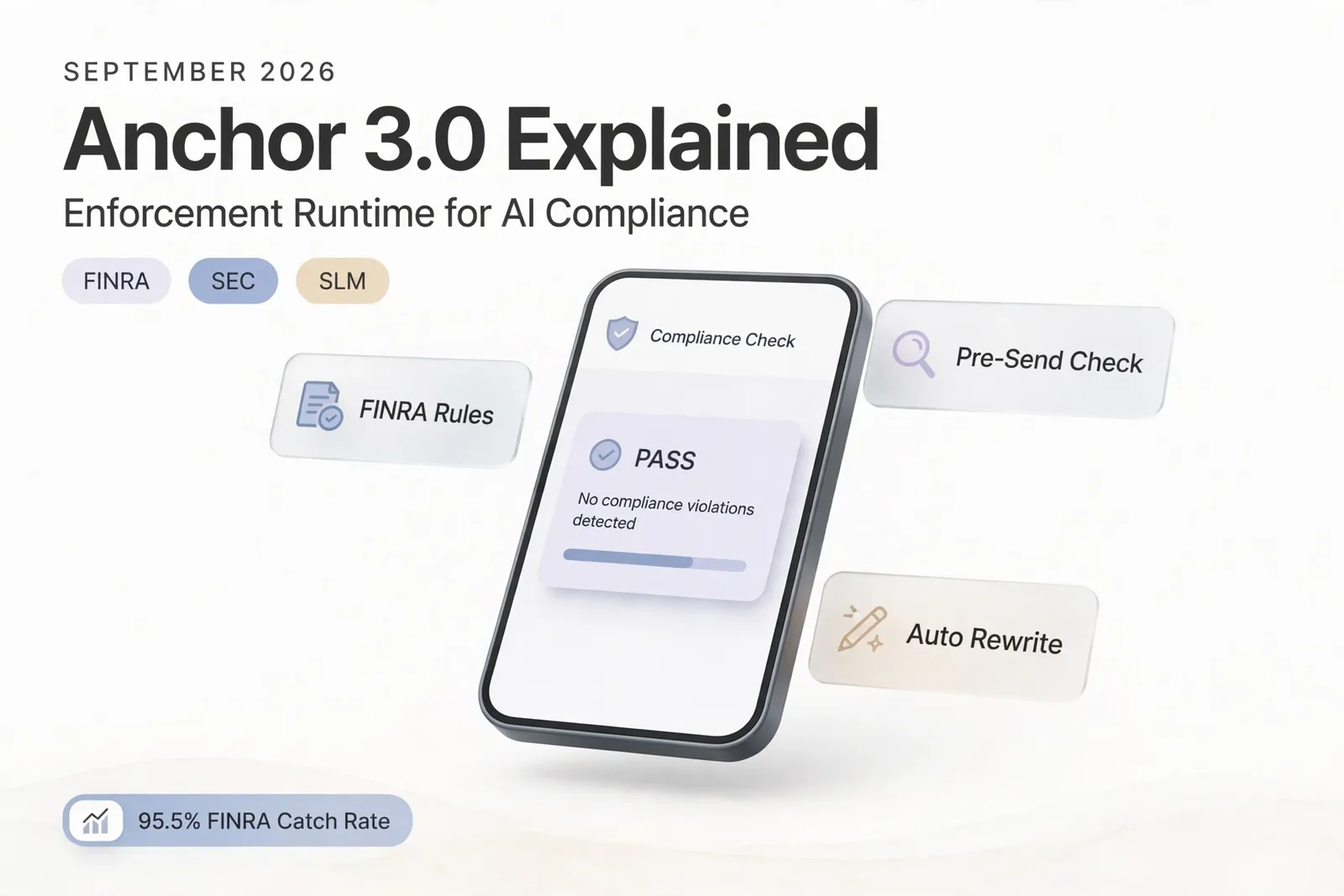
On September 23, 2026, New York startup ZeroDrift announced the general availability of Anchor 3.0, which it describes as the first family of small language models built for "enforcement runtime" — a layer that checks what AI agents say against financial regulations and company policies before anything is sent. The launch matters less for the benchmark scores — all company-reported — than for the category it tries to create: compliance that runs at AI speed instead of reviewing output after the fact.
What follows: what Anchor 3.0 is, what "enforcement runtime" means, what the FINRA benchmark claims do and don't prove, and five AI tools in the same stack that pair with this approach.
What happened
ZeroDrift announced Anchor 3.0 on September 23, 2026, via a company press release, with immediate general availability for developers through what the company calls its Enforcement API. Alongside the launch, the company published a benchmark it says is the first to measure how well AI models enforce FINRA rules on business communications, built on human-written, attorney-labeled data produced by Surge AI, a data-labeling firm.
The key facts from the announcement:
- Anchor 3.0 is a family of three small language models purpose-built to enforce regulatory and company rules on AI-generated communications before they are sent.
- The company reports the flagship model caught 95.5% of FINRA violations in its test — more than any frontier model it tested — while running up to 34 times faster and costing up to 12 times less than the strongest frontier model on the test, GPT-5.6 Sol. These are ZeroDrift's own figures, not independently verified results.
- Checks run in about 1.5 seconds through ZeroDrift's API and under 100 milliseconds when self-hosted, according to the company.
- The models are available now; developers can sign up at zerodrift.com.
What "enforcement runtime" actually means
Most compliance tooling today works after the fact: communications are captured, archived, and surveilled for violations, and reviewers investigate alerts. ZeroDrift's pitch is to move the check to before the message leaves — an "enforcement runtime" that sits between the AI agent and the outside world.
In practice, a deterministic rules engine and the Anchor small language model check every AI-generated message in parallel and produce one verdict: pass, rewrite, block, or escalate. Rewrites are re-checked before sending, and each decision cites the exact rule behind it — an audit trail a regulator can follow.
ZeroDrift's own example, shown on its product page: an agent drafts "The Apex Growth Fund is a safe way to beat the market." The system flags it, cites FINRA Rule 2210 and a "promissory performance language" policy match, and suggests a rewrite along the lines of "The fund may be appropriate for certain investors depending on objectives, risk tolerance, and time horizon."
Why a small model: frontier models take 12 to 51 seconds per message on these checks (per ZeroDrift), making them usable only for after-the-fact review. A small model tuned for one job can check every message in real time.
The three models: Mini, Anchor 3.0, and Max
Anchor 3.0 comes in three sizes, each post-trained from an open model:
| Model | Size | Base model | Built for |
|---|---|---|---|
| Anchor 3.0 Mini | 9B parameters (4B active) | Gemma E4B | Highest-volume AI traffic; runs pre-built rule packs and flags violations |
| Anchor 3.0 | 9B parameters (4B active) | Gemma E4B | The flagship behind the headline results; 200+ pre-built rules across FINRA, SEC, and other regulations; flags exact violating lines and rewrites them; custom company policies trained in via a LoRA adapter |
| Anchor 3.0 Max | 27B parameters | Qwen3.8-27B | Most capable; enforces a company's own policies with no fine-tuning; handles long-form content and document attachments with the largest context window in the family |
Coverage spans financial services (SEC, FINRA, FCA, MiFID II, and 30+ regimes, per the company), insurance (NAIC and state rules), and healthcare (HIPAA, CMS, FDA). Deployment is cloud or in-VPC, SOC 2 certified, with no customer data retained, according to ZeroDrift's specifications page.
The benchmark claims — and the fine print
ZeroDrift's headline numbers deserve a careful read:
- 95.5% of FINRA violations caught, more than any frontier model tested. This is the company's own benchmark, on data labeled by attorneys at Surge AI. Independent data labeling is good practice, but the benchmark's design, rule selection, and scoring are ZeroDrift's.
- Outperformed GPT-5.6 Sol — described as the strongest frontier model on the test — on recall, precision, and F1. Again, company-reported.
- Up to 34x faster and up to 12x cheaper than the strongest frontier model tested. Speed and cost advantages for a small specialist model over a frontier generalist are plausible, but "up to" figures represent best cases.
What the benchmark doesn't establish: how Anchor 3.0 performs on a firm's own idiosyncratic policies, how regulators view AI-rewritten communications, or how it handles anything beyond text — the current spec lists text only. Treat the numbers as a vendor claim until an independent party replicates them.
For context on the company: ZeroDrift was founded in New York by AI and platform veterans from Google DeepMind, Microsoft AI, and Goldman Sachs, led by founder and CEO Kumesh Aroomoogan, and raised $10 million in a seed round backed by a16z speedrun and others, as reported by TechCrunch in June 2026. The one named customer in the launch materials is Wand AI, whose Chief AI Architect Cristian Felix says ZeroDrift extends Wand's governance layer so its agents' communications are "checked and corrected before they are sent."
5 AI tools that pair with an enforcement-runtime layer
Anchor 3.0 handles the pre-send check. The tools below handle adjacent jobs — capture, surveillance, archiving, and agent governance — and together they sketch the emerging compliance stack for AI in regulated industries. Only Wand AI is a disclosed ZeroDrift user; the rest are independent tools in the same problem space, not claimed integrations.
1. Wand AI — agent governance, already paired with ZeroDrift. Wand AI builds agentic AI platforms, and per ZeroDrift's announcement it uses ZeroDrift to extend its governance layer with external regulatory requirements. If you're evaluating enforcement runtime, this is the reference deployment to watch: an agent platform putting a compliance gate in front of everything its agents say.
2. Behavox — unified AI compliance surveillance. Behavox offers communications archiving, trade surveillance, and policy management on a single stack with explainable, multilingual AI, and was named to the RegTech100 2026 list. Where Anchor 3.0 gates AI-generated messages before sending, Behavox covers the detective side: archiving and surveilling the full communications record, including human-written traffic.
3. Smarsh — communications governance and archiving. Smarsh's platform covers digital communications governance and archiving; in March 2026 it launched a "Noise Reduction Agent" that applies AI during ingestion to suppress low-risk content before it reaches supervision queues, reporting up to 60% fewer false positives in early previews (company-reported). Think of it as the archive of record plus alert triage behind the pre-send gate.
4. Shield — eComms surveillance for financial services. Shield specializes in electronic communications surveillance and compliance for financial firms, with AI-powered risk analysis. It covers the human side — advisors, traders, and staff writing emails and chats — while an enforcement-runtime model watches what AI agents generate.
5. Theta Lake — compliance for collaboration platforms. Theta Lake provides compliance and security for Zoom, Microsoft Teams, Webex, Slack, and other collaboration tools, with AI-powered risk detection that the company says extends to AI-generated content. Its niche is the meeting: voice, video, and chat, where a text-only pre-send check doesn't reach.
You can browse tools in these categories in the navs.site AI tools directory to compare them side by side.
Who should care — and the limits
Worth a look for: broker-dealers, RIAs, asset managers, banks, insurers, and healthcare organizations deploying AI agents that communicate with customers or counterparties; compliance and AI platform teams being asked "how do we govern what the agents say."
Honest limits:
- The launch materials disclose no pricing, so cost comparisons remain abstract for now.
- The modality is text; voice agents and video are outside the current spec.
- The benchmark is vendor-designed. Independent replication is the milestone to watch.
- An enforcement layer is not a compliance program. Regulators have levied billions in fines over communications failures, and whether AI-rewritten messages satisfy supervisory obligations is still untested ground.
The takeaway
ZeroDrift is attempting to name a category — "enforcement runtime" — for compliance that gates AI output before it ships rather than reviewing it afterward. The product logic is sound: frontier models are too slow and expensive to check every message, so a small, fast, explainable specialist fills a real gap. The performance claims should be read as vendor marketing until independently verified.
What to watch next: independent benchmark replication, disclosed pricing, whether regulators accept AI-rewritten communications as compliant, and whether the big AI labs build pre-send enforcement into their own agent platforms — which would validate the category while threatening the standalone vendors in it.
References
- ZeroDrift, "ZeroDrift Launches Anchor 3.0, the First Family of Models Built for Enforcement Runtime of AI Agent Communications" (company press release via GlobeNewswire, September 23, 2026): https://www.globenewswire.com/news-release/2026/09/23/3367512/0/en/zerodrift-launches-anchor-3-0-the-first-family-of-models-built-for-enforcement-runtime-of-ai-agent-communications.html
- ZeroDrift official product page (Anchor model specifications, deployment and coverage details): https://zerodrift.com/
- SiliconANGLE, "ZeroDrift launches service to check agent-generated messages against company policies" (September 2, 2026): https://siliconangle.com/2026/09/02/zerodrift-launches-service-to-check-agent-generated-messages-against-company-policies/
- TechCrunch, "ZeroDrift raises $10M to protect AI models from themselves" (June 2, 2026): https://techcrunch.com/2026/06/02/zerodrift-raises-10-million-to-protect-ai-models-from-themselves/
- Business Wire, "Behavox Named to RegTech100 2026 for AI-Powered Unified Compliance Platform": https://www.businesswire.com/news/home/20251211507575/en/Behavox-Named-to-RegTech100-2026-for-AI-Powered-Unified-Compliance-Platform
- Business Wire, "Smarsh Launches AI-Enabled Communication Surveillance for Small to Medium Businesses" (March 5, 2026): https://www.businesswire.com/news/home/20260305223835/en/Smarsh-Launches-AI-Enabled-Communication-Surveillance-for-Small-to-Medium-Businesses
- Theta Lake, "Theta Lake Survey Shows that 99% of Organizations Are Adopting AI, Yet 88% Struggle with AI Compliance & Security Challenges": http://thetalake.com/press-release-groundbreaking-theta-lake-survey-shows-that-99-of-organizations-are-adopting-ai-yet-88-struggle-with-ai-compliance-security-challenges/