Microsoft's decision-scoring model returning calibrated probabilities for routing, classification, and agent control — about 35x faster than GPT-6 Sol.
Microsoft-Decision-1 announcement article
1 / 3Overview
What is Microsoft-Decision-1?
Microsoft's decision model for agents and workflows
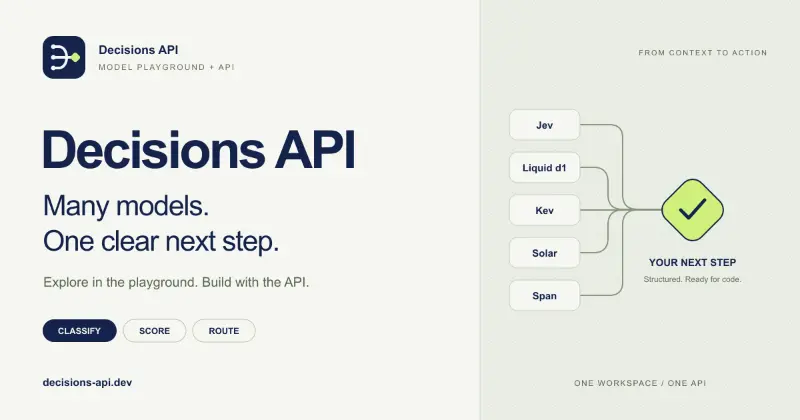
Microsoft-Decision-1 is a decision-scoring model for routing, classification, verification, and agent control. Give it fixed options and it returns a calibrated probability for each in a single pass — structured output software can act on directly, without parsing text.
Decision models are a new AI category purpose-built to deliver structured outputs. Microsoft-Decision-1 is fine-tuned from Qwen3.5-9B and delivers top performance in latency and quality: P50 latency is about 35x faster than GPT-6 Sol, so hundreds of decisions complete before one LLM call finishes. It scored highest across 36 benchmarks covering ~150k training-blind problems, stays stable under input perturbations (only 1.3% of decisions change across 8 perturbation types), and passed safety testing across 5,250 requests and 11 benchmarks for harmful content, jailbreaks, and prompt injection.
Available today in the Microsoft Foundry model catalog and via OpenRouter. Input tokens cost $0.042 USD per million tokens; output tokens are free.
Platforms and languages
Microsoft-Decision-1 Availability
Platforms
Languages
Capabilities
Microsoft-Decision-1 Key Features
Ultra-fast decisions
P50 latency is about 35x faster than GPT-6 Sol — hundreds of decisions complete before one LLM call finishes.
Top benchmark quality
Highest accuracy across 36 benchmarks covering ~150k training-blind problems, and best results on JevBench.
Stable under perturbations
Only 1.3% of decisions change across 8 input perturbation types; option rewrites, reversals, or shuffles keep decisions stable.
Calibrated probabilities
The API returns a calibrated probability per option directly — no text parsing needed, software can act on it immediately.
Tested for safety
Passed testing across 5,250 requests and 11 benchmarks for harmful content, jailbreaks, and prompt injection, identifying harmful requests without over-refusing normal ones.
Best for
Who uses Microsoft-Decision-1?
Developers building AI agents and workflows
Score decisions for routing, classification, verification, and agent control at very low latency
ML and data teams
Run high-throughput structured decisions for labeling, evaluation, and filtering tasks
Plans and access
Microsoft-Decision-1 Pricing
Paid
$0.042 per 1M input tokens, output free; available via Microsoft Foundry and OpenRouter
Common questions
Microsoft-Decision-1 FAQs
What does Microsoft-Decision-1 do?
Give it a fixed set of options and it returns a calibrated probability for each in a single pass — structured output your software can act on directly, without parsing generated text.
Where can I use it?
It is available in the Microsoft Foundry model catalog and via the OpenRouter API. Documentation is on learn.microsoft.com under Azure AI Foundry, and the model weights and code are on GitHub (microsoft/decision-1).
How much does it cost?
$0.042 USD per million input tokens; output tokens are free. No free tier was announced.
What is it used for?
Agent control, model routing, data labeling, AI evaluation, intent analysis, event routing, data validation, search relevance, content filtering, code scanning, safety screening, computer use, robotics, and scientific discovery.
Is there an app or web interface?
No — it is API-only via Microsoft Foundry and OpenRouter. There are no web, mobile, or desktop apps.
Reviews
See what the community thinks and share your experience.
—
Based on 0 ratings
Rating distribution
Community reviews
No reviews
No written reviews yet.