Open-source telemetry that measures how engineering teams actually use AI coding agents, without storing code.
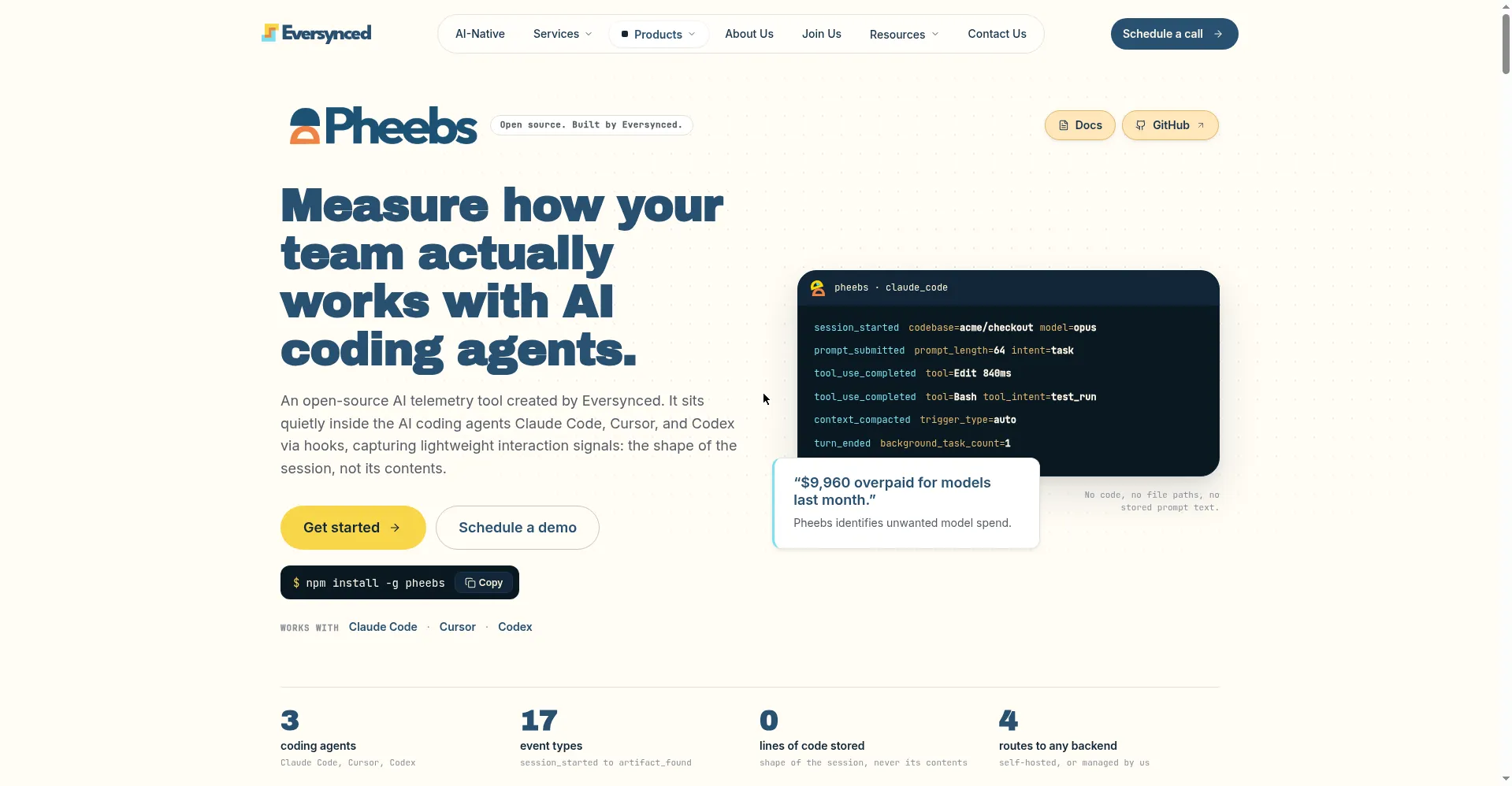
Homepage hero
1 / 2Overview
What is Pheebs?
Measure how your team actually works with AI coding agents.
Pheebs is an open-source AI telemetry tool, built by Eversynced, that measures how engineering teams actually work with AI coding agents. Leadership often guesses at AI adoption; Pheebs replaces the guesswork with real interaction signals.
It installs via npm and injects hooks into Claude Code, Cursor and Codex. Each session event is written as JSONL on the local machine and never touches a server by default. Crucially, it captures the shape of the session, not its contents: model switches, tool calls, subagents and context compaction are recorded, while source code, prompt text and file paths are never stored (every field is documented in PRIVACY.md).
On top of the telemetry sits the AI Proficiency Model, an open, versioned evaluation framework: six AI practices crossed with five judgement signals (verification, pushback, refine-to-repair, wholesale acceptance, model fit). Visual reports include practice adoption funnels, heatmaps, per-engineer views and judgement signal tables, so teams can tell structural gaps apart from individual coaching needs.
The self-hosted client is free and open source (Apache-2.0). A managed service is available for teams that want reporting run for them, priced on request.
Platforms and languages
Pheebs Availability
Platforms
Languages
Capabilities
Pheebs Key Features
Silent hook telemetry
Hooks inject into Claude Code, Cursor and Codex; every session event is written as local JSONL and never touches a server by default.
Session shape, not content
Records interaction metadata such as model switches, tool calls and context compaction; never stores source code, prompt text or file paths.
AI Proficiency Model
Open, versioned evaluation framework: six AI practices crossed with five judgement signals, giving engineers and teams an AI proficiency view.
Visual reporting views
Practice adoption funnels, heatmaps, per-engineer views and judgement signal tables separate structural gaps from coaching needs.
Open backend and OTel integration
Native OpenTelemetry export for Claude Code and Codex, an open protocol with a runnable reference implementation, self-host friendly.
Best for
Who uses Pheebs?
Engineering teams using AI coding agents
Measure real AI usage patterns to find skill gaps and coach engineers
Plans and access
Pheebs Pricing
Freemium
Self-hosted open source free; managed hosting pricing on request.
Common questions
Pheebs FAQs
What data does Pheebs collect?
Only interaction metadata: the shape of the session (model switches, tool failures, compaction timing). Never source code, prompt text, file paths or command strings; every field is documented in PRIVACY.md.
Does data leave my computer?
By default, no. A fresh install writes local JSONL logs only; events are reported only after you configure a backend endpoint and API token.
Which coding agents are supported?
Claude Code, Cursor and Codex. Claude Code and Codex are fully supported (hooks plus OpenTelemetry); Cursor is hooks-only for now.
What is the AI Proficiency Model?
An independently versioned evaluation framework: six AI practices crossed with five judgement signals, decoupled from the event schema so it can evolve over time.
How do I get started?
Run npm install -g pheebs, then pheebs init to register the hooks, pheebs doctor to verify the setup, and pheebs insights to see your report in the terminal.
Reviews
See what the community thinks and share your experience.
—
Based on 0 ratings
Rating distribution
Community reviews
No reviews
No written reviews yet.