AWS's open-source, model-driven SDK for building production AI agents in Python and TypeScript.
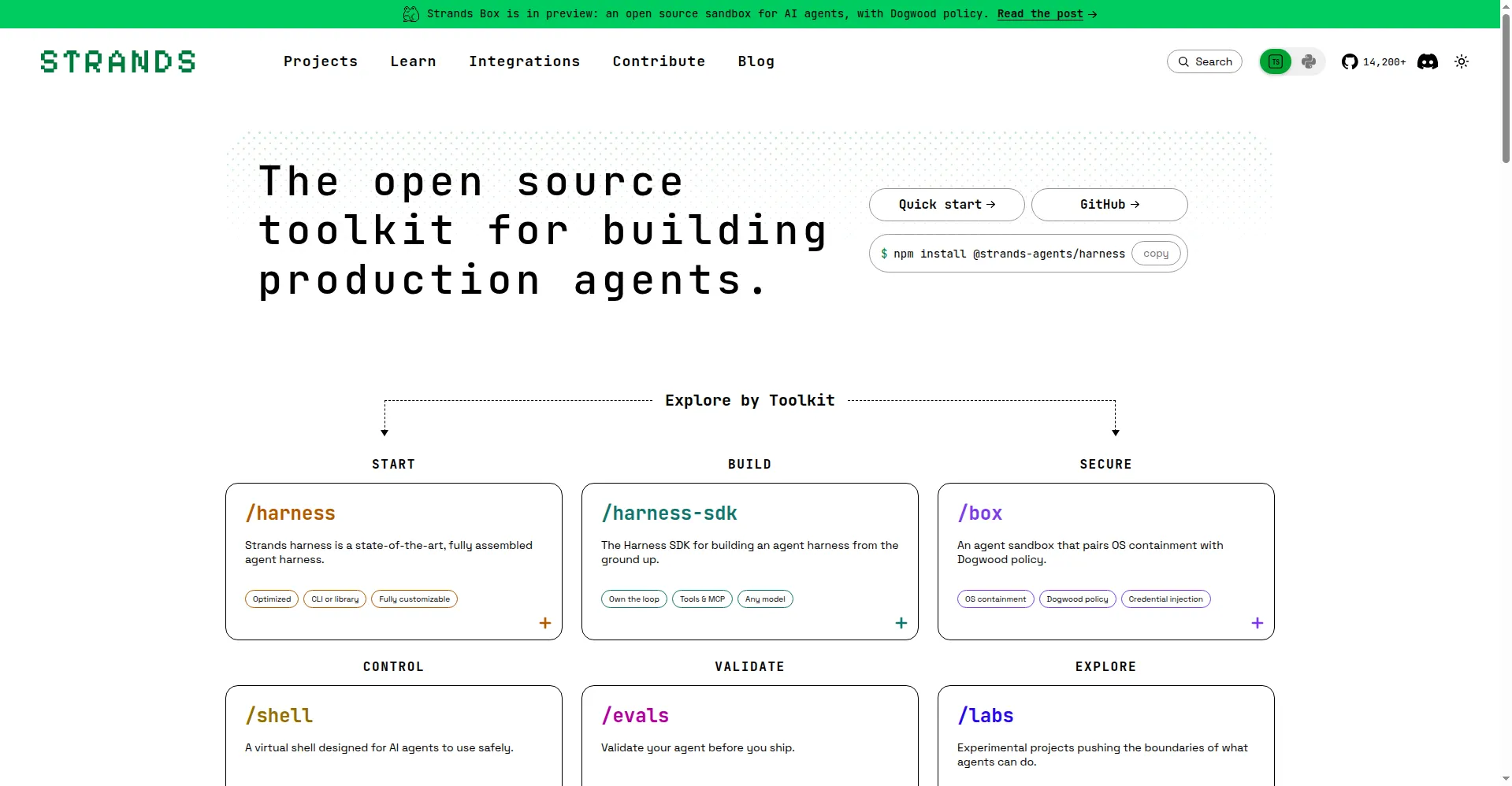
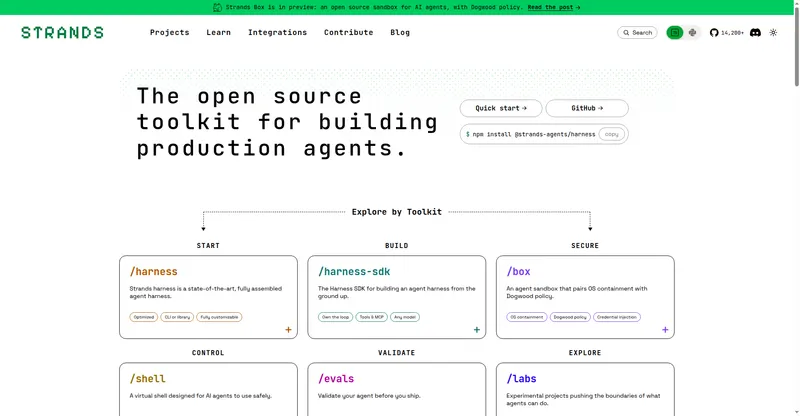
Strands Agents homepage
1 / 2Overview
What is Strands Agents?
The open source toolkit for production AI agents.
What it is
Strands Agents is AWS's open-source toolkit for building production AI agents. It takes a model-driven approach: you define the model, the tools, and the prompt, and the framework runs the agent loop — tool calls, multi-step reasoning, and error recovery included. Official SDKs exist for Python and TypeScript.
Why teams pick it
Strands ships as a library that runs in your own process, not a platform you deploy to: you bring any major model provider (Amazon Bedrock by default, plus Anthropic, OpenAI, Google, LiteLLM, Ollama, Vercel, Mistral, and others) and can move between providers without rewriting code. Built-in model routing strategies (fallback across providers, classifier-based routing) help trade off cost, latency, and capability per request.
Production features
Beyond single agents, Strands supports subagent delegation, multi-agent patterns (tools, graphs, swarms), MCP servers, OpenTelemetry-native observability, long- and short-term memory, guardrails with PII redaction and human-in-the-loop interventions, and deployment to Lambda, Fargate, EKS, or Bedrock AgentCore. A companion Evals SDK covers agent evaluation. Everything is Apache 2.0 licensed with no paid tiers.
Platforms and languages
Strands Agents Availability
Platforms
Languages
Capabilities
Strands Agents Key Features
Model-driven agent SDK
A model-driven agent loop: define the model, tools, and prompt, and the framework handles tool calls, multi-step reasoning, and recovery.
Any model provider
Bring any major model provider — Bedrock, Anthropic, OpenAI, Google, LiteLLM, Ollama, and more — and switch providers without rewriting code.
Model routing
Fallback strategies across providers and classifier-based routing to balance cost, latency, and capability per request.
Multi-agent support
Delegate to subagents and coordinate multi-agent patterns: tools, graphs, and swarms.
Tools and MCP
Custom tools, Python decorators, and MCP server connections, plus an official Strands MCP server.
Observability
OpenTelemetry-native tracing, metrics, and debugging, plus complete decision logs for auditing agent behavior.
Production safety and evals
Guardrails, PII redaction, human-in-the-loop interventions, checkpoints, and a companion Evals SDK for testing agents.
Plans and access
Strands Agents Pricing
Free
Common questions
Strands Agents FAQs
Which model providers does Strands Agents support?
Amazon Bedrock by default, plus Anthropic, OpenAI, Google, LiteLLM, Ollama, and also Vercel, Llama, Mistral, and Writer. The ModelRouter can route or fail over across providers.
Do I need AWS to use it?
No. Strands runs as a library in your own process and works with any major model provider — you pick the one you already have access to and can migrate without rewriting code.
How does it compare to other agent frameworks?
Its model-driven design and OpenTelemetry-native observability. An official comparison page walks through agent-loop control, MCP, multi-agent patterns, memory, guardrails, and its built-in Evals SDK versus OpenAI Agents SDK, LangGraph, Vercel AI SDK, and Pydantic AI.
Is it production-ready?
Yes — that is its stated positioning: "production AI agents," with deployment targets (Lambda, Fargate, EKS, Bedrock AgentCore), guardrails, PII redaction, intervention approvals, checkpoints, and an evaluation SDK.
Reviews
See what the community thinks and share your experience.
—
Based on 0 ratings
Rating distribution
Community reviews
No reviews
No written reviews yet.