
DeepSeek V4.1-Flash-1017: The $0.15 Agent Model
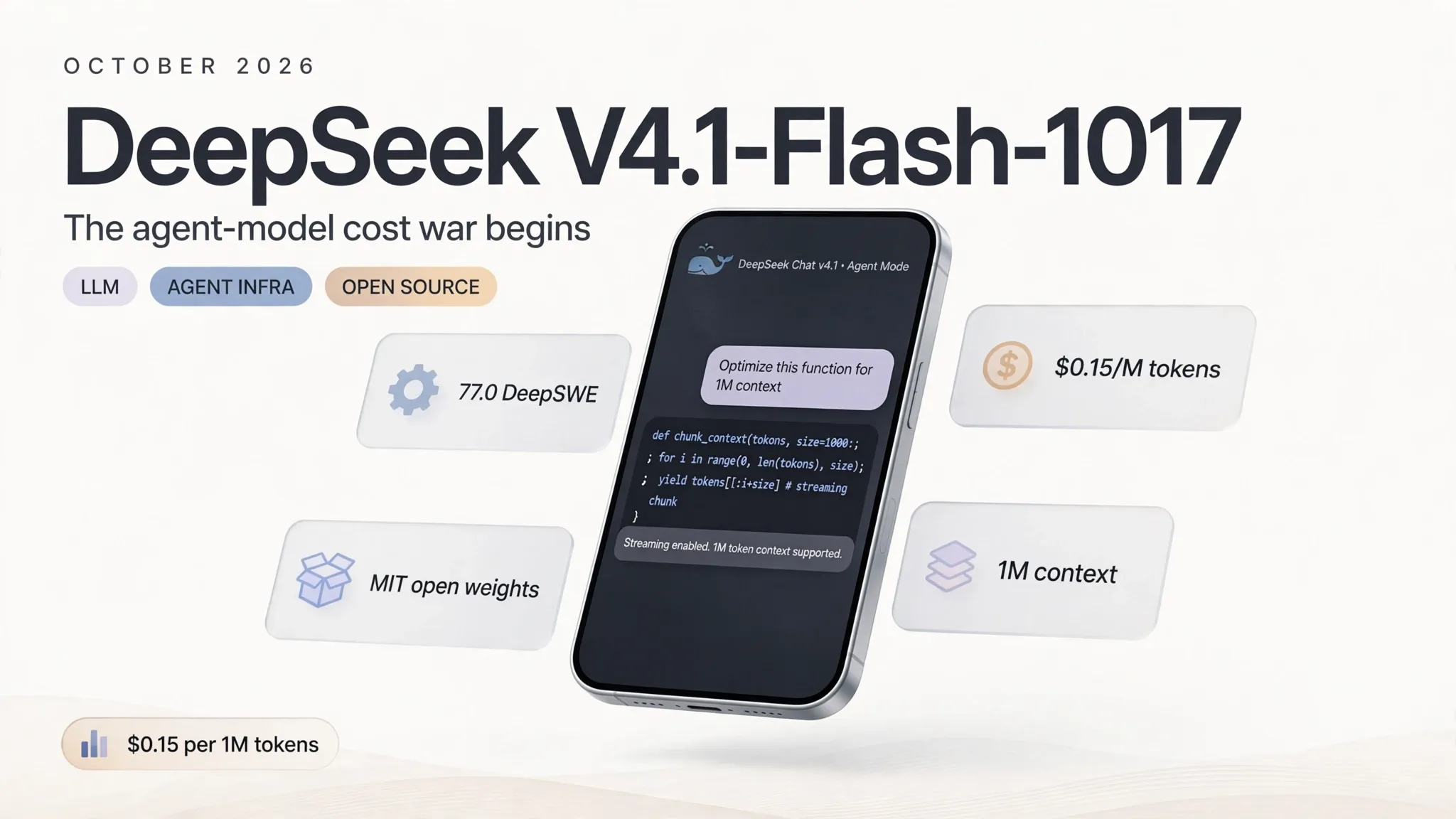
On October 17, 2026, DeepSeek quietly swapped the model running behind its most popular API endpoint — and cut nothing from the price sheet. DeepSeek-V4.1-Flash-1017, an updated checkpoint of September's V4.1-Flash, is now live on the DeepSeek website, app, and API under the same deepseek-flash model name. Existing users got the upgrade automatically; API calls cost exactly what they cost before.
The company calls it "a Pareto improvement in performance and cost": better benchmark scores, faster task completion, shorter outputs — at unchanged prices. All of the headline numbers are DeepSeek's own and have not been independently reproduced, though the first outside test runs have started to land and broadly support the value story. Alongside the model, DeepSeek opened its in-house search infrastructure to every developer through new Search and Fetch APIs. The message is clear: cost efficiency is becoming the main battleground for agent models, and DeepSeek wants to sell the whole stack — model plus web layer.
What actually changed
V4.1-Flash-1017 is not a new architecture. It is a tuned post-training checkpoint of the V4.1-Flash model that launched on September 10, built on the same 552B-parameter Causal Encoder-Decoder mixture-of-experts design, which activates just 8B parameters per token on input and 16B on output. The context window remains 1M tokens, with the model card listing at least 256K tokens of maximum output.
What changed is performance, according to DeepSeek's own published table. The update improves on all 11 benchmarks the company reports, with gains ranging from 2.0 to 11.1 points:
- DeepSWE v1.1 (agentic coding): 77.0, up from 74.2 — ahead of Claude Opus 5 (74.0) and GPT-5.6 Sol (73.0) in DeepSeek's table.
- Terminal-Bench 4.0: 42.3, up from 31.2, a 35% jump and the largest single gain.
- Automation-Bench: 60.5, up from 54.8 — the best score in DeepSeek's comparison table.
- Apex Bench and Agents' Last Exam: 72.1 and 35.4, leading DeepSeek's five-model table.
It is not a clean sweep. Claude Opus 5 still leads the same table on raw knowledge (HLE: 56.3 vs 42.6), Terminal-Bench 4.0 (51.8 vs 42.3), ProgramBench (37.0 vs 29.1), and repository reconstruction (NL2Repo-Bench: 75.3 vs 68.2). The model also gained multimodal grounding: Chartography rose to 83.0 and BabyVision to 92.5.
Perhaps more consequential than any benchmark row, the weights are open under the MIT license on Hugging Face and ModelScope — fully commercial use permitted. And DeepSeek says the new checkpoint was trained with reinforcement learning plus self-feedback for end-to-end project work, citing examples from game creation to 3D modeling.
One early independent data point arrived on October 18: Browser Use ran 1017 through its 180-task benchmark and called it "the new Pareto frontier" — scoring 75.0 at $0.22 per task, matching Claude Opus 5.5's 75.0 at $2.35 per task. A single run by the benchmark owner, but a promising start for the independent picture.
Why 890 bytes per token matters more than the benchmarks
The technical headline of this release family is not a parameter count — it is memory. The companion technical report is titled "DeepSeek-V4.1-Flash: Pushing the Limits of KV Cache Compression," and it puts the numbers on the cover: the global KV cache is 890 bytes per token, roughly a quarter of the previous Flash generation. At that rate, a full 1M-token context needs about 0.9 GB of GPU memory for its cache. The weights themselves are the bigger bill — 510 GB — but the cache, which grows with every long agent conversation, is where inference cost actually bites.
This is what makes the pricing credible. DeepSeek's API rates (unchanged with this update):
- Input: $0.15 per million tokens off-peak ($0.30 at peak), with cache reads at just $0.003/M
- Output: $0.60 per million tokens off-peak ($1.20 at peak)
An independent 56-trial pilot cited in coverage put the per-task cost at $0.0157, against $0.0577 for GPT-6.1 Sol and $0.0653 for Claude Sonnet 5.5 — roughly a quarter of the price per completed task.
In agent workflows, where the model re-reads the same long context across dozens of tool calls, cached-input pricing dominates the bill. A model that is 4x cheaper per token and compresses the dominant cost line is not marginally cheaper — it changes which workloads are economical to automate.
The bigger move: DeepSeek's Search and Fetch APIs
The model update was only half the announcement. For the first time, DeepSeek opened its own search infrastructure to all developers. The new Search API returns up to 50 ranked web results per query, and the Fetch API converts a single web page into Markdown — powered, according to DeepSeek, by an in-house search engine serving hundreds of millions of requests daily.
Pricing is $0.75 per 1,000 successful calls per endpoint, with failed, timed-out, or result-less calls not billed. Calls routed through server-side tools in DeepSeek Harness, Anthropic's Claude Code, and OpenAI's Codex stay free for DeepSeek API users until billing starts on October 31, 2026 at 16:00 UTC. The endpoints are capped at 5 queries per second per account.
This is the strategic line that matters. DeepSeek is moving up the stack: from selling a model to selling agent infrastructure — a low-cost coding model plus a first-party web-search layer behind a single API key. That puts it in direct competition with dedicated search-API providers. For builders, it means grounded agents (search, fetch, cite) without wiring a second vendor.
DeepSeek also tuned this checkpoint for specific harnesses: its own open-source DeepSeek Harness (v0.2.1-rc.1 or later recommended), Tencent's CodeBuddy coding assistant, and WorkBuddy, Tencent's desktop office agent — a deliberate pull toward a stack DeepSeek influences end to end.
5 ways to use DeepSeek V4.1-Flash-1017
1. DeepSeek — the official app and API
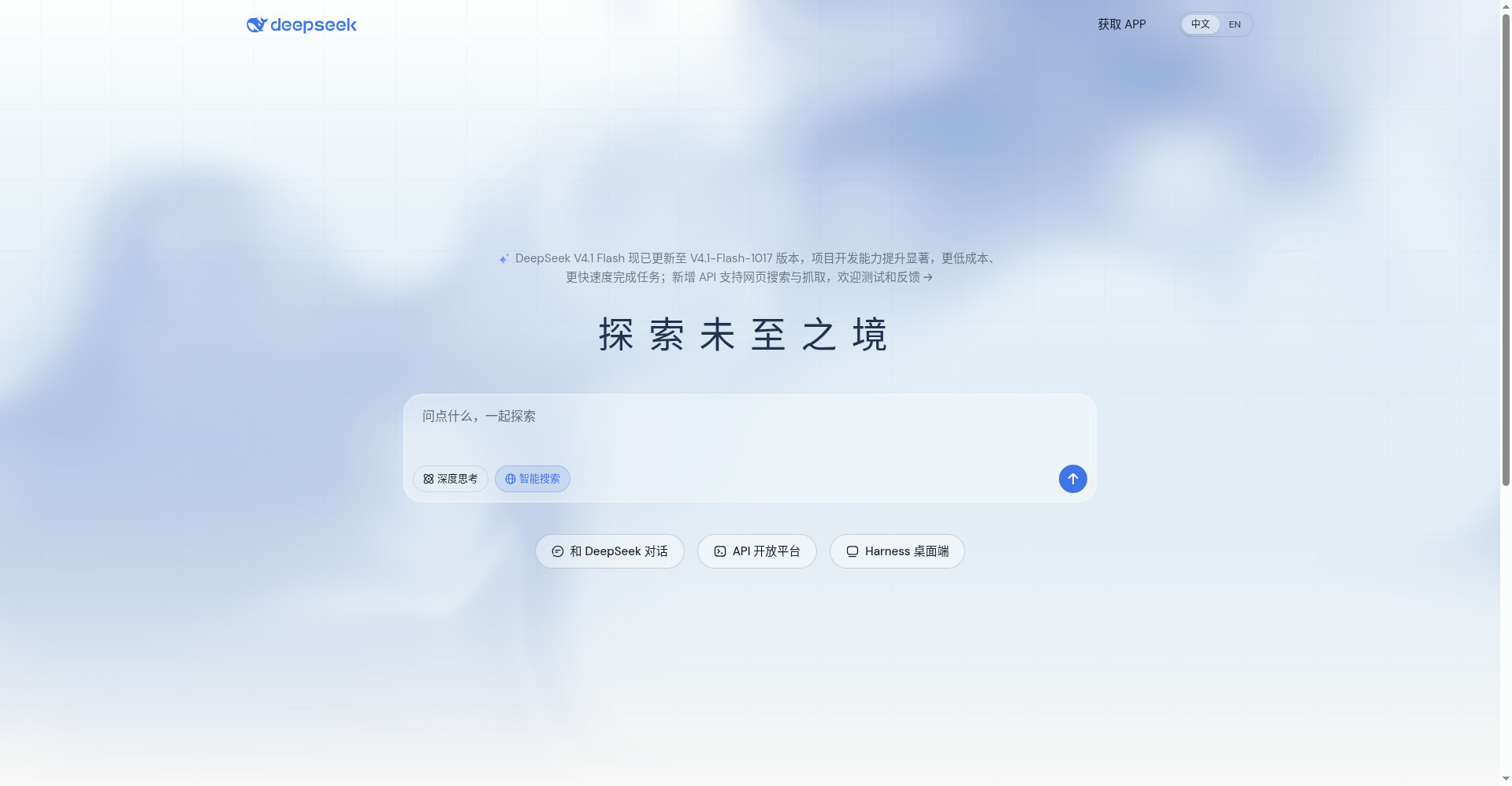
The simplest entry point. The model is already live on the DeepSeek website and app, and the API serves it under the existing deepseek-flash name — no code changes needed, since the endpoint swapped underneath. API pricing stays at $0.15/M input and $0.60/M output off-peak, with cache reads at $0.003/M. Recommended sampling is temperature 1.0 / top_p 1.0. If you run long-horizon agents, this is the cheapest officially supported way to do it.
2. OpenRouter — one key, every provider
OpenRouter already lists the model as deepseek/deepseek-v4.1-flash-1017, so you can call it through OpenRouter's unified API alongside every other provider, compare its per-token cost against rivals in one dashboard, and A/B test it against Claude or GPT models without changing your integration. Useful if you want price-comparison data before committing your agent fleet to a single vendor.
3. Hugging Face — the MIT weights
The weights are published under the MIT license, which means commercial use, fine-tuning, and redistribution are all permitted with no usage tiers. The repository ships the model card with the full benchmark table, a technical report on the KV-cache work, and prompt-encoding references. If you self-host inference, this is where the 890-bytes-per-token story becomes your own margin.
4. Cursor — the AI-first code editor
Cursor lets you point its agent at any API-compatible model, which makes it a natural home for a cheap, strong coding checkpoint. With 1017's DeepSWE gains and shorter outputs, running your coding agent on the Flash tier is exactly the workload this release was built for: lots of context, lots of tool calls, price per task that stays boring.
5. Cline — the open-source coding agent
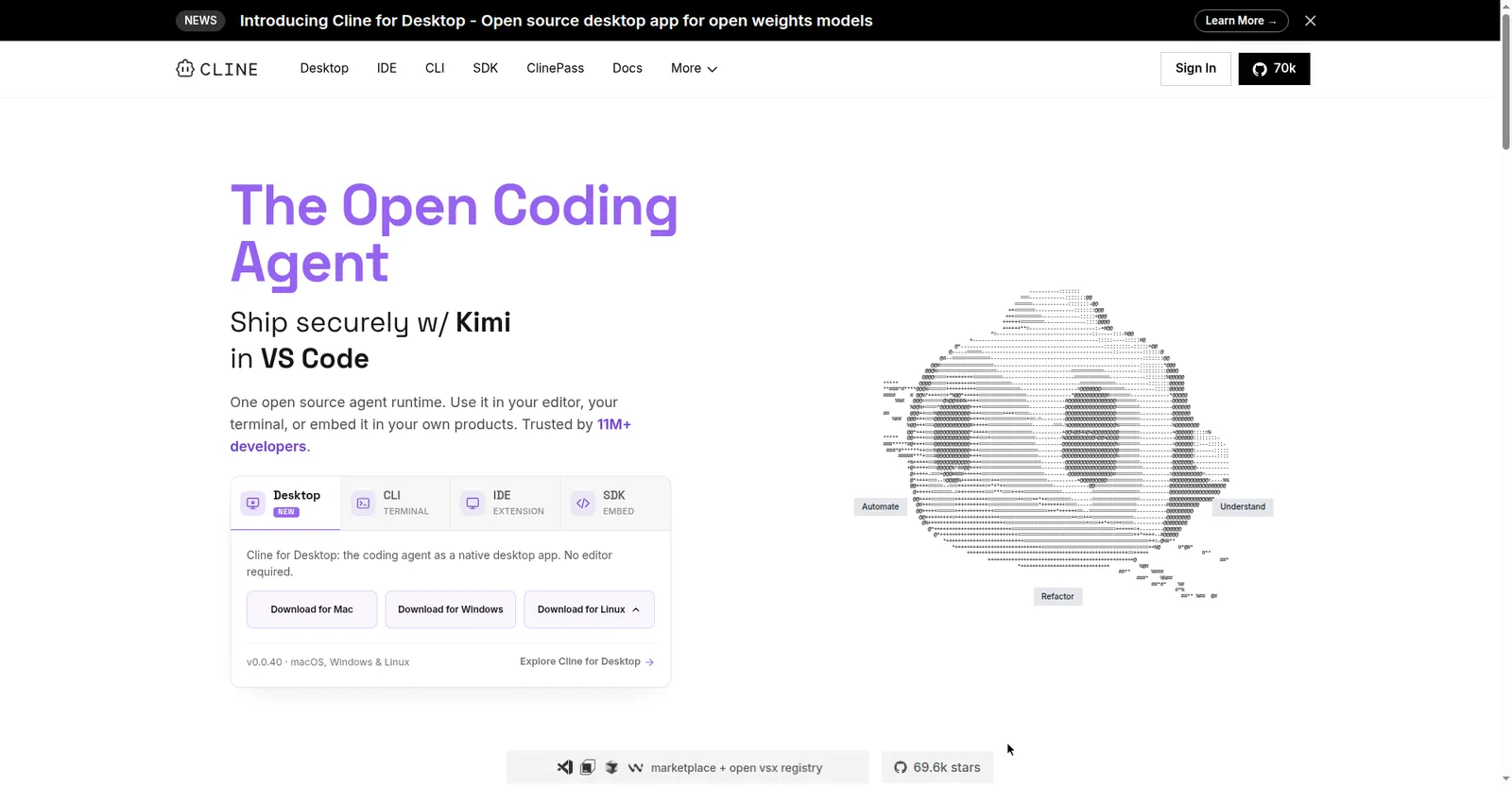
Cline, the open-source autonomous coding agent for VS Code, supports custom API endpoints — so you can wire deepseek-flash in as its brain. Pairing the model with an open agent loop like Cline is a sensible way to test the Pareto claim on your own repos before betting production workloads on it.
Caveats worth keeping in mind
Every benchmark number above is DeepSeek's own, produced on harnesses it chose. Independent reproduction has barely begun — one Browser Use run and one Enactra run do not constitute a consensus. Treat the "Pareto improvement" framing as a company claim, not an established fact, until third-party evals accumulate.
Two more notes from the coverage: media reports noted a service outage of roughly five hours around the release window, a reminder that the cheapest API is only cheap if it is up. And aiweekly observed that DeepSeek describes this release as a "tuned checkpoint" — language that, intentionally or not, can sidestep the frontier-model regulatory scrutiny that a "new model" announcement would invite in several jurisdictions.
The bottom line
DeepSeek-V4.1-Flash-1017 is what a mature cost war looks like: no price cut needed, because the architecture already compresses the expensive part. The benchmark gains are real on DeepSeek's own terms, the MIT weights remove the open-versus-closed tradeoff, and the Search and Fetch APIs signal where the company is really going — from model vendor to agent-infrastructure provider.
For builders, the practical takeaway is simple: pin the checkpoint, re-run your own eval suite in the harness you actually use, and measure output length as well as pass rate. The calendar date that matters most is not October 17 — it is October 31, when the free Search and Fetch window through server-side tools closes.
Sources
- DeepSeek, "DeepSeek-V4.1-Flash-1017: Wish-Driven Programming Made Real" (official release note, October 17, 2026): https://api-docs.deepseek.com/news/news261017
- DeepSeek-V4.1-Flash-1017 model card (Hugging Face, MIT license, benchmark table): https://huggingface.co/deepseek-ai/DeepSeek-V4.1-Flash-1017
- CellCog, "DeepSeek V4.1 Flash: Price, Specs, and the Rumor Scorecard" (includes October 17 update with benchmark table and first independent runs): https://cellcog.ai/blog/deepseek-v4-1-flash-release-date/
- SiliconANGLE, "DeepSeek releases updated V4.1-Flash model it says completes tasks faster" (October 18, 2026): https://siliconangle.com/2026/10/18/deepseek-releases-updated-v4-1-flash-model-it-says-completes-tasks-faster/
- aiweekly, "DeepSeek Opens V4.1-Flash-1017 Weights and $0.75 Search API": https://aiweekly.co/alerts/deepseek-opens-v41-flash-1017-weights-and-075-search-api
- MarkTechPost, "DeepSeek Just Released V4.1-Flash-1017, Scores 77.0 on DeepSWE, Opens Search API": https://www.marktechpost.com/2026/10/17/deepseek-just-released-v4-1-flash-1017-scores-77-0-on-deepswe-opens-search-api/