
Google DeepMind Genie 4 Explained: Worlds You Can Talk To and Steer in Real Time
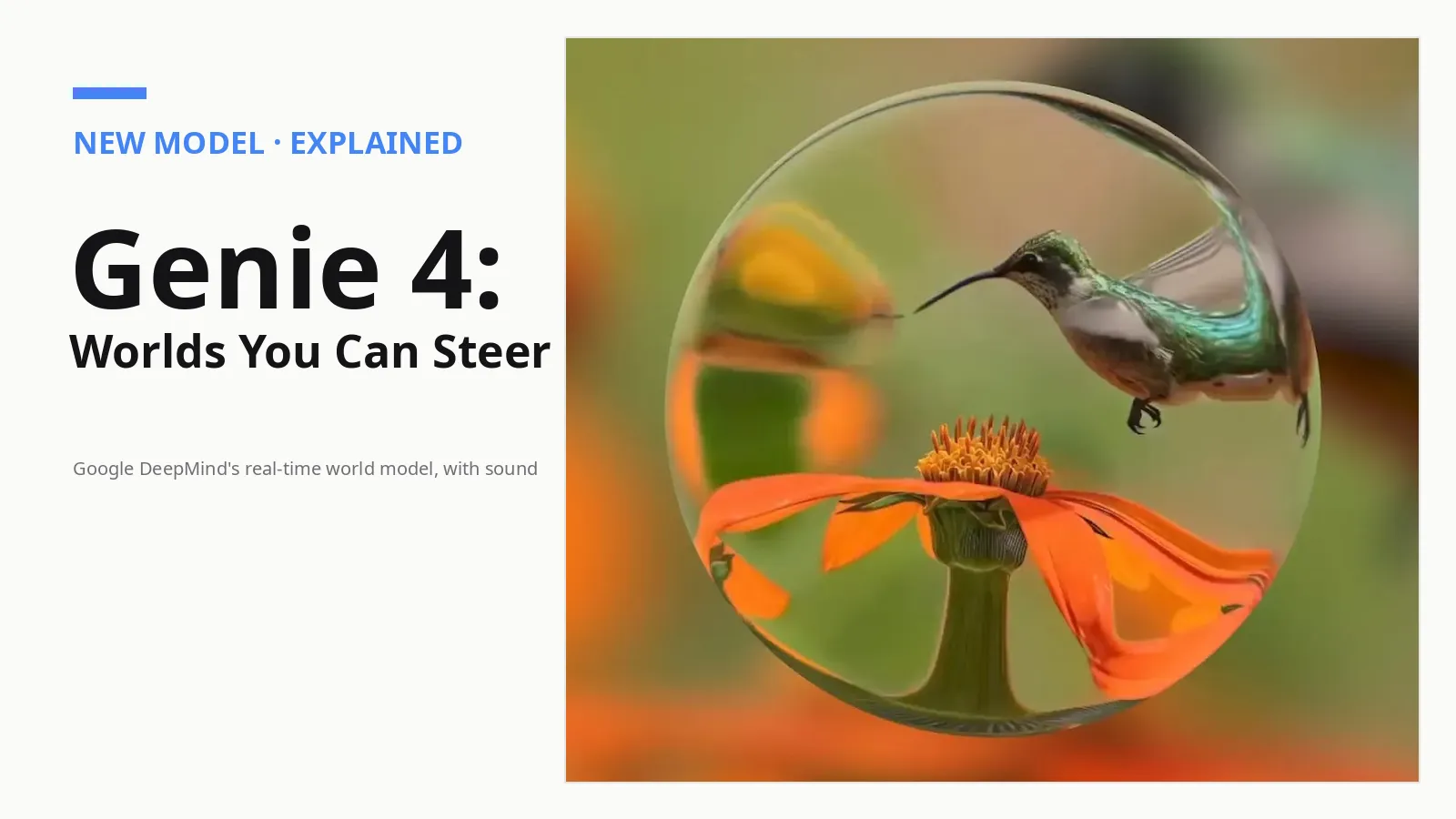
Type a sentence, and a world appears. Type another sentence, and it starts to rain inside that world while a character keeps talking to you. That is the promise of Google DeepMind's Genie 4, announced on October 27, 2026. It is not a video generator that hands you a finished clip. It is a world model: a system that simulates a place you can move through, change, and talk to in real time.
There is one important catch, and DeepMind states it plainly. Genie 4 is a research preview for trusted testers only. Most readers cannot try it today. This article explains what Genie 4 actually does, what changed since Genie 3, who it is for, where it still falls short, and what you can do while you wait.
What happened
On October 27, 2026, Google DeepMind announced Genie 4, its new world model for real-time interactive simulation. According to DeepMind, you set an event in motion, and Genie 4 simulates what happens next: how the world responds, how it sounds, and how the people in it move, react, and speak.
The announcement describes Genie 4 as natively multimodal. Music, ambient noise, and interactive dialogue are generated together with the visuals, in the same simulation, rather than added afterwards. DeepMind calls it the company's first real-time world model to generate audio natively.
Access is limited for now. DeepMind says it has started rolling Genie 4 out as a research preview for trusted testers, gathering feedback before a wider release. The next steps, according to the announcement, are Google AI Ultra subscribers in Project Genie and early access partners of the Gemini API and Google AI Studio. A waitlist for Project Genie is open, but DeepMind has not announced a date for general availability.
Key features and changes
Four changes define Genie 4.
Steer the world while it runs
The most practical change is real-time steering. You navigate with standard keyboard controls and change the scene with natural-language prompts while the simulation keeps running. DeepMind gives examples such as changing the weather, moving the camera, or introducing a new person or object. Gemini adapts your prompt to fit the surrounding scene, and between your inputs it monitors and steers the scene so the world keeps progressing coherently.
This is the difference between a world model and a video model. A video model produces a clip and you watch it. A world model produces a place and you act inside it.
Sound is generated with the world
Genie 4 generates audio natively: ambient sound from the setting itself, such as wind in trees or waves at a beach, plus music and interactive dialogue. Characters can converse and react to your inputs or to events in the world, in real time.
For earlier world models, sound was the missing half. A silent world can look convincing for a few seconds and then feel empty. Dialogue changes the interaction itself: you can trigger an event and hear a response that belongs to that moment rather than a scripted line.
More realistic physics and people
DeepMind says Genie 4 sets a new standard of realism for real-time interactive simulation, built on an advanced physical understanding of the world. The announcement cites real-world physics scenarios such as aerodynamics and collisions. The most dramatic leap, according to DeepMind, is how the model simulates people: characters move naturally, respond organically to their environments, and can be steered interactively in real time. That claim is DeepMind's own characterization, not an independent benchmark: the announcement publishes no benchmark table for Genie 4, and no resolution, frame rate, or parameter count was disclosed.
Gemini runs inside the loop
Genie 4 is built on the Gemini family in two specific roles. Gemini Omni anchors simulations in real-world appearance and behavior. Gemini 3.8 Flash serves as a guiding agent in the loop: it observes the scene, breaks a goal into a sequence of steps, reviews incoming frames to check that each step succeeded, and adapts the plan when the world shifts or the user intervenes.
DeepMind also showed a research experiment pairing Genie 4 with Gemini 4 Argon. In that demo, Argon broke a task into steps that Genie 4 rendered in real time, simulating Apptronik's Apollo humanoid playing checkers. The point is not the game: it is a path toward testing how an AI system handles a multi-step task in simulation before it attempts anything in the real world.
Longer, but still short
How long can a Genie 4 world hold together? DeepMind itself says only that the model can maintain coherent environments over short sessions. TechCrunch reports a more specific figure, cited in secondary coverage: scenes stay consistent for up to about two minutes, roughly double the limit of Genie 3. Genie 3, announced in August 2025, is reported to have run at 720p and 24 frames per second with visual memory reaching back about one minute.
Two minutes is still short. It is long enough for a scene to develop — a character can cross a room, weather can turn, a conversation can go somewhere — but not for a full game level or a finished film scene. The jump matters less as a number and more as evidence that coherence, the core problem of world models, is improving.
Who it's for
DeepMind says it has been working with trusted testers across creative industries, journalism, education, gaming, and engineering. The early uses those testers report point to four audiences.
Filmmakers and creative directors can use Genie 4 as a rapid draft mode for pre-visualization: step into a live simulation and run multiple takes in real time, adjusting camera angles, lighting, dialogue, and action. The output tests an idea; it is not a finished shot.
Game developers can go from an idea to an explorable prototype in seconds, testing visual styles and interactive mechanics through prompts before writing engine code. For a small team, that quick prototype can save weeks of building a scene that turns out to feel wrong.
Journalists and educators are testing another use: turning a single archival photograph into a grounded simulation, so readers or students can experience a historical space or visualize how a short-term event such as a flash flood might unfold. This use deserves a caution: a simulation built from a photograph is an interpretation, not a record, and should be labeled as one.
Robotics and agent researchers get the most technical use: generating training environments and scenario tests, including the multi-step task simulations demonstrated with Gemini 4 Argon. Enterprise partners, according to DeepMind, are evaluating it for rapid zero-to-one scenario generation instead of building a full simulator by hand.
Strengths and limits
Genie 4's strengths are easy to list: native audio with dialogue, real-time steering, more natural human motion, and a reasoning model guiding the simulation from inside. Together they make a simulated world feel less like a recording and more like a place. DeepMind is direct about the limits:
- Visual details and object permanence can shift or drift over time, especially as a simulation runs longer, after multiple complex prompt edits, or while navigating through the scene.
- Complex physical interactions, real-time audio accuracy, rendering legible text, spatial accuracy, and long-term consistency remain active areas of research.
- Sessions are short, measured in minutes, not hours.
There are also limits DeepMind does not spell out as problems, but readers should notice. No public pricing, resolution, or frame rate has been published. No general release date has been announced. And every video and audio output carries SynthID, Google's imperceptible watermark identifying AI-generated media, which is good for transparency but means Genie 4 output is always marked as synthetic.
The honest summary is that Genie 4 is a strong research preview with a clear direction and a short leash. It is not a production pipeline, and DeepMind does not present it as one.
How to start
You cannot start using Genie 4 today unless you are a trusted tester. What you can do is prepare, in three steps.
First, join the Project Genie waitlist if you want to be considered for the consumer rollout, and watch for announcements about Google AI Ultra access. DeepMind has said Ultra subscribers in Project Genie come first, followed by early access partners of the Gemini API and Google AI Studio.
Second, get familiar with the platform where developer access will land. Google AI Studio is Google's browser-based environment for experimenting with Gemini models, and it is the route DeepMind names for early access partners. Learning its prompting and prototyping workflow now means less ramp-up later.
Third, study the closest publicly available relative. Veo 3 is Google's video generation model, and working with it teaches the prompting habits — describing a scene, camera, and action precisely — that transfer to world models. It does not simulate an interactive world, and it should not be confused with Genie 4, but it is the nearest hands-on way to practice the same creative skill today.
Bottom line
Genie 4 is the clearest statement yet of where world models are heading: worlds that look real, sound real, respond to speech, and can be rewritten mid-scene with a sentence. The combination of native audio, real-time steering, and a Gemini model guiding the simulation from inside is a genuine step beyond Genie 3.
It is also, by DeepMind's own account, an early and experimental model with short sessions, drifting details, and access limited to trusted testers. The right response is interest without overcommitment: follow the Project Genie rollout, learn the surrounding Google AI tools, and judge Genie 4 again when the public can actually step inside it.
Sources
Google DeepMind official blog — deepmind․google MarkTechPost — marktechpost․com