
Mercury 3 vs DeepSeek V4.1-Flash-1017: Which Budget Agent Model Should You Pick?
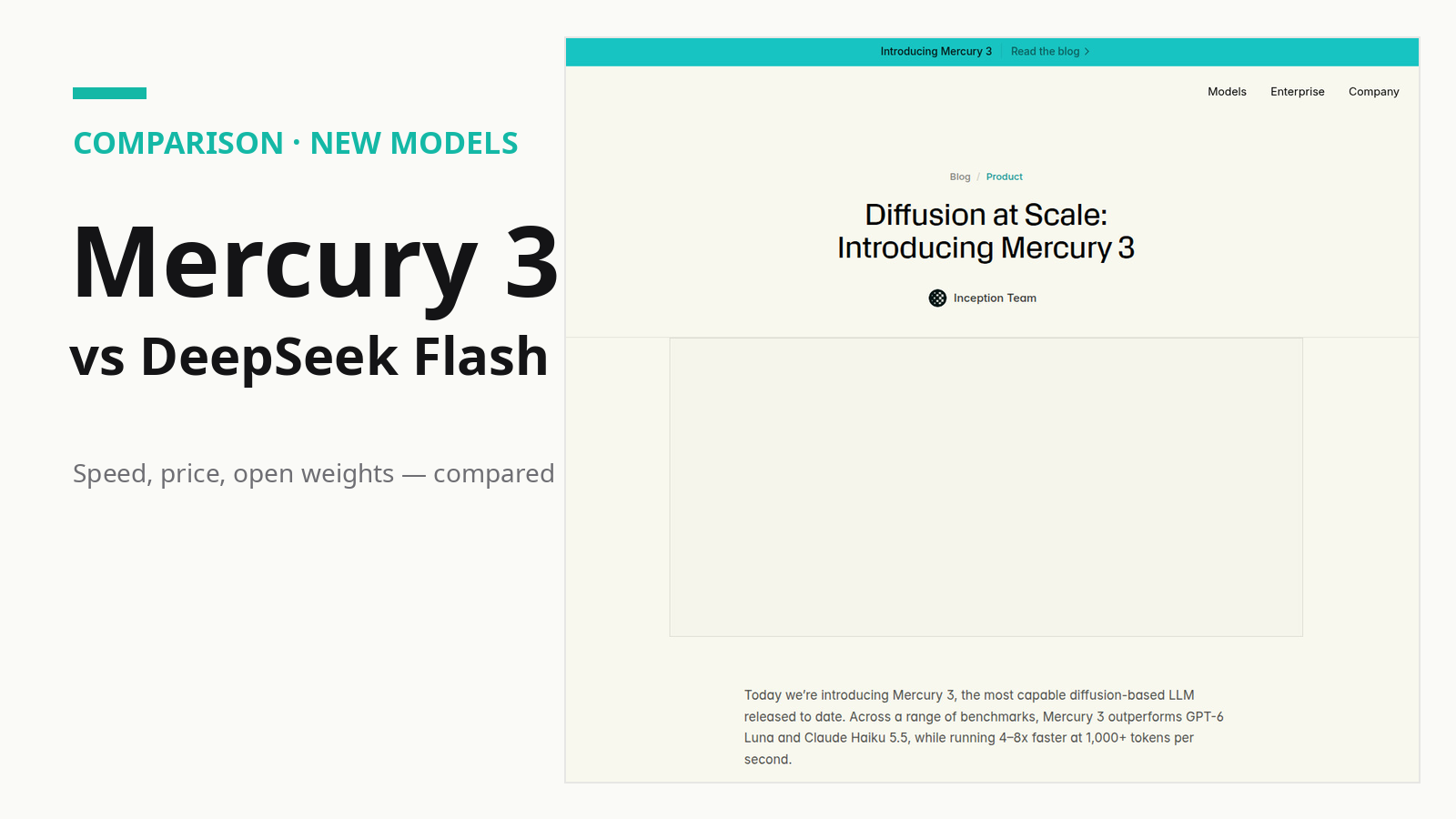
In less than 48 hours, the market for cheap, fast AI models got two new entries. On October 17, DeepSeek swapped the checkpoint behind its popular API endpoint with V4.1-Flash-1017. On October 19, Inception Labs introduced Mercury 3, the latest diffusion-based LLM and its most capable to date. Both carry a one-million-token context window. Both are priced at roughly a dime and a half per million input tokens. And both are explicitly built for the same buyer: developers running AI agents.
Which one should actually run your agents? The honest answer is that these two models are answering the same question — how cheap can good intelligence get? — from opposite directions. This guide compares what is verifiable about each: pricing, architecture, benchmarks, openness, and the ecosystem around the model, so you can decide which trade-offs fit your workload.
The two contenders at a glance
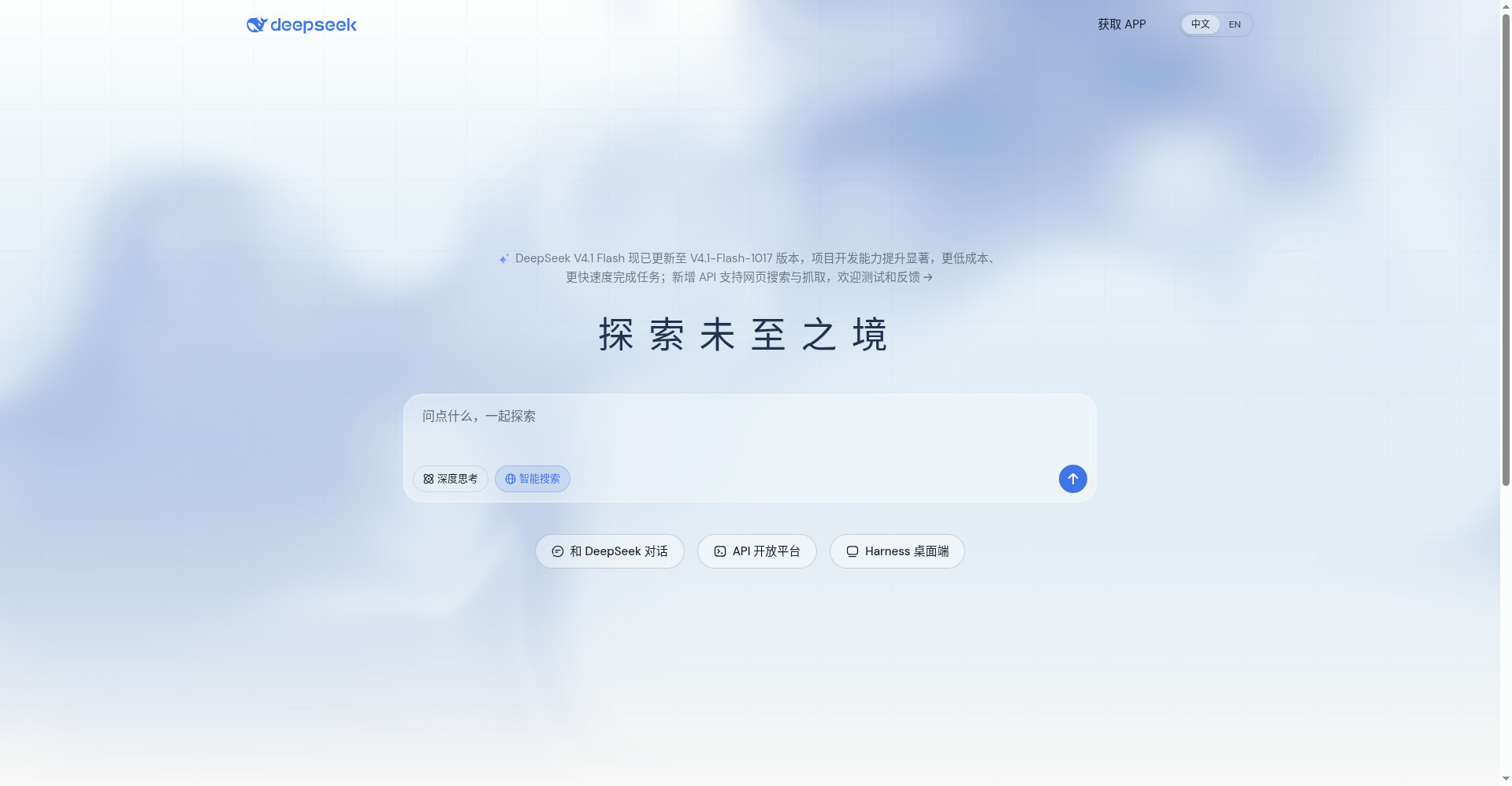
DeepSeek V4.1-Flash-1017 is an updated post-training checkpoint of September's V4.1-Flash, a 552-billion-parameter mixture-of-experts model that activates just 8 billion parameters per token on input and 16 billion on output. It keeps the same 1M-token context window and MIT-licensed open weights. The headline number from the company is a DeepSWE v1.1 score of 77.0 on agentic coding tasks, and the engineering story behind the price is KV-cache compression down to a claimed 890 bytes per token.
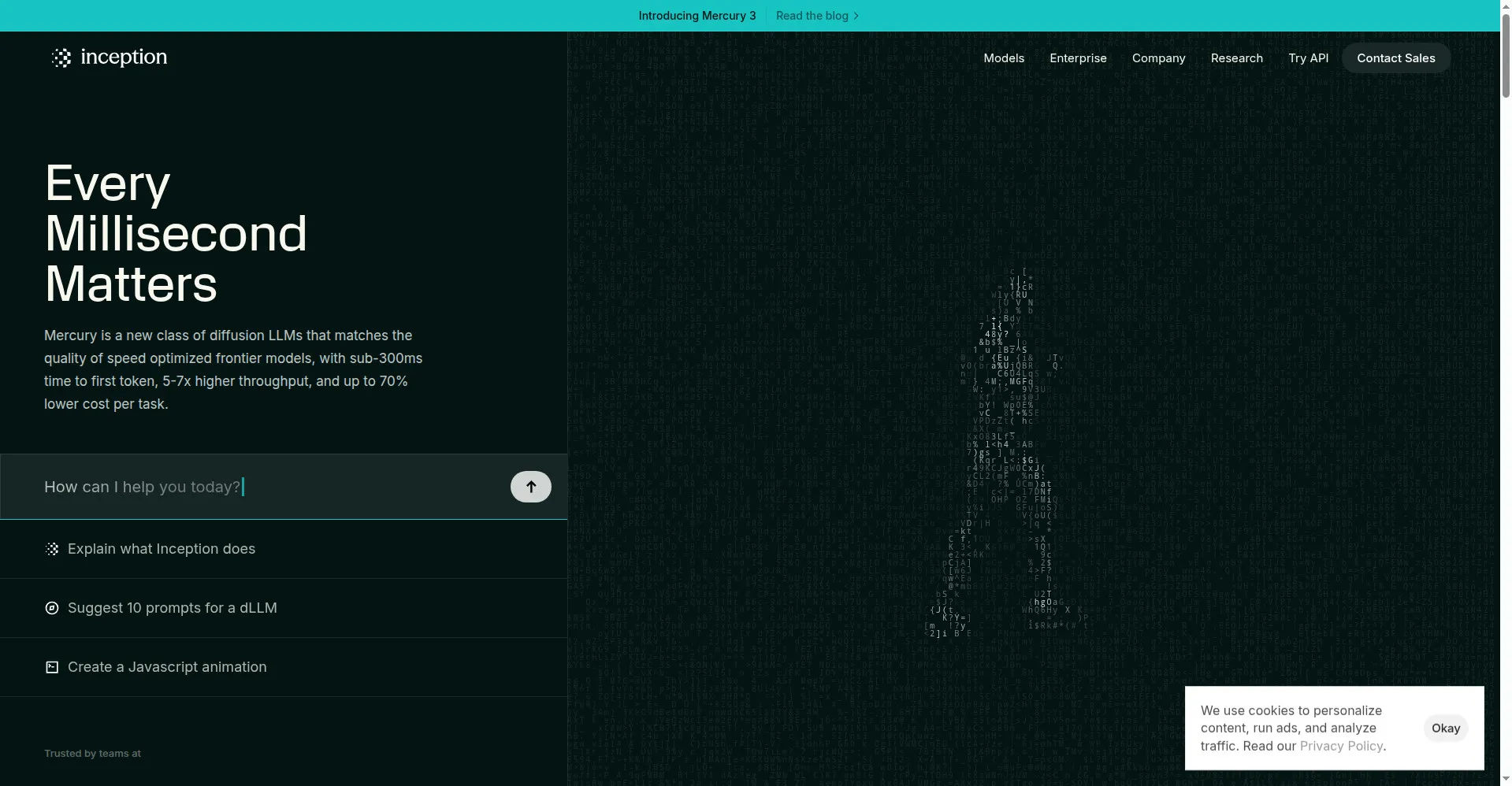
Mercury 3, from Inception Labs, is the company's flagship diffusion LLM — a model that generates text through parallel refinement rather than token-by-token prediction. Inception says it is more than 40 times larger than Mercury 1 while still generating over 1,000 tokens per second on NVIDIA GPUs, and positions it as the most capable diffusion LLM released to date. Its API runs through the Inception API platform, OpenRouter, Baseten, and Vercel's AI Gateway, and it is OpenAI API compatible.
Pricing: the headline battle
This is where the comparison gets concrete, because both vendors publish simple per-token price lists.
| Mercury 3 (launch price) | DeepSeek V4.1-Flash-1017 (off-peak) | |
|---|---|---|
| Input, per 1M tokens | $0.10 | $0.15 |
| Output, per 1M tokens | $0.35 | $0.60 |
| Cached input, per 1M tokens | $0.01 | $0.003 |
| List price (no promotion) | $0.20 / $0.70 | peak hours: $0.30 / $1.20 |
| Context window | 1M tokens | 1M tokens |
| Free tier | 100M tokens for new accounts | chat app free; API free trial available |
At launch pricing, Mercury 3 undercuts DeepSeek Flash by about a third on input tokens and roughly 40% on output tokens. But two caveats belong in the same paragraph. First, Mercury 3's prices are a 50% launch discount off a $0.20/$0.70 list price, and Inception has not said how long the promotion lasts — DeepSeek's own story suggests the direction of travel, but the launch rate could move. Second, cached input is the cheapest line on the whole table, and it belongs to DeepSeek: $0.003 per million tokens, roughly a third of Mercury 3's promotional cache rate. For agent workloads that re-read long contexts across dozens of tool calls, that difference compounds fast.
One independent data point exists for DeepSeek, from an October 18 run by Browser Use over 180 tasks: V4.1-Flash-1017 scored 75.0 at $0.22 per task, matching Claude Opus 5.5's 75.0 at $2.35 per task. It is a single run by the benchmark owner, not a consensus — but it is the kind of real-world task-cost number Mercury 3 does not yet have from third parties.
Speed: two different engineering stories
Mercury 3's core argument is raw generation speed: over 1,000 tokens per second — 1,068 on NVIDIA GPUs, per the company — achieved through diffusion-based parallel decoding. Inception says the model is more than 40 times larger than Mercury 1 yet runs at comparable speed, framing Mercury 3 as evidence that diffusion architectures scale without giving up their speed advantage. Early-access customers quoted in the announcement back the latency story in production: tutoring company RevisionDojo reports hints and marked answers returning "in about a second," and smart-glasses maker Octen AI cites a median generation time of 0.9 seconds in its Sense API tests.
DeepSeek's efficiency story is different and quieter: not speed, but memory. The companion technical report is titled around pushing KV-cache compression, putting the cache at a claimed 890 bytes per token — roughly a quarter of the previous Flash generation. At that rate, a full million-token context needs about 0.9 GB of GPU memory for its cache. For long agent runs, that is what makes the $0.15/$0.60 price list credible: the cache, which grows with every tool call, is where inference cost actually bites. DeepSeek also describes the new checkpoint as completing tasks faster with shorter outputs, though it does not publish a tokens-per-second figure comparable to Inception's.
The takeaway: Inception optimizes for latency — answers that feel instant. DeepSeek optimizes for the cost of long context — agents that can afford to think for a long time. Neither publishes the other's metric in comparable form, so treat any head-to-head speed claim as unfinished business until independent harness results arrive.
Capability claims: read the fine print
Both companies' benchmark claims deserve the same treatment: they are company-reported numbers on harnesses they chose, and the two vendors ran different suites, so the scores are not directly comparable.
Inception says Mercury 3 outperforms GPT-6 Luna and Claude Haiku 5.5 across a range of benchmarks while running four to eight times faster. It also cites a production run of its web-agent harness on 50 live Mind2Web navigation tasks, where Mercury 3 completed 50% — which the company describes as significantly higher than GPT-6.1 Sol's count at the same token volume and step count.
DeepSeek's published table for V4.1-Flash-1017 shows improvements on all 11 reported benchmarks versus the previous checkpoint, led by DeepSWE v1.1 at 77.0 (up from 74.2), Terminal-Bench 4.0 at 42.3 (up from 31.2), and Automation-Bench at 60.5. It is not a clean sweep in the company's own table: the comparison model Claude Opus 5 still leads on raw knowledge, Terminal-Bench 4.0, and repository reconstruction.
The notable difference is independent evidence: DeepSeek already has at least one third-party run (Browser Use) broadly supporting the value story; Mercury 3, one day old at this writing, has only the company's numbers and customer quotes. Expect independent evaluations of Mercury 3 to land within weeks — that is when this comparison gets sharper.
Open versus closed, and everything around the model
This is the clearest structural difference. DeepSeek's V4.1-Flash-1017 weights are published on Hugging Face and ModelScope under the MIT license: commercial use, fine-tuning, and redistribution permitted, no usage tiers. If you self-host, the 890-bytes-per-token cache story becomes your own margin. Mercury 3 is a closed API model — but new platform accounts get 100 million free tokens with no payment details required, which is a generous on-ramp for evaluation.
Each vendor also bundles something the other does not. DeepSeek opened its in-house search infrastructure through Search and Fetch APIs ($0.75 per 1,000 successful calls, capped at 5 queries per second per account), moving up the stack from model vendor toward agent infrastructure. Inception, meanwhile, ships a portfolio around the flagship: Mercury Voice, tuned for voice agents with time-to-first-token under 170 milliseconds, and Mercury Decide, a classification model priced at $0.02–$0.04 per million input tokens with $0 output.
Two administrative notes. Inception says Mercury 2 and Mercury 2.5 are no longer available to new users, with existing customers keeping access until November 15, 2026. And DeepSeek's free Search and Fetch access through server-side tools in DeepSeek Harness, Claude Code, and Codex runs until October 31, 2026 at 16:00 UTC — after that, standard billing starts.
Verdict: who should pick which
Pick Mercury 3 if your bottleneck is latency. Interactive agents, browser-use loops, tutoring and customer-support workloads that need sub-second answers are exactly the use cases Inception's early customers describe — and the launch pricing makes it the cheapest published per-token rate on this page, with 100M free tokens to trial before you commit. Just remember the discount has no published end date.
Pick DeepSeek V4.1-Flash-1017 if your bottleneck is long-context cost. Heavy cache reuse at $0.003 per million tokens, MIT weights for self-hosting, and a first-party Search and Fetch layer make it the better pick for long-running agents and grounded retrieval work — plus it has the first independent task-cost data point.
Or pick neither yet. Both models are days old, both benchmark stories are vendor-reported, and the honest comparison will arrive when third-party harnesses run Mercury 3 through the same agent tasks as Flash. Pin both launch prices against their end dates, run your own eval suite in the harness you actually use, and measure cost per completed task rather than cost per token — that is the number both vendors are really competing on.
Sources
- Inception, "Diffusion at Scale: Introducing Mercury 3" (official blog, October 19, 2026) — inceptionlabs․ai
- Unite․AI, "Inception Releases Mercury 3, Its Flagship Diffusion LLM" — unite․ai
- BusinessWire, "Inception Launches Mercury 3, Setting a New Pareto Frontier in Speed and Intelligence" (press release, October 19, 2026) — businesswire․com
- The Deep View, "Why Inception's Mercury 3 upends AI economics" — thedeepview․com
- Vercel, "Mercury 3 now available on AI Gateway" — vercel․com
- DeepSeek, "DeepSeek-V4.1-Flash-1017: Wish-Driven Programming Made Real" (official release note, October 17, 2026) — api-docs․deepseek․com
- CellCog, "DeepSeek V4.1 Flash: Price, Specs, and the Rumor Scorecard" — cellcog․ai
- SiliconANGLE, "DeepSeek releases updated V4.1-Flash model it says completes tasks faster" — siliconangle․com