Inception
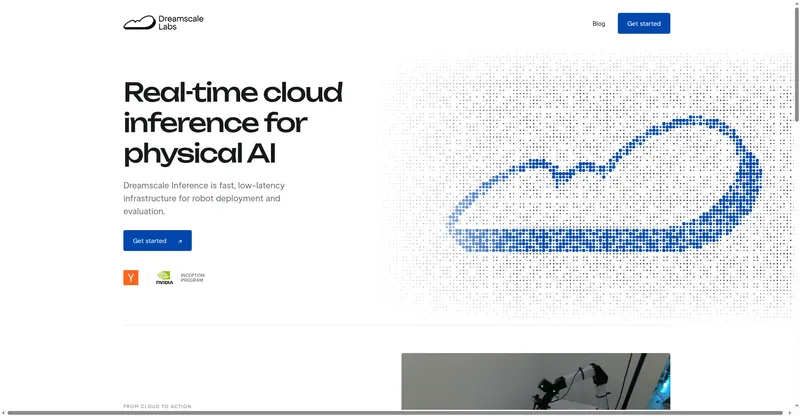
The fastest diffusion LLMs for real-time AI agents and voice applications.
API platform for Mercury diffusion LLMs: flagship Mercury 3 reports 1,000+ tokens/sec with a 1M-token context, built for real-time AI agents.
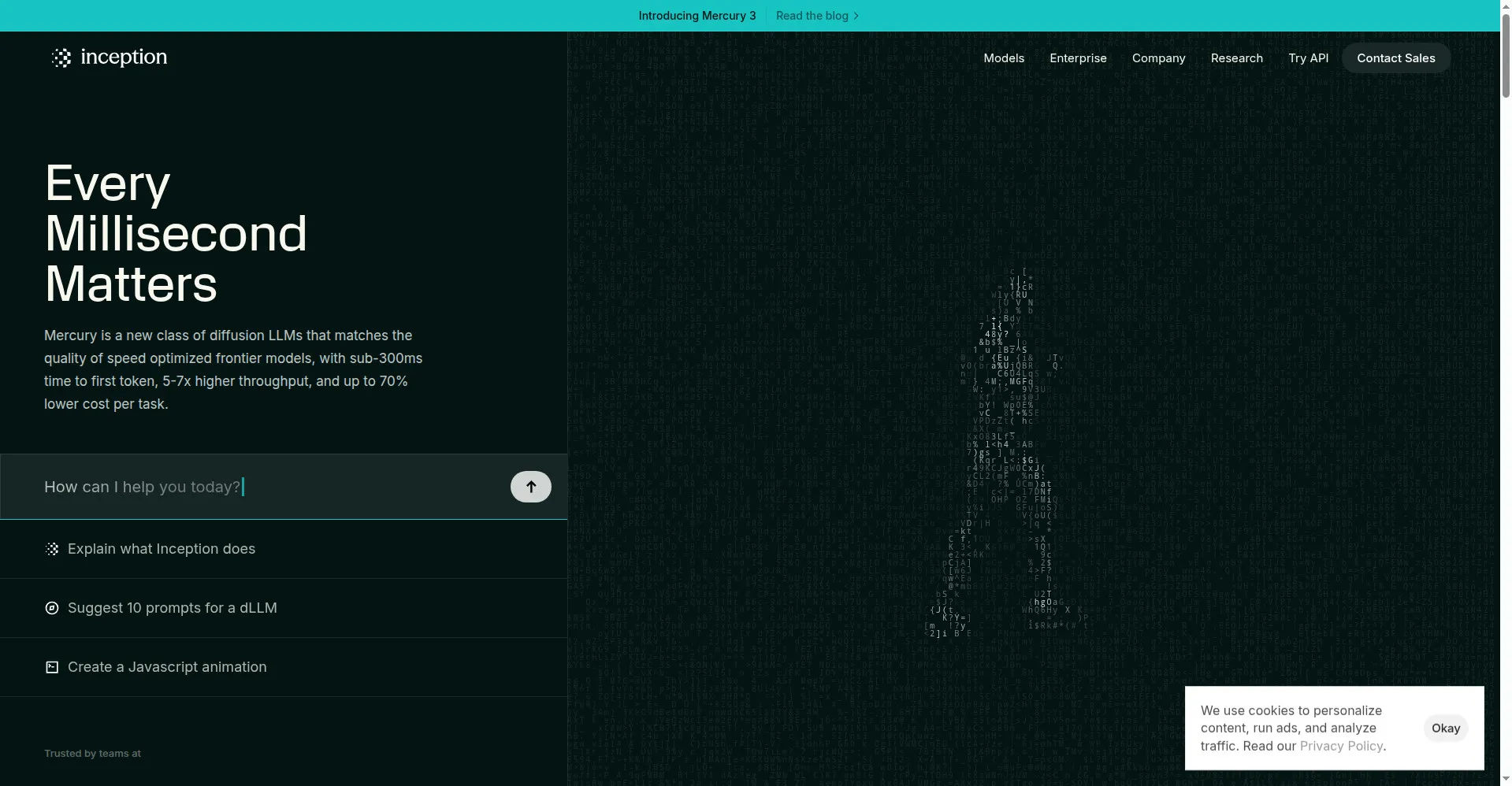
Inception homepage
1 / 2Overview
What is Inception?
The fastest diffusion LLMs for real-time AI agents and voice applications.
Inception is the API platform behind the Mercury family of diffusion large language models, designed for latency-sensitive AI. Its flagship, Mercury 3 (released October 19, 2026), is a closed-weights API model: Inception reports generation speeds above 1,000 tokens per second on NVIDIA GPUs alongside a 1-million-token context window, positioning it against speed-optimized models such as GPT-6 Luna and Claude Haiku 5.5.
The API is OpenAI-compatible (model name mercury-3), supports reasoning_effort and temperature parameters, and ships official SDKs for Python and TypeScript. Mercury 3 is served through Inception's own platform as well as OpenRouter, Baseten, and Vercel AI Gateway. New accounts include 100 million free tokens with no payment details required.
The portfolio also includes Mercury Voice, tuned for voice agents with time-to-first-token under 170 ms, and Mercury Decide, a classification model that returns calibrated probabilities and can escalate uncertain cases to a human reviewer. Launch pricing for Mercury 3 is $0.10 per million input tokens and $0.35 per million output tokens (50% off the $0.20/$0.70 list price); cached input is $0.02 per million tokens ($0.01 at launch).
Platforms and languages
Inception Availability
Platforms
Languages
Capabilities
Inception Key Features
Mercury 3 flagship diffusion LLM
Over 1,000 tokens per second on NVIDIA GPUs with a 1M-token context; Inception's most capable diffusion model to date.
OpenAI-compatible API
Drop-in replacement for existing integrations with reasoning_effort and temperature controls, plus official Python and TypeScript SDKs.
Mercury Voice for voice agents
Tuned for low-latency voice workloads with time-to-first-token under 170 ms.
Mercury Decide for classification
Decision model returning calibrated probabilities and escalating uncertain cases to a human reviewer.
Multiple serving options
Available through the Inception API platform, OpenRouter, Baseten, and Vercel AI Gateway.
100M free tokens
New accounts include 100 million free tokens with no payment details required.
Plans and access
Inception Pricing
Freemium
Common questions
Inception FAQs
What is a diffusion LLM and why is it fast?
Diffusion language models generate text through parallel refinement rather than predicting one token at a time. Inception reports Mercury 3 sustains over 1,000 tokens per second on NVIDIA GPUs while being more than 40 times larger than Mercury 1.
How much does Mercury 3 cost?
Launch pricing is $0.10 per million input tokens and $0.35 per million output tokens, a 50% discount off the $0.20/$0.70 list price. Cached input costs $0.02 per million tokens ($0.01 at launch). Inception has not published an end date for the launch discount.
Is there a free way to try Mercury 3?
New accounts on the Inception API platform include 100 million free tokens with no payment details required. The model is also available through OpenRouter, Baseten, and Vercel AI Gateway.
Is Mercury 3 open source?
No. Mercury 3 is served as a closed API model; its weights have not been published under an open license.
What happened to Mercury 2 and 2.5?
Inception says Mercury 2 and 2.5 are no longer available to new users. Existing customers keep access until November 15, 2026, and enterprise customers remain supported under their existing agreements.
Reviews
See what the community thinks and share your experience.
—
Based on 0 ratings
Rating distribution
Community reviews
No reviews
No written reviews yet.