
Muse Spark Open vs Mistral Large 4: Two Open-Weight Giants, Two Different Bets
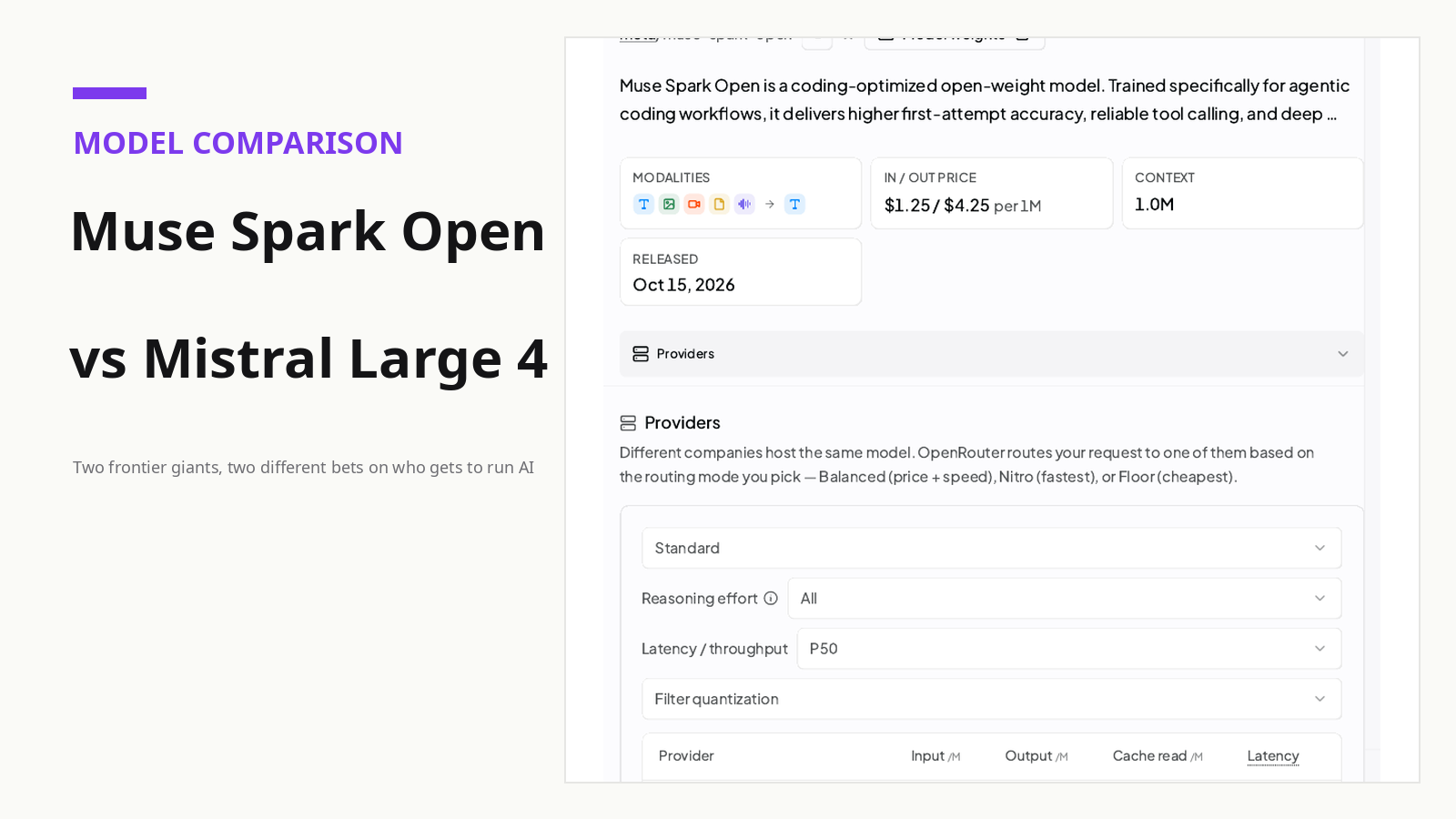
Nine days apart in October 2026, two labs made the same promise: frontier-scale AI you can download and run yourself. On October 6, Mistral put its largest model ever, Large 4, into public preview, with weights promised "by the end of the month." On October 15, Meta released Muse Spark Open — 816 billion parameters, downloadable on day one. Both are mixture-of-experts models with million-token context windows, and both claim to be the strongest open-weight model their side of the ocean has produced.
But "open" means very different things in Paris and Menlo Park: one model you can download today under a custom license, the other you can only rent through an API while its license is still effectively a blank page. This guide compares what is verifiable about each — release status, hardware, pricing, benchmarks, and licensing — so you can decide which one deserves your GPU.
The two contenders at a glance
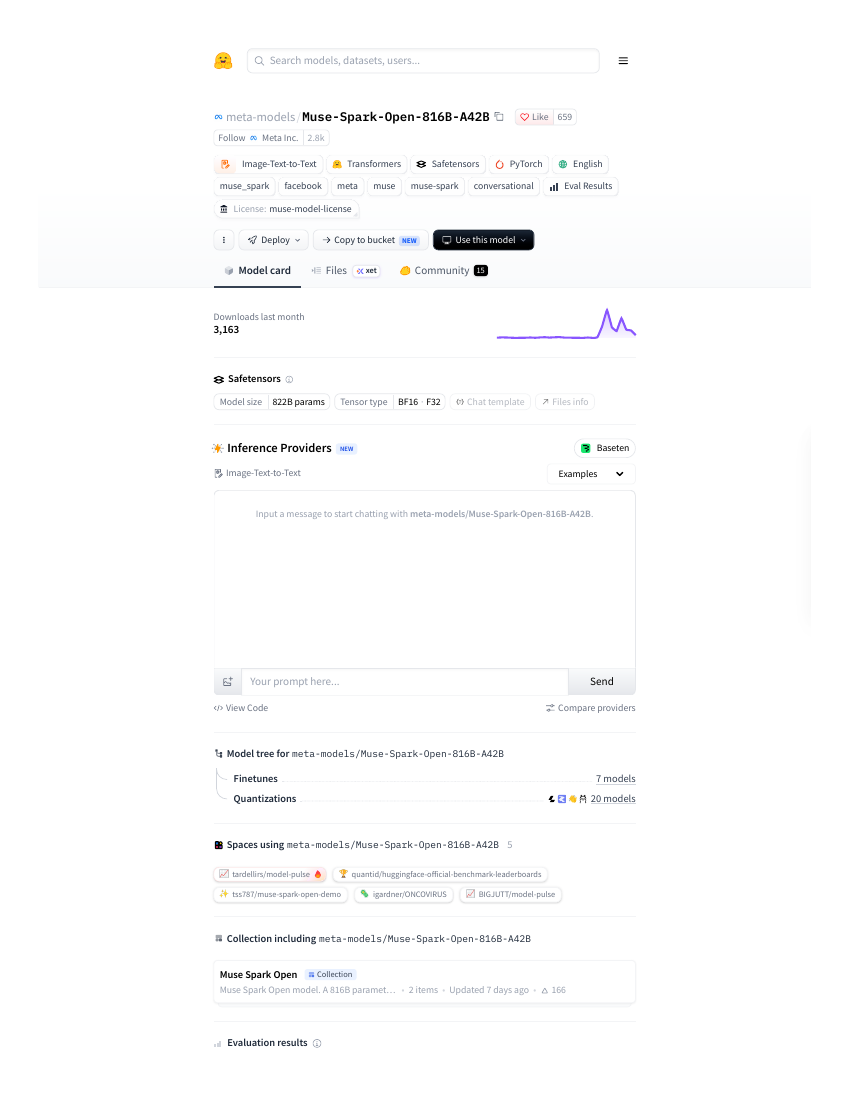
Muse Spark Open is Meta's open-weight release of the Muse Spark model family: 816 billion total parameters with 42 billion active per token, a 1-million-token context window, and native multimodality — text, image, audio, and video in, text out. Meta calls it "the most capable US open-weight model to date," a claim that rests on the company's own evaluation table rather than independent testing. The weights shipped across Hugging Face, Amazon SageMaker AI, Google Cloud Model Garden, and Microsoft Foundry Models, with seven hosted API providers — including Baseten, Fireworks AI, Groq, and Together AI — serving it from day one.
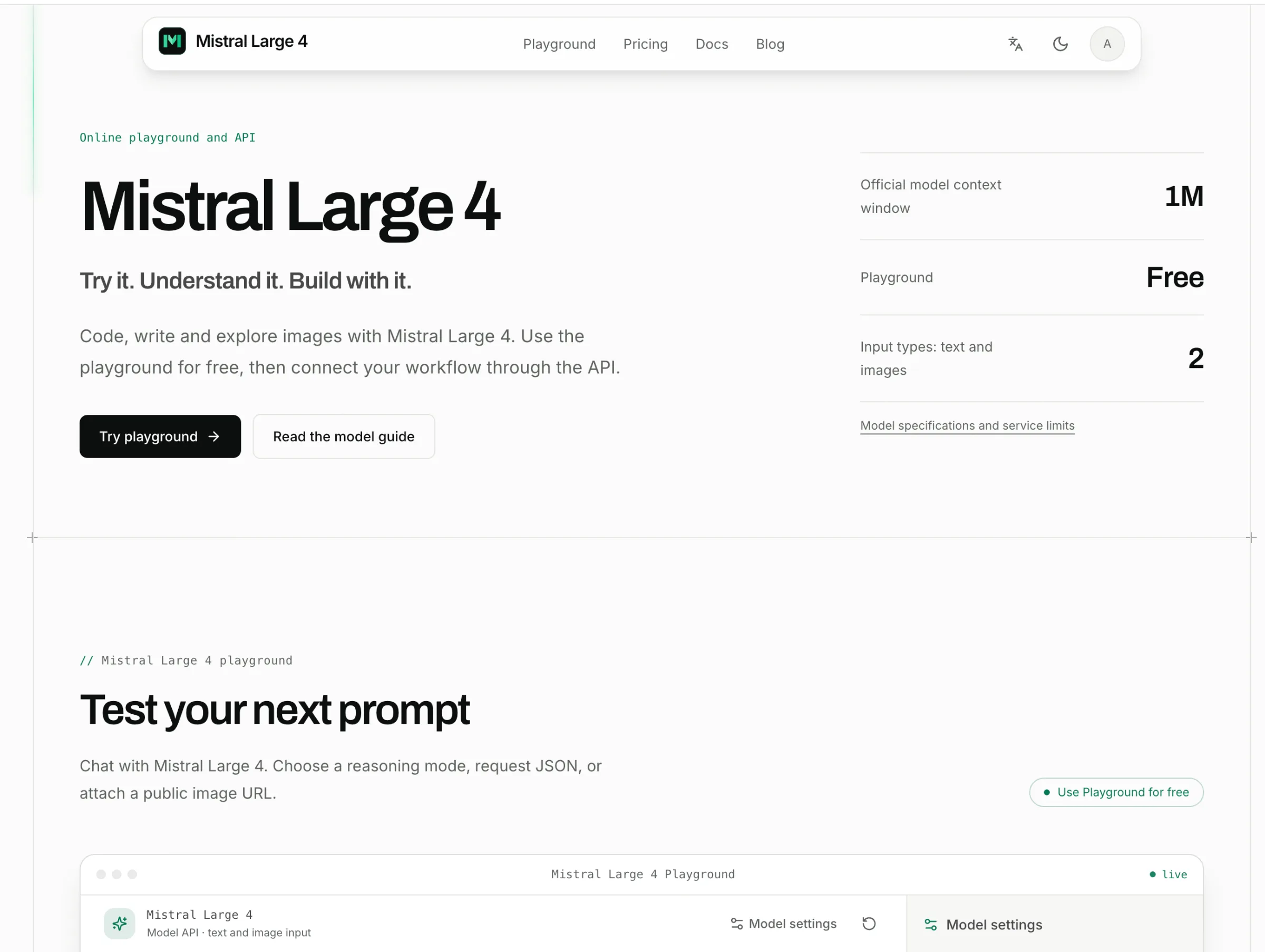
Mistral Large 4 (ML4) is Mistral's largest model: 1.05 trillion total parameters with 52 billion active per token, plus a 1.6-billion-parameter vision encoder, and a 1-million-token context on the company's model card. It entered public preview on October 6 on Mistral's own API and Vercel AI Gateway, trained from scratch on 3,800 NVIDIA Grace Blackwell GPUs in Mistral's European datacenters. The weights are promised by the end of October — and the reinforcement-learning run is still in progress, so the downloadable build may differ from today's preview.
| Muse Spark Open | Mistral Large 4 | |
|---|---|---|
| Released | October 15, 2026 (weights live) | October 6, 2026 (public preview) |
| Parameters | 816B total / 42B active | 1.05T total / 52B active |
| Context window | 1M tokens | 1M on model card; 524K on served preview |
| Inputs | Text, image, audio, video | Text, image |
| Weights downloadable | Yes, since day one | Promised end of October 2026 |
| License | Muse Model License (custom) | Not yet named |
| Hosted price (input/output per 1M) | $1.25 / $4.25 (Together AI) | $0.68 / $2.09 (50% sale; $1.36 / $4.18 list) |
What "open" actually means here
Start with the most practical question: can you download it? For Muse Spark Open, yes — since October 15. But the download comes with two strings attached. First, the Hugging Face access gate asks for your full legal name, date of birth, and full organization name, warning that the form cannot be edited afterward — an unusually detailed request with precedent in Meta's earlier Llama 4 Scout release. Second, the Muse Model License is not a standard open-source license. It permits running, modifying, fine-tuning, and redistributing the model, but businesses whose model-serving revenue (licensee plus affiliates) exceeds $20 million in any consecutive 12 months must sign a separate agreement with Meta. Internal deployment and research are exempt, though products must carry a "Built with Muse Spark Open" attribution.
For Mistral Large 4, the honest answer is: not yet, and the terms are unknown. The model card's weights tab reads "coming soon," and Large 4 is the only model in Mistral's own catalogue carrying the word "OPEN" with no named license — every other open Mistral model ships with an explicit badge such as Apache 2.0. Until the license is published, Mistral's pricing FAQ states that commercial deployments require a Mistral license with separate terms. The practical contrast: Spark Open is downloadable today under known-but-custom terms; Large 4 is rentable today under terms finalized only when the weights land.
The hardware question: desktop versus data center
Muse Spark Open's signature demonstration is the year's most unusual hardware story: two Apple Mac Studios with M5 Ultra chips, each with 512GB of unified memory, linked over Thunderbolt 5 so that, in Meta's words, "two Mac Studios behave like one supercomputer with a terabyte of unified memory," running through Apple's MLX framework. No model this large has shipped with instructions for running it on desktop hardware a team can own outright.
The catch is in the fine print. Apple's 512GB configuration was not shipping at announcement time and its price was unannounced; the model card itself asks for at least 700GB of accelerator memory for the NVFP4 build and 2TB for BF16, meaning eight 80GB H100s (640GB) fall short of the card's own line. Meta's launch demos are company demonstrations with no published tokens-per-second figure. On the server side, Meta ships day-one support across vLLM, SGLang, TensorRT-LLM, MLX, llama․cpp, and Unsloth.
Mistral Large 4 makes no desktop claim. At 1.05 trillion parameters, the weights alone are roughly 1TB at 8 bits per parameter and about 525GB at 4 bits, before KV cache — multi-GPU server hardware, full stop. If your plan is to self-host something this month, only one of these two models is actually downloadable — and it still needs on the order of a terabyte of memory.
Pricing: cheaper to rent than to run
If downloading is out of reach, both models are rentable — and Mistral currently wins on price. Together AI lists Muse Spark Open at $1.25 per million input tokens and $4.25 per million output tokens. Mistral Large 4 lists at $1.36 input and $4.18 output, but a 50%-off launch sale with no published end date brings it to $0.68 and $2.09 — roughly half of Spark Open's hosted rate. Budget at list price: Mistral has not said when the sale ends.
Two caveats. First, per-token prices flatter verbose models, and independent measurement found Large 4 producing about 2.5 times the median output tokens on the Artificial Analysis index. Second, prices vary by host: Groq's Spark Open listing carries a 131,072-token context limit versus the advertised million. To try both without committing, OpenRouter serves Muse Spark Open, while Vercel AI Gateway carries Large 4 at Mistral's sale price.
Capability claims: read the fine print
Both benchmark stories deserve the same treatment: vendor-selected tests with different suites on each side — so the scores are not directly comparable, and neither is an independent verdict.
Meta's table puts Spark Open ahead of its listed rivals on tool-use evaluations — 61.8 on JobBench and 89.2 on MCP-Atlas — but behind Kimi K3, GLM 5.3, and Qwen3.8 on terminal coding (76.4 versus 85.0 on Terminal-Bench 2.1) and professional-work evaluations. Its Artificial Analysis Intelligence Index score of 39 comes from Meta's own model card and could not be verified against an independent assessment at publication time. The pattern: a contender with specific strengths in agentic work, not an overall open-weight leader.
Mistral's table tells a similar story: 61.7% on DeepSWE v1.1, 28.3% on Terminal-Bench 4, and a Coding Agent Index of 49.8% that the company says beats DeepSeek V4 Pro and Qwen3.8 Max. The most useful line is the human evaluation, because it includes a closed model: Large 4 scores 3.74 out of 5, ahead of the Chinese open-weight models tested but nearly half a point behind Claude Opus 5 at 4.22. The cyber headline — 82% on a reproduce-and-patch test — needs its own asterisk, supplied by Mistral itself: leading closed models score near zero because they refuse the task, so the record measures the absence of a refusal as much as superior skill. Independent measurement puts Large 4 at an Intelligence Index of 38, just behind DeepSeek's 4.1 Flash — a big jump from Large 3, and "about six months behind the frontier" in one analyst's summary.
Verdict: who should pick which
Pick Muse Spark Open if you need downloadable weights today, not at month end. US-developed provenance matters for procurement teams bound by governance rules, and the model's strongest reported area — agentic tool use — matches the workloads enterprises want to self-host. Just go in with eyes open: the custom license with its revenue clause and attribution requirement, the identity-heavy Hugging Face gate, and hardware demands that make "runs on two desktops" a tens-of-thousands-of-dollars statement.
Pick Mistral Large 4 if your constraints are European. EU training and serving infrastructure, 160-plus training languages, and a cyber-defense pitch aimed at work that closed models refuse make it the rational pick for regulated industries — and at sale pricing it is the cheaper API today. But treat the preview as a preview: the weights, the license, and possibly the model build itself are all still to come.
Pick neither yet if you want the best coding agent (Claude Opus 5 still leads Mistral's own human eval by a clear margin), the lowest cost per token (the DeepSeek Flash class remains far cheaper), or a model whose independent evaluations have caught up with its launch claims. Both models are days old, both benchmark stories are vendor-reported, and the honest comparison gets sharper once third parties run the final builds through the same harnesses. Measure cost per completed task, not cost per token — that is the number both labs are really competing on.
References
- VentureBeat, "Meta unveils Muse Spark Open, the new top U․S․ open weights model — and it runs on two paired Mac desktops" — venturebeat․com
- TechRepublic, "Meta Unveils Muse Spark Open, Its Most Powerful Open-Weight AI Yet" — techrepublic․com
- Developers Digest, "Mistral Large 4: Specs, Pricing, Benchmarks and Weights Date" — developersdigest․tech
- Mistral official announcement and model card (cited via Developers Digest) — mistral․ai
- Meta Research announcement (cited via TechRepublic) — research․meta․ai