
Gemini 4 Argon Explained: Google's Frontier Model, and 5 Tools to Use It
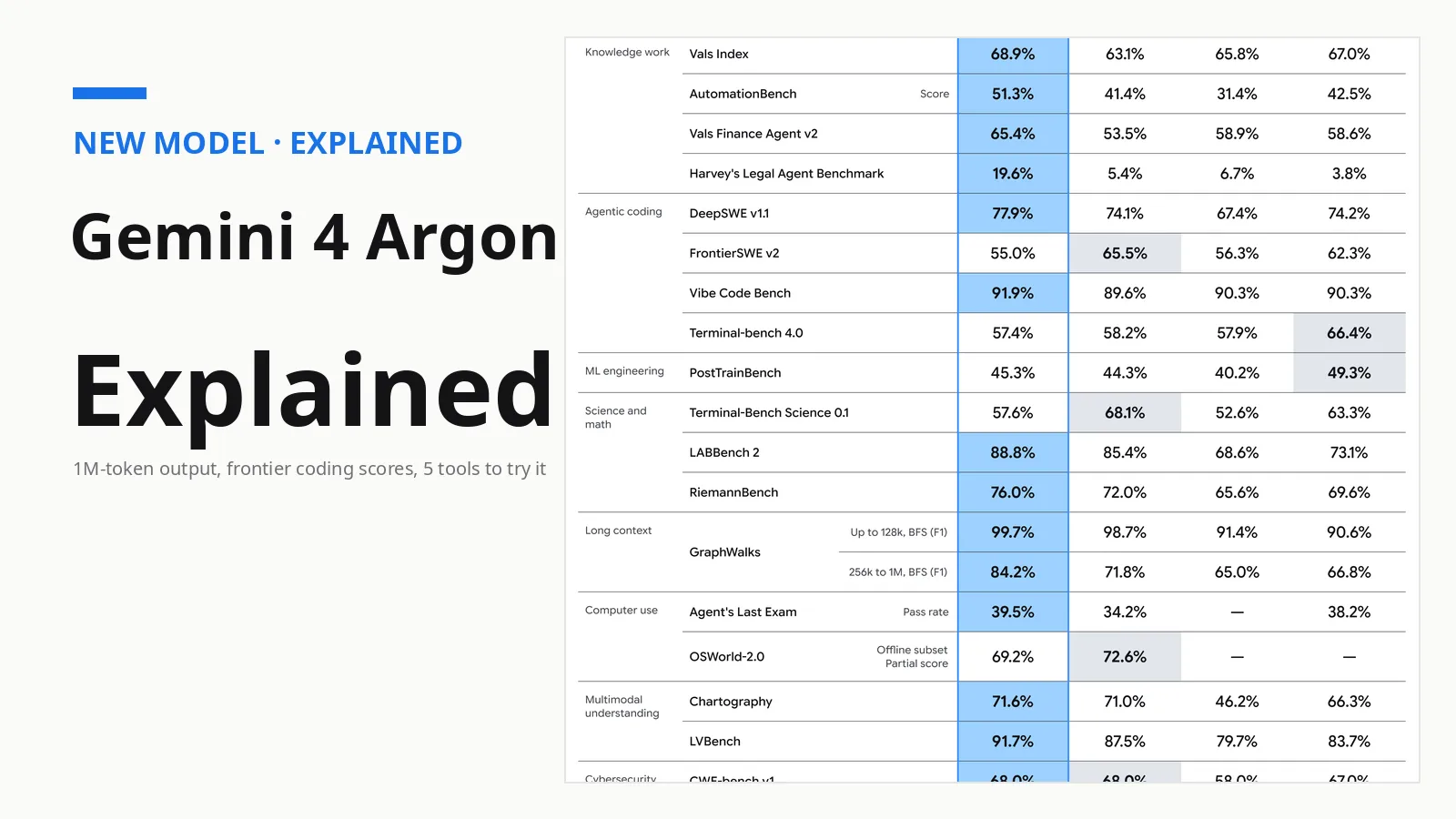
Google skipped a generation. After months of delays, a scrapped Gemini 3.5 Pro, and a leadership shakeup at DeepMind, Google's new frontier model isn't called Gemini 3.5 at all — it's Gemini 4 Argon. Announced September 30, 2026 and generally available to developers since October 13, Argon is Google's attempt to reclaim ground from OpenAI and Anthropic in the one category where raw model size matters less than stamina: sustained, multi-step "deep work."
This post explains what Gemini 4 Argon actually is, what Google claims it can do (clearly labeled as the company's own reports), where you can use it right now, and five tools — all with pages on NAVS — where Argon is already available.
What Gemini 4 Argon is
Gemini 4 Argon is the first model in the Gemini 4 family, announced by Koray Kavukcuoglu, SVP of Google DeepMind and Google's Chief AI Architect. Rather than a general-purpose consumer chatbot, Google positions Argon for three domains: real-world software engineering, enterprise knowledge work (legal, finance, and tax), and cybersecurity defense.
The defining feature is stamina. Argon is built to sustain deep reasoning across complex, long-horizon workflows — tasks that take hundreds of thousands of tokens in a single trajectory. Google says it is "fundamentally changing the way we work and build at Google," with thousands of Googlers already using it for specialized coding tasks, research, and writing.
The launch also came with unusual baggage. Reuters reported that Google canceled the planned Gemini 3.5 Pro — which CEO Sundar Pichai had said would ship in June — and that DeepMind's co-founder Demis Hassabis stepped aside during an overhaul of the lab. Argon arrived after that rocky stretch, with Google explicitly trying to "regain ground against rivals OpenAI and Anthropic."
The 1M-token output limit
Argon's headline spec is its output limit: 1 million tokens in a single response, up from 64K in previous models. That's the largest output window in the industry, per Google. Google doesn't disclose the parameter count or the exact input context size; the point of the spec is what it enables — code migrations, long agent trajectories, and research tasks that previous models had to split across sessions.
Why it matters: when a model can think and generate hundreds of thousands of tokens in one go, agents can run longer without losing the thread. Google's example: Argon agents migrating C/C++ codebases to Rust across Google — from tens of thousands of lines in core libraries like re2 and libgav1 up to 800K+ lines of the Fuchsia Zircon kernel. On libgav1, Argon agents replaced 32K lines of SIMD code with safe Rust that runs 2.7x faster than the existing Rust port, with identical video output. These are Google's own internal reports, not independently verified results.
Other internal deployments Google cited: quantum computing researchers optimizing spacetime resources of subroutines with a 40% improvement over the published baseline "in a matter of minutes," and Argon agents analyzing fleet-wide profiling telemetry to free up over 300 TiB of memory across Google's data centers.
Benchmarks: what Google claims
All of the following are vendor-reported scores from Google's announcement; no independent third-party reproduction was available at publication time.
- DeepSWE v1.1 (real-world long-horizon software engineering): 77.9%, a new state of the art per Google.
- Vals Index (economic impact across finance, coding, legal, and tax, weighted by US GDP contribution): leading model.
- Vals Finance Agent v2 and Harvey's Legal Agent Benchmark: leading performance on multi-step financial research and legal research/drafting.
- AutomationBench (Zapier's end-to-end business task benchmark): ranked #1 at 51.3%.
- LVBench (long video understanding): 91.7%, state of the art.
- CWE-bench v1 (security vulnerability remediation): 68%, tying for first place.
- Gray Swan's Indirect Prompt Injection benchmark: leading in prompt injection robustness.
The pattern is deliberate: Google chose benchmarks that measure multi-step agentic work — software engineering, finance, legal — rather than single-turn chat quality.
The cybersecurity angle and the phased rollout
Argon's release plan is unusual. Instead of launching to everyone at once, Google first rolled it out to a set of trusted cyber defenders through its Fairwind Program — and said it would open the program to hundreds of additional partners. Google trained Argon to be highly capable at cybersecurity defense: it can autonomously find, validate, and patch critical software vulnerabilities.
Wiz is already using Argon for cybersecurity defense through its Scan for Good initiative, which protects critical public infrastructure for free. In one early demonstration, per Google, the model uncovered a critical vulnerability exposing sensitive personal information across healthcare software used by hospitals worldwide — a risk Google says previous frontier models had missed.
Safety is getting an explicit overhaul too. Google says it's strengthening safeguards across four areas before broad availability: defending against misuse (cyber and CBRN attacks), defending against prompt injection, monitoring for misalignment (watching Argon's chain-of-thought and stopping execution when needed), and hardening sandboxed environments. And notably, Google says it will release a version of Argon without its cyber guardrails to trusted defenders — an acknowledgment that the same capabilities are dual-use.
Pricing and availability
As of October 13, 2026, Argon is generally available. Pricing is introductory: $2 per million input tokens and $10 per million output tokens, with cached input tokens at 95% off ($0.10). Google plans to raise rates to $4/$20 after November 30, 2026, according to Reuters.
Where you can get it today:
- Developers: paid tier of the Gemini API in Google AI Studio and Android Studio, plus Google AI Ultra subscribers in AI Studio.
- Consumers: Google AI Pro and Ultra subscribers in the Gemini app and AI Mode in Search. (No free tier.)
- Coding agents: Google Antigravity, limited to Ultra subscribers; teams using Argon in Antigravity saw agentic code submissions rise more than 35% while code rollbacks fell by nearly a third, per Google.
- Third-party routers: OpenRouter lists it as
google/gemini-4-argonat $2/$10 per 1M tokens. - Enterprises: early testers include Deloitte, LexisNexis, Ambience Healthcare, and Isomorphic Labs. Separately, Google will give 10,000 scientists six months of free access to Antigravity's highest usage tier.
Five tools where you can use Gemini 4 Argon
1. Google Gemini (the app)
The fastest route for most people. Google AI Pro and Ultra subscribers can select Argon in the Gemini app on web, mobile, and macOS. Google says Argon answers more directly with less hedging, keeps you updated on progress during long tasks, and — on the macOS app — can switch between chat and Google Antigravity's agentic coding interface. There's also a new chat-to-tasks toggle: Gemini can keep working across your Google apps even when you're not at your computer. Best for: everyday deep work, research, and long multi-step tasks without touching code.

2. Google AI Studio
The developer playground and the cheapest way to experiment with the Gemini API's paid tier. Google AI Studio is where you can try Argon's long trajectories directly — including the 1M-token output limit — and Google AI Ultra subscribers get access here too. Best for: prototyping prompts and agents before committing to an API integration.
3. Google Antigravity
Google's agent-first development platform and the showcase for Argon. Antigravity combines an app, CLI, IDE, and SDK, and Google reports that teams using Argon in Antigravity increased agentic code submissions by more than 35%. Access is currently limited to Google AI Ultra subscribers. Google is also giving 10,000 scientists six months of free access to Antigravity's highest usage tier. Best for: agentic coding workflows where Argon's long-horizon stamina matters most.
4. Android Studio
Android's official IDE, with Argon available through the paid tier of the Gemini API. The Gemini agent panel inside Android Studio helps Android developers generate code, fix bugs, and answer Android-specific questions — the kind of long-context tasks Argon is designed for. Best for: Android developers who want frontier reasoning inside their existing IDE.
5. OpenRouter
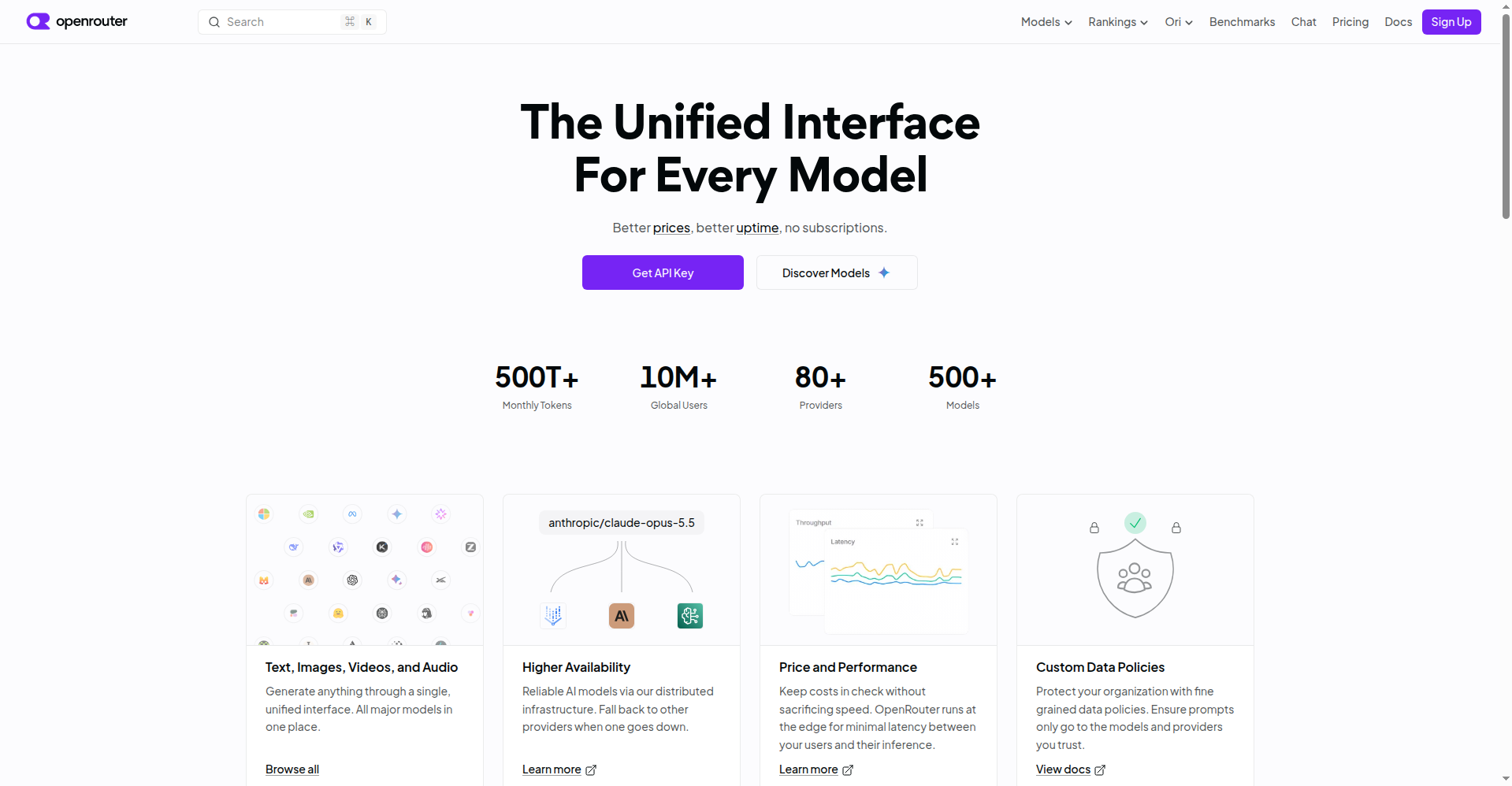
The one-string-change route. OpenRouter lists Argon as google/gemini-4-argon behind its OpenAI-compatible endpoint at $2 per million input tokens and $10 per million output tokens, alongside an Intelligence Index of 52.6. Switching from another frontier model takes a model-slug change rather than a new integration. Best for: developers who want to benchmark Argon against rivals like Claude Opus 5.5 ($4/$20 on OpenRouter) without managing multiple API keys.
Who should care — and who should wait
Argon is worth trying now if you do long-horizon work: code migrations, multi-step agent workflows, financial or legal research, or defensive security work through the Fairwind Program. The 1M-token output limit is genuinely new territory for production use.
Reasons to wait: it's not on any free tier, the introductory pricing doubles on December 1, and the headline benchmarks are vendor-reported with no independent verification yet. If you mostly need fast, cheap answers rather than long reasoning trajectories, models like Claude Haiku 5.5 or Gemini 3.8 Flash will be cheaper.
Google skipped a generation to ship this. Whether Argon is the model that closes the gap with OpenAI and Anthropic will be decided by independent benchmarks and real developer adoption over the next few months — not by the launch blog.
参考来源
Google Blog: Introducing Gemini 4 Argon — blog․google Google Blog: Gemini 4 Argon is now available for developers — blog․google Google Blog: Gemini 4 Argon is now available in the Gemini app — blog․google Reuters: Google launches flagship AI model Gemini 4 Argon — reuters․com OpenRouter model comparisons — openrouter․ai DataCamp: Gemini 4 Argon vs Claude Opus 5.5 — datacamp․com