
Reflection Beam vs DeepSeek V4: Which Open-Weight Model Should You Bet On?
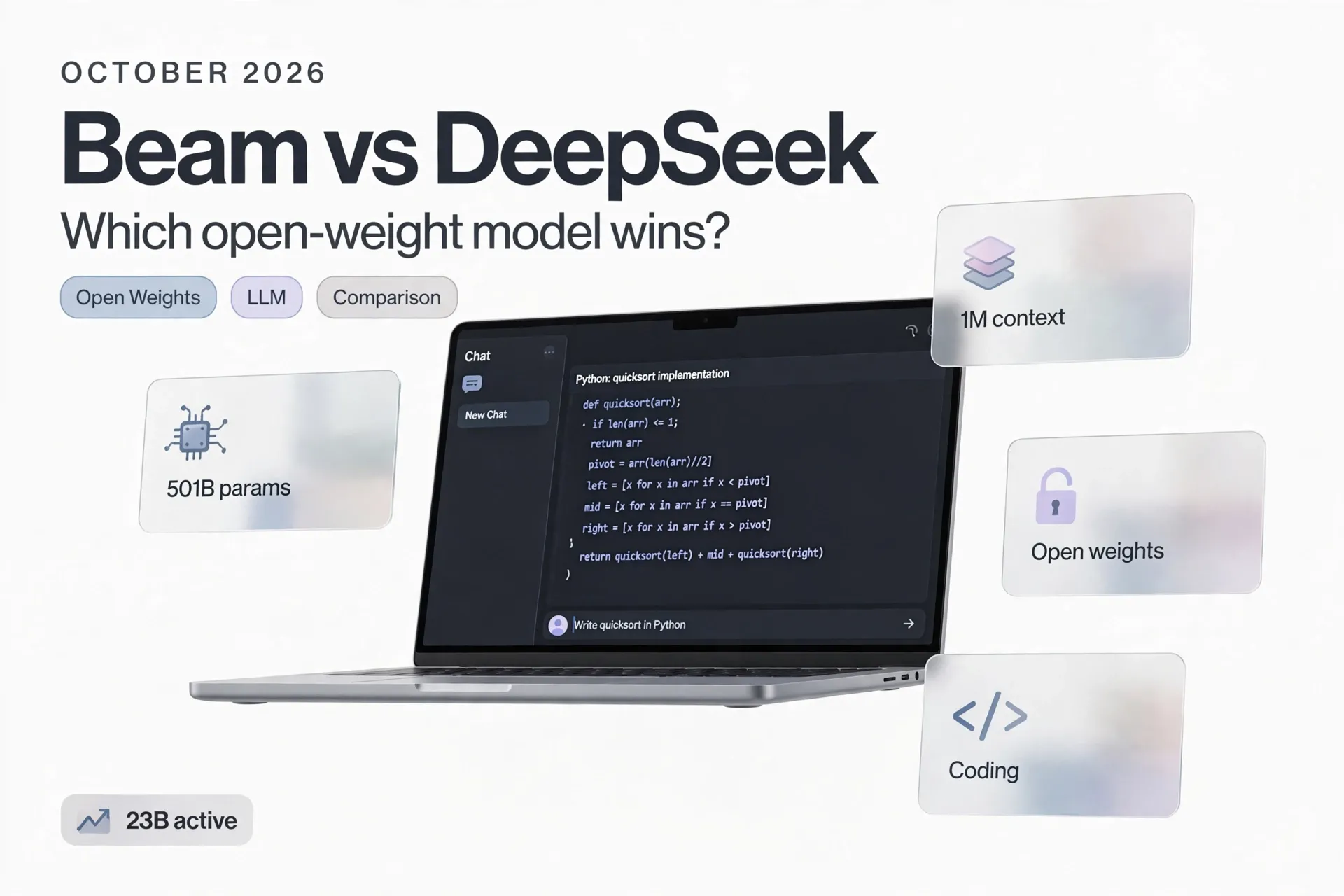
On October 5, 2026, Brooklyn-based startup Reflection AI unveiled Beam, its first frontier open-weight model — a 501-billion-parameter system it says can match leading Chinese open models on advanced reasoning benchmarks while using three to four times less inference compute. The announcement, reported first by Axios over the weekend and confirmed in a lengthy company blog post on Monday, lands squarely in territory currently ruled by one incumbent: DeepSeek.
DeepSeek's V4 family has been the default open-weight stack for most of 2026. Its weights are downloadable today, its API is live, and independent leaderboards have had months to measure it. Beam, by contrast, is an announcement with weights promised "later this month." Is Beam a credible alternative, or just a well-funded promise? Here is how the two compare: specs, benchmarks, who each fits, and how to try them.
What Reflection Beam is
Beam is a text-only mixture-of-experts (MoE) model with 501 billion total parameters and 23 billion active parameters per token. It was pretrained on 23.8 trillion tokens and ships with a 1 million token context window. Reflection says it trained Beam with high-compute reinforcement learning to make it effective at reasoning, coding, and agentic tasks while activating only a small slice of its network per token — the official announcement cites over 100 million RL rollouts on 10.5K NVIDIA GB300 GPUs over four weeks of training, which is where the efficiency claim comes from.
The company's pitch is explicit: Beam is built to rival Chinese open models like DeepSeek, Qwen, and Z.ai's GLM series, while offering a US-origin option for enterprises and governments that can't use Chinese-origin weights for policy or procurement reasons. Reflection calls Beam a "workhorse model" for enterprises, the public sector, and developers, and its broader plan is to sell "AI factories" — customized, local AI systems built by training its models on a client's own proprietary data.
Reflection was founded in 2024 by two former Google DeepMind researchers, Misha Laskin and Ioannis Antonoglou. PitchBook data cited by TechCrunch puts its total funding at roughly $4.7 billion — including backing from Nvidia, Sequoia, and Lightspeed — with its last round valuing it at about $25 billion pre-money, plus more than $7 billion in compute deals through 2029 with SpaceX and Nebius for Nvidia GB300 capacity.
Important caveat: as of this writing, Beam's weights are not public. Reflection says they will be released under an Apache 2.0 license later this month, alongside a technical report and model card, and that an early version is available to a waitlist while final red-teaming and evaluations wrap up. Until the weights ship, every performance claim below is company-reported and not independently verifiable.

Reflection Beam — announced October 5, 2026; weights expected later this month.
What DeepSeek V4 is
DeepSeek V4 is a family of models, not a single checkpoint, and its full history matters because the lineup has moved fast:
- April 24, 2026 — DeepSeek previewed the V4 family, including V4-Pro (1.6 trillion total parameters, 49 billion active) and early Flash builds, under an MIT license.
- July 31, 2026 —
DeepSeek-V4-Flash-0731went generally available: 284 billion total parameters with around 13 billion active per token, open weights on Hugging Face (~167 GB), and a live API. - August 13, 2026 —
DeepSeek-V4-Pro-0813went GA on DeepSeek's chat app, web, and API: 1.6T total / 49B active parameters, 1M-token context, up to 384K output tokens, and three reasoning modes. - September 10, 2026 —
DeepSeek-V4.1-Flashlaunched: a 552B-parameter backbone activating 8B parameters in prefill and 16B in decode, natively multimodal (text and image input), still MIT-licensed. DeepSeek claimed it comprehensively surpassed V4-Pro on performance, cost, and speed, announced an orderly deprecation of V4-Pro — then cancelled that deprecation plan days later after user pushback.
All checkpoints are mixture-of-experts models with a 1M-token context, MIT-licensed open weights, and API access. V4.1-Flash is served through DeepSeek's API as deepseek-flash; published pricing is $0.30 per million input tokens and $1.20 per million output tokens at peak hours, with off-peak rates at half that (figures from third-party guides checked against DeepSeek's docs).
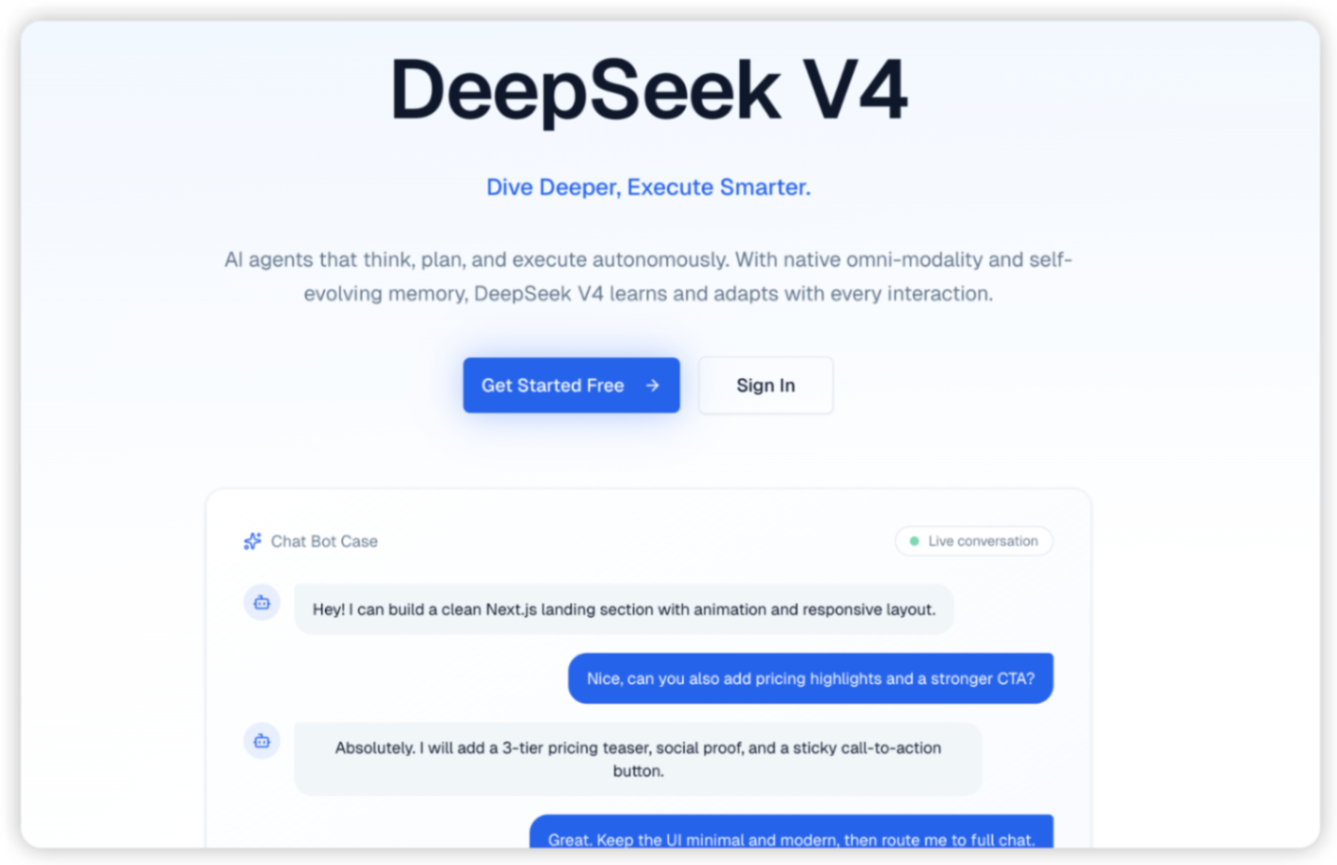
DeepSeek V4 — open weights available now under MIT license.
Head-to-head: specs at a glance
| Reflection Beam | DeepSeek V4 family | |
|---|---|---|
| Status | Announced Oct 5, 2026; weights due later this month | Released; downloadable since July–September 2026 |
| Architecture | MoE, text-only | MoE; V4.1-Flash is multimodal (text + image input) |
| Total / active params | 501B / 23B | V4-Pro: 1.6T / 49B; V4.1-Flash: 552B backbone, 8B–16B active |
| Context window | 1M tokens | 1M tokens (V4-Pro: up to 384K output) |
| License | Apache 2.0 (planned, pending release) | MIT (weights downloadable now) |
| Access | Waitlist via reflection.ai | Chat app, web, API, Hugging Face weights |
| Origin | US (Reflection AI, Brooklyn) | China (DeepSeek) |
| Price | Not announced | V4.1-Flash: $0.30 / $1.20 per M tokens (peak) |
Both converge on 1M-token context — the current table stakes for long-document and agentic work.
Benchmarks: what the numbers actually say
Every number in this section needs a label. Reflection's benchmarks are company-reported and, per TechCrunch, have not been independently verified. DeepSeek's scores below come from Reflection's own comparison table (which cites Artificial Analysis and DataCurve) and independent third-party guides.
Reflection reports Beam at 80.9 on SWE-bench Verified (versus 70.7 for Nvidia's Nemotron 3 Ultra) and 80.1 on Terminal-Bench 2.1 — close to Z.ai's GLM-5.2 at 81.0, but behind Kimi K3 (88.3) and DeepSeek V4.1 Flash (90.6). It also reports 90.5 on GPQA Diamond and 65.5 on SWE-Bench Pro v1 (versus GLM-5.2's 62.1), with 36.2 on Humanity's Last Exam (no tools) against GLM-5.2's 40.5 and Kimi K3's 46.9.
To Reflection's credit, its own announcement shows the newer Chinese models — GLM-5.3 and Kimi K3 — ahead of Beam on most tests. The company's own framing: "Where frontier open models like Kimi K3 remain ahead on raw capability, Beam's advantage is efficiency at inference time." Not "we beat everyone," but "we match GLM-5.2-class reasoning at 3–4x less inference compute."
The headline data point for DeepSeek is that 90.6 on Terminal-Bench 2.1 for V4.1 Flash — which even Reflection's own table concedes.
Who each model fits
Choose Beam if: you are an enterprise or public-sector team that can't deploy Chinese-origin models for policy reasons and needs a US-origin open-weight option; you plan to fine-tune on proprietary data and self-host; or inference cost matters more to you than the last few benchmark points. You'll need to wait for the weights and verify the efficiency claims yourself.
Choose DeepSeek V4 if: you need open weights you can download today; you want the broadest ecosystem (Hugging Face checkpoints, third-party routers, community quantization, agent integrations); you need multimodal input (V4.1-Flash accepts images); or you want proven, independently measured performance.
Consider both if: you build eval-driven — stand up a serving path with DeepSeek V4 today, and swap in Beam for a head-to-head test once the weights land.
Strengths and limitations
Beam's strengths: a genuinely interesting efficiency bet (23B active parameters is lean for this capability tier); a permissive Apache 2.0 license planned; US origin for regulated buyers; and unusual candor that rivals still lead on raw scores. Beam's limitations: nothing is downloadable yet, so all claims are unverified; text-only; hosted API pricing unannounced; and first open-weight releases usually improve fast after launch as the community ships fixes — budget a re-test window.
DeepSeek V4's strengths: weights public now under MIT; the broadest open-model ecosystem in 2026; multimodal support in V4.1-Flash; transparent, cheap API pricing; independent benchmark coverage. DeepSeek V4's limitations: the September deprecation flip-flop on V4-Pro (announced, then cancelled after user pushback) shows the API roadmap can move under you; and origin-based restrictions exclude it for some buyers regardless of the numbers.
How to try them
DeepSeek V4: the fastest path is DeepSeek's chat app or web interface; developers can use the API (deepseek-flash for V4.1-Flash, deepseek-v4-pro for V4-Pro) or download the MIT-licensed weights from Hugging Face and serve them with vLLM, SGLang, or llama.cpp.
Reflection Beam: join the waitlist on reflection.ai for the early version; watch for the open-weight release, technical report, and model card later this month. Before building on it, read the actual license file — open-weight does not automatically mean unrestricted commercial use — and run your own evals rather than trusting launch-day benchmarks.
The bottom line
Beam is the most serious US attempt yet to answer DeepSeek on its home turf: open weights, coding and agentic strength, and a credible efficiency story. But today it is an announcement with a waitlist, while DeepSeek V4 is a downloadable, measurable, widely deployed model family. If you need to ship now, DeepSeek V4 is the only real choice. If you can wait a few weeks — and especially if your procurement rules demand a non-Chinese model — Beam deserves a slot in your evaluation queue. Revisit this comparison once the weights land and independent numbers exist; that is when the efficiency claim either holds up or doesn't.
References
- TechCrunch, "Reflection debuts Beam, an open-weight AI model to rival Chinese models at lower compute cost," October 5, 2026 — https://techcrunch.com/2026/10/05/reflection-debuts-beam-a-open-weight-ai-model-to-rival-chinese-models-at-lower-compute-cost/
- Reuters, "Nvidia-backed Reflection unveils first AI model to take on Chinese open models," October 5, 2026 — https://www.reuters.com/technology/nvidia-backed-reflection-unveils-first-ai-model-take-chinese-open-models-2026-10-05/
- Reflection AI official site — https://reflection.ai
- Reflection AI, "Introducing Beam: Reflection's 501B open-weight model," October 5, 2026 — https://reflection.ai/blog/introducing-beam
- MarkTechPost, "Reflection AI Introduces Beam: A 501B Open-Weight MoE Model," October 5, 2026 — https://www.marktechpost.com/2026/10/05/reflection-ai-introduces-beam-a-501b-open-weight-moe-model-with-23b-active-parameters-for-coding-and-agentic-workloads/
- Yotta Labs, "DeepSeek V4: Models, Specs, Pricing, and What's Current (2026)" — https://www.yottalabs.ai/post/deepseek-v4-release-date-specs-how-to-access-2026
- Codersera, "DeepSeek V4.1 Flash Guide: Pricing, Benchmarks, Local Setup," October 2026 — https://codersera.com/blog/deepseek-v4-1-flash-complete-guide-2026/