
AstaBrief 8B Explained: Ai2's Open Model That Writes Cited Science Reports in 51 Seconds — and 5 Ways to Use It
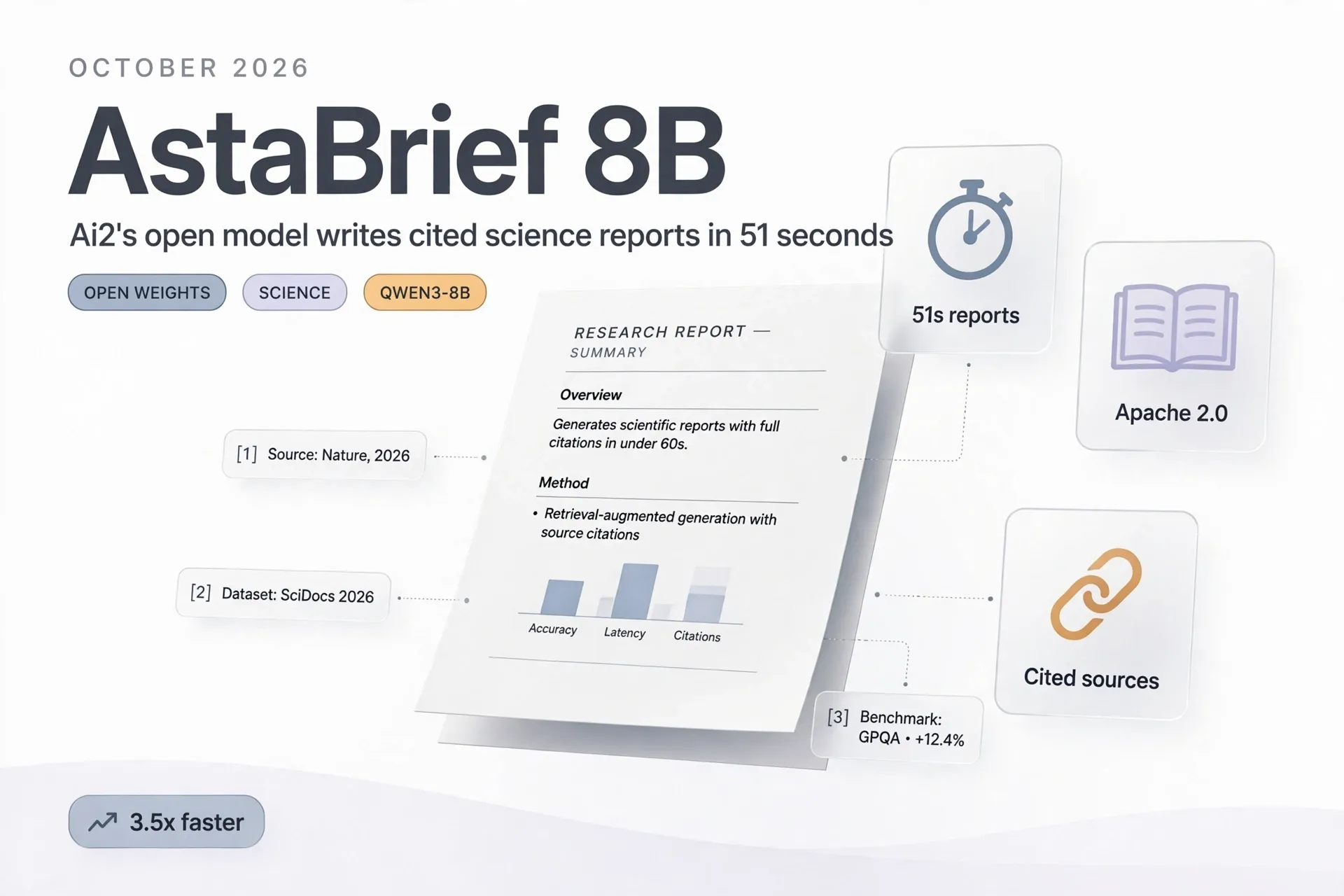
On October 2, 2026, the Allen Institute for AI (Ai2) open-sourced AstaBrief 8B, an 8-billion-parameter model built for exactly one job: turning a research question plus retrieved scientific literature into a fully cited report. It already powers a new "Fast mode" inside Asta, Ai2's agentic platform for scientific work, where Ai2 says it produces reports in 51.1 seconds on average — about 3.5 times faster than the Claude-powered "Thinking mode" it now sits alongside. The weights, the training data, and an example workflow are all public under the Apache 2.0 license.
What makes this release worth attention is the recipe. Ai2 deliberately skipped reinforcement learning, bet almost everything on data quality — especially one strikingly simple filter — and got a small, cheap model to match a far more expensive multi-step pipeline on what researchers actually care about: whether a report covers the question, stays relevant, and cites claims it can support.
What happened
Ai2 announced AstaBrief 8B on October 2, 2026, publishing the model on Hugging Face as allenai/AstaBrief_8B the same day. It starts from Qwen3-8B and is post-trained with supervised fine-tuning (SFT) followed by direct preference optimization (DPO) — no reinforcement learning, a choice Ai2 attributes to RL being unstable, expensive, and harder to debug.
Two things shipped with the weights. First, the training data itself, so others can study and reproduce the approach. Second, an example workflow in Ai2's ai2-scholarqa-lib GitHub repository that researchers can adapt to generate reports from their own PDFs. The model is live in production: inside Asta's "Generate a report" feature, users can pick the new Fast mode (AstaBrief) or the existing Thinking mode (Claude-powered pipeline). Per the model card, intended use is research and educational work under Ai2's Responsible Use Guidelines.
How Ai2 built it
Training began with real user queries — not synthetic prompts. Ai2 took logs from the ScholarQA system behind Asta's report feature and filtered aggressively: beta-tester and bot traffic removed, too-short queries dropped, and an LLM-based pass to catch non-English queries, non-scientific requests, and prompts containing personal information. That left 90,000 research-focused queries.
For SFT, Ai2 generated full-report targets with the existing multi-step ScholarQA pipeline, backed by Claude 3.5 Sonnet, Claude 3.7 Sonnet, o3, o4-mini, and GPT-4.1. Quality filtering left 47,000 usable examples. For DPO, pairs came from a separate query subset: one ScholarQA-pipeline report (usually Claude-backed) against a competing report from the same excerpts by o3, o4-mini, DeepSeek-V3, or DeepSeek-R1. Two judge models — GPT-4.1 and DeepSeek-R1 — picked a winner per pair; Ai2 says the judges matched human preferences 95% of the time, and only pairs where both agreed were kept, yielding about 6,000 examples.
The most interesting finding was about filtering. Ai2 tested four statistics-based filters for weak synthetic examples: output-to-input token ratio, citation relevance, citation density (the share of statements carrying at least one citation), and citation diversity. The strongest gains came from simply dropping reports with low citation density; more aggressive filtering, filter combinations, and learning-rate sweeps added nothing meaningful. Scientific specialization, Ai2 concludes, is not necessarily about adding more scientific text to pretraining — post-training data composition and quality can matter more.
For speed, AstaBrief was trained to write the complete report in a single pass from the query and retrieved snippets, bypassing the snippet-summarization and clustering stages the Claude pipeline uses. Ai2 reports this was possible without sacrificing performance.
What the numbers actually say
All figures below are Ai2's own self-reported results — not independent verification.
On speed: across the full Asta pipeline, Fast mode averages 51.1 seconds per report versus 178.5 seconds for Thinking mode, roughly 3.5x faster. Note Ai2's careful phrasing: it separately claims "nearly an order-of-magnitude reduction in generation time relative to the proprietary models it tracked," a different comparison set than the 3.5x figure. Don't conflate the two.
On quality, the main target was SQABench-CS2 — 200 user-written computer science research questions — tracked on rubric score (coverage), answer precision (relevance), citation precision (do citations support their claims), and citation recall (are claims fully supported). Per the model card, AstaBrief-8B averaged 87 across tracked metrics, versus 83.7 for the SFT-only checkpoint and 77.3 for base Qwen3-8B, with 90.5 on citation precision and 78.2 on citation recall. LLM-judged win rates against the Asta ScholarQA pipeline were 55% on the development split and 72% on the test split. On DeepScholarBench (63 queries of long-form synthesis from recent arXiv papers), AstaBrief scored 53.50 versus 60.25 for Asta ScholarQA and 56.26 for DR-Tulu-8B — competitive, not leading.
The human study was small: three researchers, 14 questions. Ai2 reports DR Tulu won on overall preference, while two of three researchers preferred AstaBrief on citation accuracy.
Early production usage, also self-reported: among 374 Asta users who tried Fast mode, 29.1% used it on two or more days, users averaged 3.67 report threads, 23% never switched back to Thinking mode, and 18% alternated by goal. Positive feedback was 84.2% for Fast mode versus 85.2% for Thinking mode — which Ai2 calls similar while noting feedback is too sparse for strong conclusions.
Two caveats Ai2 states explicitly: most training and evaluation finished in 2025, so the proprietary comparison points reflect that era's frontier, and the full evaluation has not been rerun against today's models.
5 ways to put AstaBrief to work
The weights are Apache 2.0, the model is 8B, and community GGUF quants are already on the Hugging Face Hub — a release you can run the same week it drops. Five concrete ways, from zero-setup to self-hosted.
1. Try Fast mode inside Asta
The fastest path is the product it was built for. In Asta's "Generate a report" feature, Fast mode now sits next to the Claude-powered Thinking mode. Ask a research question as usual; Asta retrieves the literature and hands it to AstaBrief for single-pass generation. Use it for a preliminary sub-minute report you can iterate on; switch to Thinking mode for the heavier pipeline.
2. Download the weights and data from Hugging Face
Everything reproducible lives on Hugging Face under allenai/AstaBrief_8B: the final DPO-tuned weights, the intermediate AstaBrief_8B_SFT checkpoint, and the training datasets. To study the recipe — the 47K SFT examples, the 6K preference pairs, the citation-density filtering — start here. Note the model card's recommended prompt format: Ai2 warns that deviating from the SFT prompt format can degrade output.
3. Run it on your laptop with Ollama
At 8B parameters AstaBrief fits consumer hardware, and community GGUF quants (e.g. mradermacher/AstaBrief_8B-GGUF) are already on the Hub. Ollama is the simplest way to run them: pull a quant, use a Modelfile with Ai2's recommended prompt format, and you have a local cited-report writer that never sends your documents anywhere — the exact scenario Ai2 highlights for sensitive or unpublished work.
4. Run it with a point-and-click GUI via LM Studio
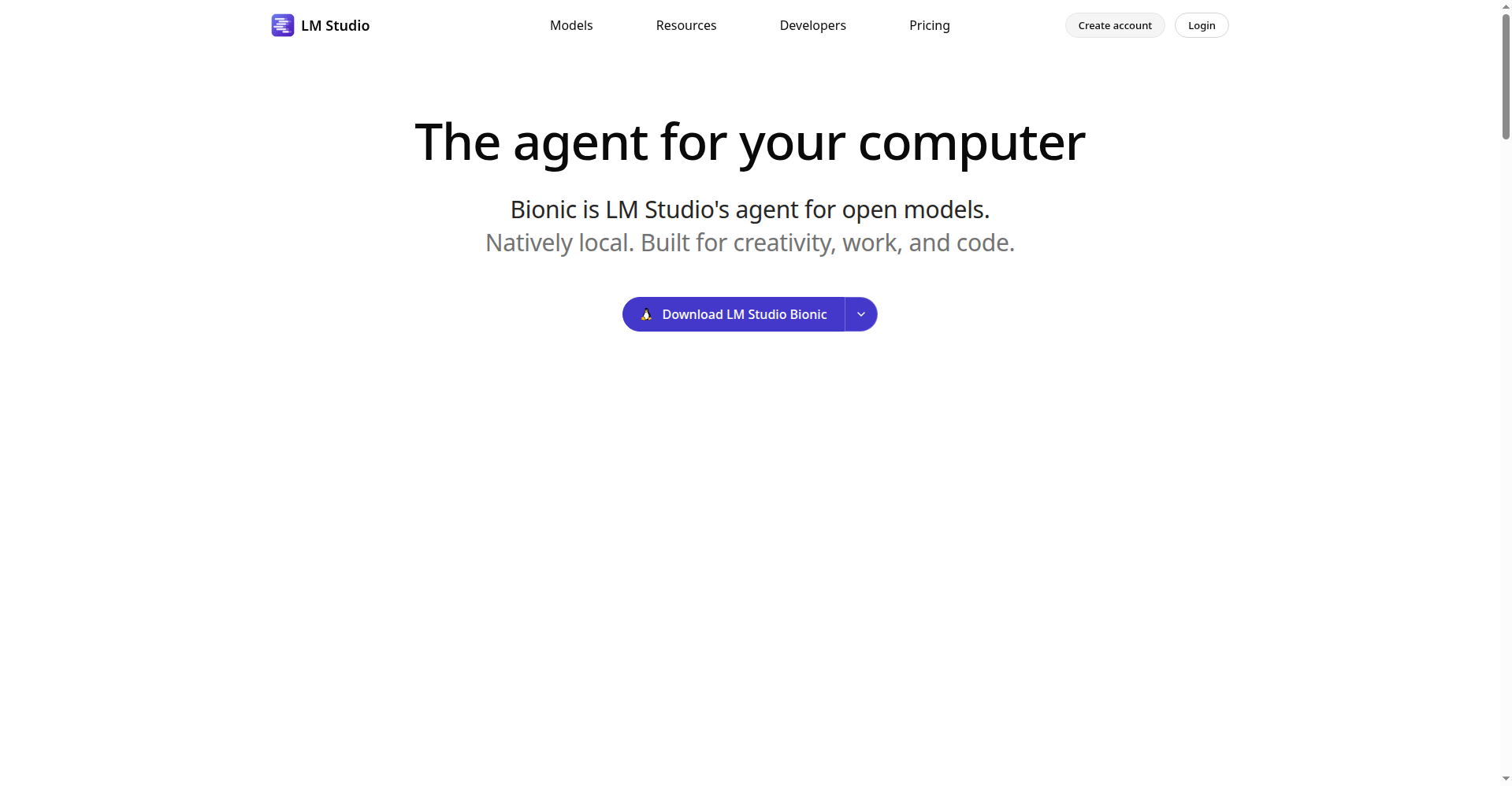
If you prefer not to live in a terminal, LM Studio is a desktop app for downloading GGUF models and chatting with them locally. Search its built-in model browser for an AstaBrief GGUF quant, download, and load it — no API keys, no per-token billing, everything on your machine.
5. Serve it for a team with vLLM
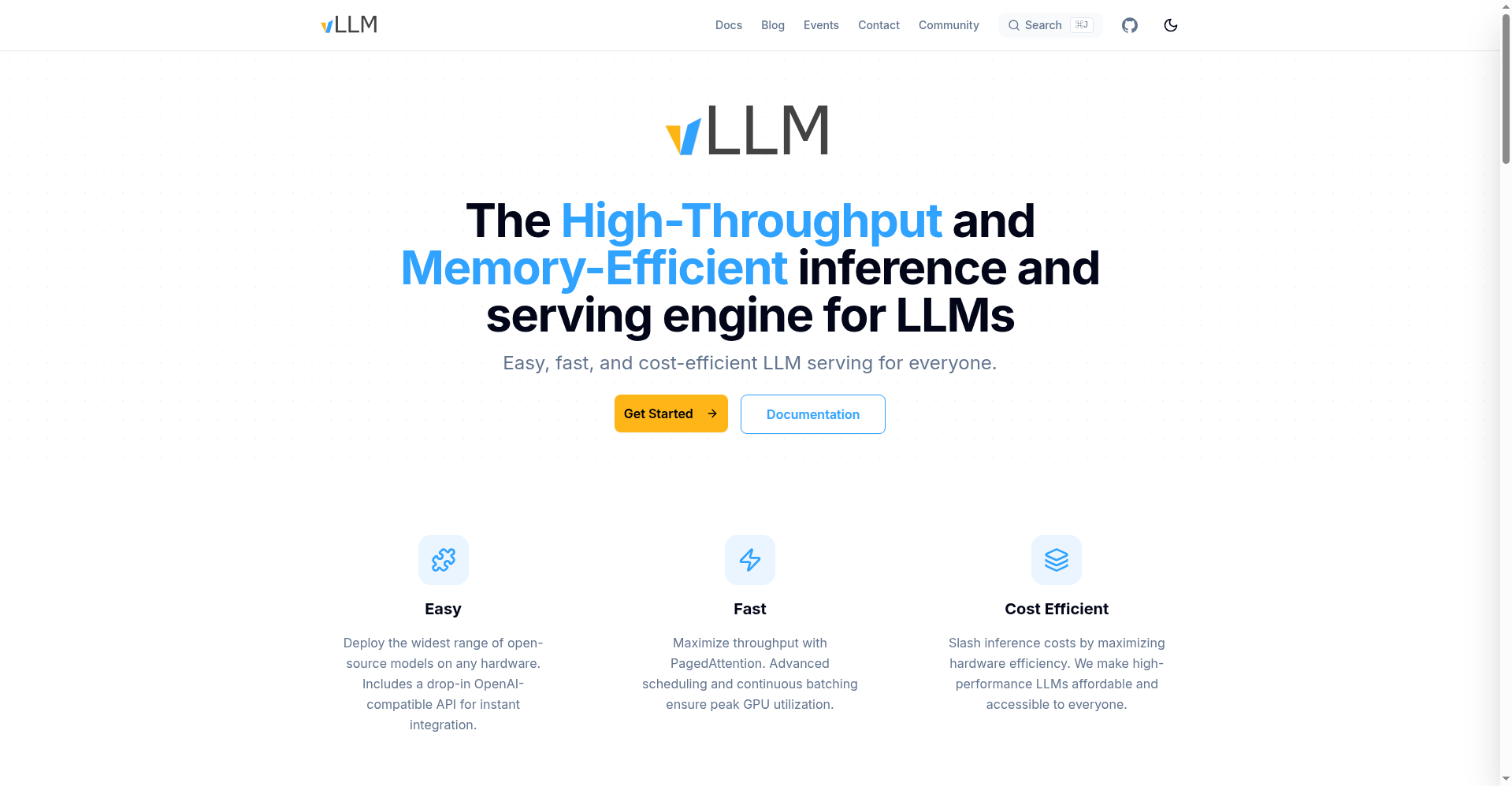
For shared or production use, the model card itself points at vLLM: Ai2's published inference snippet loads allenai/AstaBrief_8B with vLLM's LLM class and tuned sampling parameters. An 8B model serves cheaply on a single GPU — the cost argument behind this release. Pair it with Ai2's example workflow in ai2-scholarqa-lib to wire retrieval over your own documents into the same single-pass generation.
Who should care — and the limits
AstaBrief suits people who generate literature-grounded reports repeatedly: researchers doing lit reviews, R&D teams synthesizing papers, and institutions that cannot send documents to third-party APIs. The open weights plus released training data also make it a reference implementation for studying how post-training data quality — not model size — drives grounding.
The limits are real. This is a single-purpose model, not a general chatbot: it expects a research question plus retrieved excerpts in a specific prompt format, scoped to research and educational use. The evaluations were built in 2025 against that era's frontier, the human study covered 14 questions, and on DeepScholarBench the model trails both the Claude pipeline and DR Tulu. Treat 51 seconds as a pipeline average from Ai2's deployment, not a guarantee on your hardware. And as Ai2 notes, citation support is only part of scientific faithfulness — a model can cite the right study yet overstate what it established, so every report still needs a researcher's eyes before becoming a working artifact.
Bottom line
AstaBrief 8B is a small, practical experiment with an unusually honest write-up: a cheaper SFT-plus-DPO recipe, one simple data filter doing most of the work, and a single 51-second pass replacing a multi-step proprietary pipeline. Whether the quality holds outside Ai2's benchmarks is still open — but with weights, data, and workflow all public, you don't have to take Ai2's word for it. Download it and check.
References
- Allen Institute for AI, "Open-sourcing AstaBrief, the fast report-generation model in Asta" (October 2, 2026): https://allenai.org/blog/astabrief
- Unite.AI, "Ai2 Open-Sources AstaBrief 8B for Fast Scientific Report Generation": https://www.unite.ai/ai2-open-sources-astabrief-8b-for-fast-scientific-report-generation/
- AstaBrief-8B model card, Hugging Face: https://huggingface.co/allenai/AstaBrief_8B
- Brocker.org, "Ai2 Open-Sources AstaBrief 8B for Cited Science Reports" (confirmed facts and open questions): https://www.brocker.org/ai2-open-sources-astabrief-8b-report-model