
Microsoft's New Voice Stack: MAI-Transcribe-2-Streaming & MAI-Voice-2.1 Explained — and 5 Ways to Use Them
Microsoft released three new voice models on October 1, 2026: MAI-Transcribe-2-Streaming, its first real-time speech-to-text model, and two text-to-speech models, MAI-Voice-2.1 and MAI-Voice-2.1-Flash. Together they form a complete first-party stack for voice agents — the model that listens and the models that speak — and the latency numbers matter more than the benchmark headlines.
What Microsoft Shipped
The headline model is MAI-Transcribe-2-Streaming, the real-time sibling of MAI-Transcribe-2, a batch model Microsoft released in September that transcribes finished recordings. Streaming is a different problem: audio flows in continuously, and the model returns text while the speaker is still talking, revises those early hypotheses as more context arrives, and commits a stable final transcript when the utterance ends.
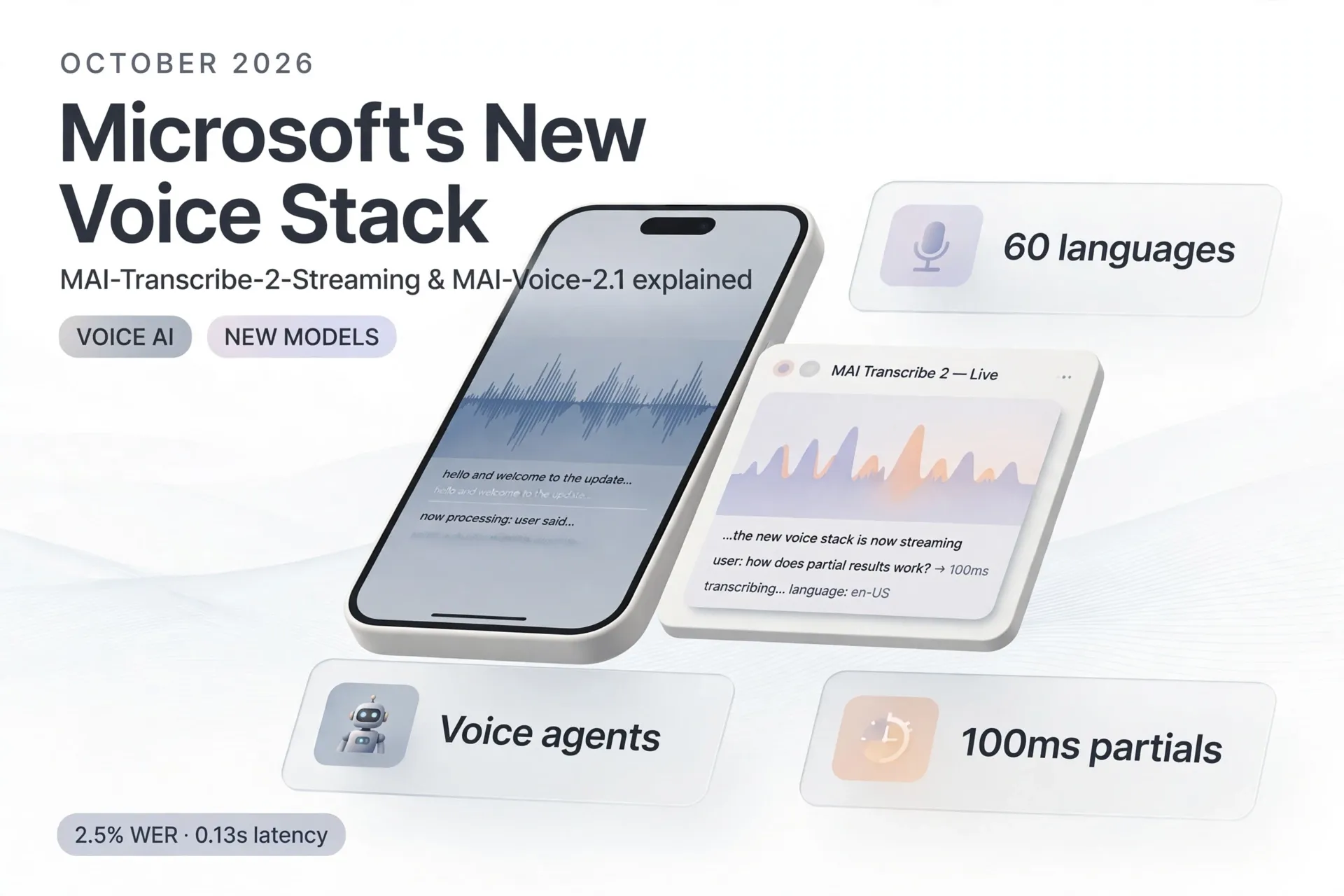
Microsoft reports that the model transcribes 60 languages with automatic, continuous language detection — no need to declare the language up front, and it can keep up if the language changes mid-stream. Its first hypotheses, called partials, arrive just over 100 milliseconds after audio starts flowing. Because partials stream in early, a voice agent can start reasoning or calling tools before the speaker finishes a sentence, and live captions can appear almost as the words are spoken.
The two voice models go the other direction, turning text into speech. MAI-Voice-2.1 is Microsoft's most expressive TTS model yet, covering 23 languages across 26 locales with one recognizable voice identity that adopts a native accent in each language — a bilingual assistant no longer changes character mid-sentence. MAI-Voice-2.1-Flash is the cheaper, faster variant: it begins producing 45 seconds of audio at 150 milliseconds end-to-end, with inference Microsoft measures as 55 percent faster than the standard model. Both support voice cloning with consent checks built in.
All three models launched in public preview. That designation matters: there is no service-level agreement, and Azure does not recommend them for production workloads until general availability.
The Numbers: Accuracy, Latency, and Price
Microsoft reports that MAI-Transcribe-2-Streaming reaches a 2.5 percent word error rate with the final transcript ready 0.13 seconds after speech ends, and claims the top spot for accuracy on Artificial Analysis's streaming index of 38 models — including matching 2.5 percent WER on the very first partial at 0.12 seconds. Artificial Analysis also places the model on the accuracy-versus-latency Pareto frontier, meaning higher accuracy does not demand a heavy latency trade-off.
Two caveats are important here. First, these are Microsoft's reported figures; independent reporting noted the model had not yet appeared on the public streaming leaderboard at launch, so treat the "#1 of 38" ranking as the company's claim rather than independently verified fact. Second, Microsoft says its internal tests found words appearing twice as fast as its closest competitor — again, the company's own measurement.
For context, coverage of the Artificial Analysis index places Grok Voice Transcribe 2.0 at 2.7 percent WER and 0.49 seconds to final, and Meta's Muse Voice Transcribe at 3.1 percent and 0.16 seconds; Cartesia's Ink-2 is faster still (0.07 seconds) but at 4.0 percent WER. The accuracy gap between Microsoft and its nearest rival is small — roughly two extra correct words per thousand — while the latency gap is large. The honest summary: this release is about speed, not a dramatic accuracy leap.
Pricing follows the same logic. Streaming transcription costs $0.54 per hour of audio as an introductory rate through the end of 2026 (about $9.00 per 1,000 minutes). That is 5.4 times what Microsoft's own batch model costs ($0.10 per hour) — streaming is a product for conversations, and Microsoft prices it accordingly. It also costs more than xAI ($0.20/hour) and Meta ($0.18/hour), and roughly matches Google's estimated rate for its live transcription. MAI-Voice-2.1 costs $22 per million characters; the Flash variant costs $15 per million.
Microsoft also confirmed there is no open-weights release: all three models are hosted only.
Who Should Pay Attention
This release is most relevant if you are building a voice agent where the caller waits on the reply. A phone assistant built on an LLM has two latency budgets: the model thinking, and the audio pipeline around it. Cutting transcript delay from roughly half a second to 0.13 seconds removes a noticeable pause from every turn, and paired with MAI-Voice-2.1-Flash at 150 milliseconds, a full voice loop — hear, think, speak — can complete in well under a second. That is the threshold where a voice agent stops feeling like a walkie-talkie.
Contact centers and multilingual support lines are the obvious early adopters, along with live-captioning products, real-time dictation, and meeting tools that need words on screen while people are still speaking.
If you already run Deepgram or ElevenLabs and your transcripts are good enough, this is a "watch, don't switch" release: Microsoft charges roughly 38 percent more per minute for an accuracy difference you will struggle to notice. And if your audio is already finished when it reaches you, skip streaming entirely — the batch model at $0.10 an hour does the same job.
Developers should also note three gaps Microsoft is not claiming yet: no speaker attribution (diarization) for the streaming model, so "who said what" in a meeting is not answered; no per-language breakdown across the 60 languages; and no noisy or far-field testing claims — benchmark audio is clean, while call centers and meeting rooms are not.
5 Ways to Use the New MAI Voice Models
The models are available through five channels. Each is a legitimate product in its own right; pick the one that matches where you already build.
1. Microsoft Foundry — the official home
Foundry is Microsoft's unified AI platform for building agents: a model catalog of more than 1,900 models, deployments, evaluations, and agent tooling under one management plane. The three MAI models went live here on day one, and Microsoft positions Foundry as the production path once they reach general availability. If your stack already lives on Azure, this is the natural front door — and the MAI Playground, Microsoft's no-setup try-it surface, sits in the same ecosystem.
2. Azure AI Speech — the SDK path
Microsoft documents two integration paths: a Realtime API for apps already using an OpenAI Realtime-compatible WebSocket, and the Azure Speech SDK, which handles connection management, retries, and audio streaming. Both return intermediate and final results, so you can render partials in your UI while waiting for the committed transcript. Azure AI Speech also offers text-to-speech, translation, and speaker recognition APIs, now grouped under Foundry Tools, with a free tier for experimentation.
3. Vercel AI Gateway — one endpoint, zero markup
Vercel's AI Gateway fronts hundreds of models behind a single OpenAI-compatible endpoint with budgets, usage monitoring, load balancing, and automatic failover — charging zero markup over provider list prices. The MAI streaming model is listed there with Azure as the provider at the same $0.54 per audio hour. If your app is already built on Vercel's AI SDK, a model string auto-routes through the gateway, making this the lowest-friction way to try the new model inside an existing project.
4. OpenRouter — the multi-provider router
OpenRouter gives you one API key and one OpenAI-compatible endpoint for 400+ models from dozens of providers, with automatic failover and a catalog of free models for testing. For teams that already route inference through OpenRouter — to A/B models without rewriting code, or to split cheap bulk work from premium models — the MAI models slot into the same routing layer. Pay-as-you-go billing with no card required to start makes it a cheap place to benchmark the new models against whatever you use today.
5. LiveKit — the voice-agent stack (support coming)
LiveKit is the open-source WebRTC stack plus cloud for realtime voice and video AI agents: an agents framework (Python and Node.js) bundling STT, LLM, TTS, turn detection, and telephony, with LiveKit Inference supplying models without per-provider API keys. Microsoft has announced LiveKit support for the new MAI models as coming soon, with no date given. If you already build voice agents on LiveKit, this is the integration to watch — its turn-detection layer is exactly where a 100-millisecond partial transcript pays off.
How to Start
If you want hands-on today, the fastest route is the MAI Playground: no code, no keys, just audio in and transcripts out. For a prototype with real code, the Vercel AI Gateway or OpenRouter paths get you calling the model within minutes through an OpenAI-compatible client. For anything headed toward production on Azure, start with the Azure Speech SDK in a non-critical environment and keep the public-preview caveat front and center: no SLA, and Microsoft's own guidance says to wait for general availability before betting a business on it.
Whatever path you choose, benchmark on your own audio. Clean benchmark numbers say little about accented speech, room microphones, and background noise — the exact conditions where transcription scores collapse and where your users actually live.
Wrap-up
Microsoft's October 1 release fills the missing piece in its first-party voice stack: a streaming transcription model that is genuinely fast (first words in just over 100 milliseconds, final transcript 0.13 seconds after speech ends) paired with two TTS models that keep one voice across 23 languages. The benchmark crown is Microsoft's own claim and the accuracy lead is thin — but the latency lead is real, and latency is what makes a voice agent feel like a conversation instead of a walkie-talkie. Just remember the price math: streaming costs 5.4 times the batch model, the intro rate expires at year end, and everything is still in public preview.
References
- MarkTechPost, "Microsoft AI Releases MAI-Transcribe-2-Streaming: #1 Real-Time Speech-to-Text Model on Artificial Analysis" (Oct 2, 2026) — https://www.marktechpost.com/2026/10/02/microsoft-ai-releases-mai-transcribe-2-streaming-1-real-time-speech-to-text-model-on-artificial-analysis/
- DataNorth, "Microsoft MAI-Transcribe-2-Streaming: 60 languages" (Oct 2026) — https://datanorth.ai/news/microsoft-releases-mai-transcribe-2-streaming
- Tech Times, "Microsoft Ships First Streaming Transcription Model, Completing Voice Agent Pipeline on Foundry" (Oct 2, 2026) — https://www.techtimes.com/articles/328501/20261002/microsoft-ships-first-streaming-transcription-model-completing-voice-agent-pipeline-foundry.htm
- PYMNTS, "Microsoft Targets Contact Center Market With Real-Time AI Voice Models" (Oct 1, 2026) — https://www.pymnts.com/news/artificial-intelligence/2026/microsoft-targets-contact-center-market-with-real-time-ai-voice-models/
- Microsoft Azure, "Azure Speech in Foundry Tools" — https://azure.microsoft.com/en-gb/products/ai-foundry/tools/speech
- Microsoft Learn, "What is Microsoft Foundry?" — https://learn.microsoft.com/en-us/training/modules/get-started-with-ai-in-azure/4-microsoft-foundry