Hardware-isolated microVMs to safely run AI-generated code — self-hosted or on managed cloud.
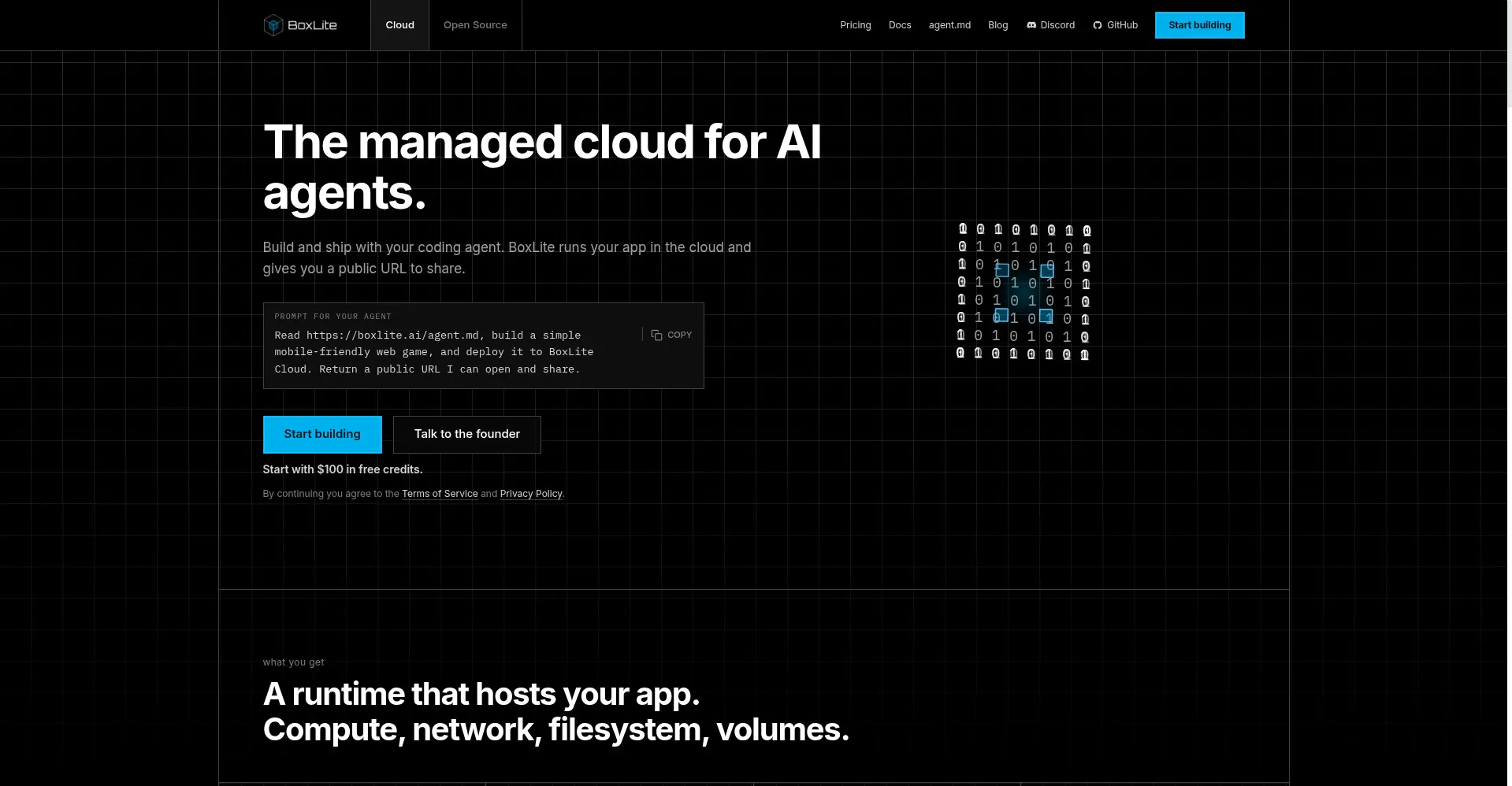
BoxLite Cloud homepage
1 / 3Overview
What is BoxLite Open Source?
Open-source microVMs for AI agents, embedded in your app
BoxLite Open Source is an open-source (Apache 2.0) microVM runtime for safely running AI-generated code. Each box is a real virtual machine with its own Linux kernel — stronger isolation than containers, much lighter than a full VM, and booting in under 50ms.
It ships as a library, not a service: pip install boxlite and call it from your own app, with no daemon, no root and no cloud account required. SDKs are available for Python, Node.js, Go, Rust and C, alongside a CLI and a 104-endpoint REST API. The runtime runs any Docker/OCI image, keeps files across restarts, and supports snapshots and branching (fork) for full-state rollback.
Networking is controlled with allow_net outbound restrictions, secrets are injected as placeholders so real keys never enter the VM, and boxes expose port forwarding, public URLs, and CPU/memory/network/boot metrics with logs. It runs on macOS (Apple Silicon), Linux (x86_64 and ARM64 with KVM) and Windows (WSL2).
BoxLite Cloud is the managed counterpart built on the same SDK and API: pay-as-you-go boxes from $0.0666/hour on a prepaid wallet, optional Starter ($19/mo), Pro ($149/mo) and Max ($499/mo) plans, custom enterprise pricing, and $100 in free credits at signup with no credit card required. The runtime itself can also run entirely on your own machines.
Platforms and languages
BoxLite Open Source Availability
Platforms
Languages
Capabilities
BoxLite Open Source Key Features
Hardware-isolated microVMs
Each box is a real VM with its own Linux kernel (KVM on Linux, Hypervisor.framework on macOS). Stronger isolation than containers, lighter than full VMs, booting in under 50ms.
Embedded library, no daemon
Ships as a library: pip install boxlite and call it from your app. No root, no background service. SDKs for Python, Node.js, Go, Rust and C, plus a CLI and a 104-endpoint REST API.
OCI-native images
The open-source runtime runs any Docker/OCI image as-is, no conversion needed.
Persistent state with snapshots and branching
Disk survives stop and restart. Snapshot the full state, branch (fork) it, and roll back whenever you need to.
Controlled networking and secrets
Restrict outbound traffic with allow_net, inject secrets as placeholders so real keys never enter the VM, and expose port forwarding and public URLs.
Built-in observability
CPU, memory, network and boot-time metrics plus logs for every box.
Apache 2.0 open source
The runtime is fully open source (~2.6k GitHub stars), self-hostable on your own machines with no account and no data leaving your network.
Best for
Who uses BoxLite Open Source?
Developers and teams building and deploying AI coding agents
Sandbox AI-generated code in hardware-isolated microVMs without building their own isolation infrastructure
Plans and access
BoxLite Open Source Pricing
Freemium
$100 free credits on signup; pay-as-you-go from $0.0666/hr; plans $19-$499/mo.
Common questions
BoxLite Open Source FAQs
Is BoxLite Cloud the same thing as the open-source runtime?
Yes. Cloud is a managed hosting layer built on top of BoxLite. You use the same SDK and core API; you just access boxes over a URL plus API key, and Cloud adds managed storage and box lifecycle handling.
How much does it cost to get started?
You start with $100 in free credits and no credit card required. Boxes bill by the hour, and the console shows the rate for the size you pick before you create one.
Do I need a subscription?
No. You can go wallet-only with pay-as-you-go, subscribe to a plan, or combine both: plan quota is used first and the wallet covers any overage.
Can I run BoxLite entirely on my own infrastructure?
Yes. The runtime is Apache 2.0 open source, so you can run it fully on your own machines with no account — data never leaves your network.
Does BoxLite work with my existing Docker images?
The open-source runtime runs any Docker/OCI image as-is. BoxLite Cloud accepts base, python and node alias images; direct Docker references like python:slim are rejected there.
Reviews
See what the community thinks and share your experience.
—
Based on 0 ratings
Rating distribution
Community reviews
No reviews
No written reviews yet.