
Claude Duet vs Meta Muse: Two Proactive Agents, Two Different Jobs
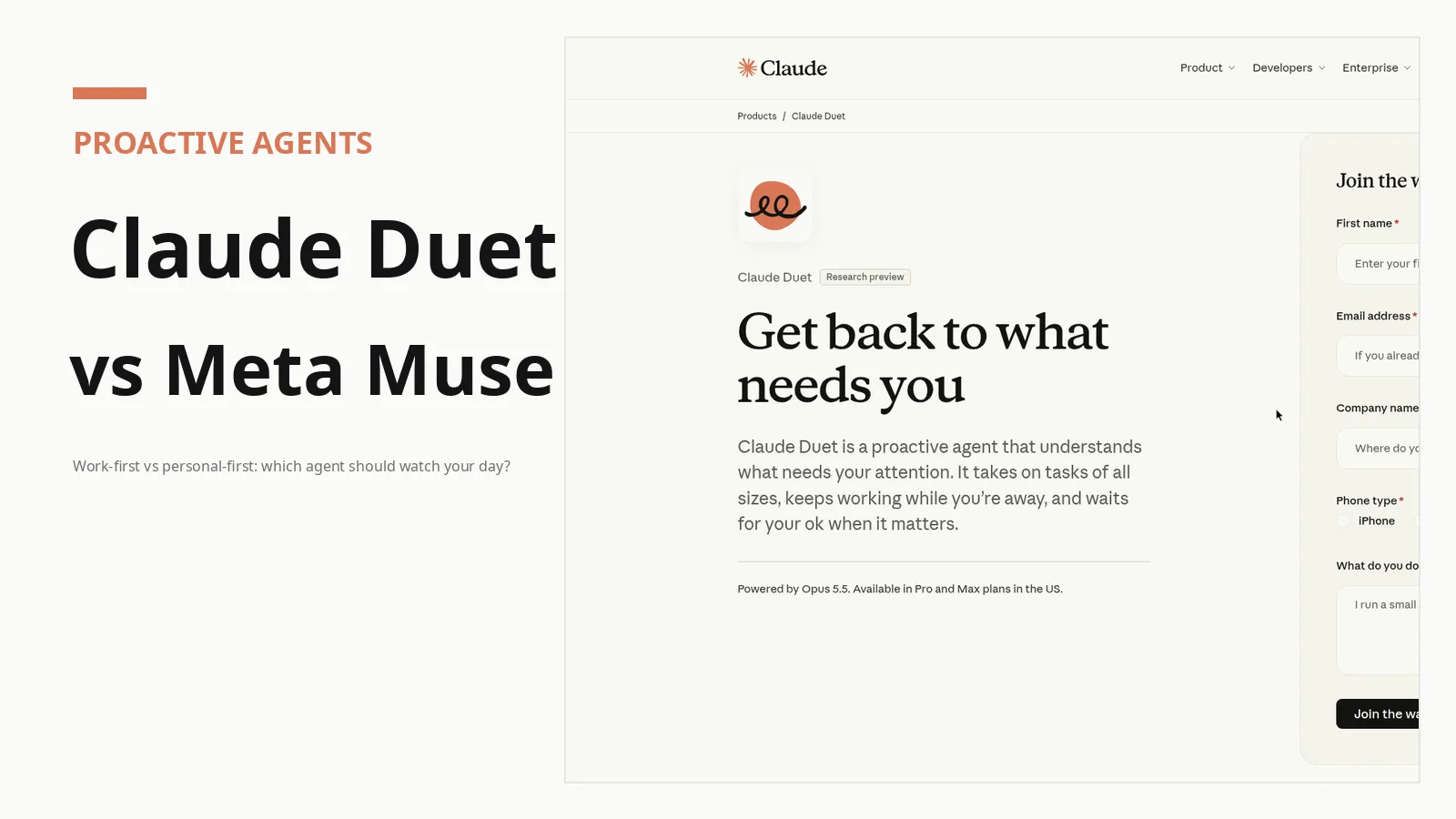
Until recently, every AI assistant waited for you to speak first. In September and October 2026, that changed twice. Meta launched Muse on September 8, an agent that keeps working after you close the app and comes back when something needs a decision. Anthropic followed on October 21 with Claude Duet, an agent that sends you a morning brief and watches your connected work apps through the day.
Both products share the same big idea: the assistant should reach out before you ask. But they are built for different people. Duet is aimed squarely at professionals and small business owners with more to track than they can handle. Muse started as a personal agent for everyday life, then added a small-business version on September 29. If you are choosing between them, the deciding factor is less about which one is smarter and more about whose workday it was designed to watch.
What happened
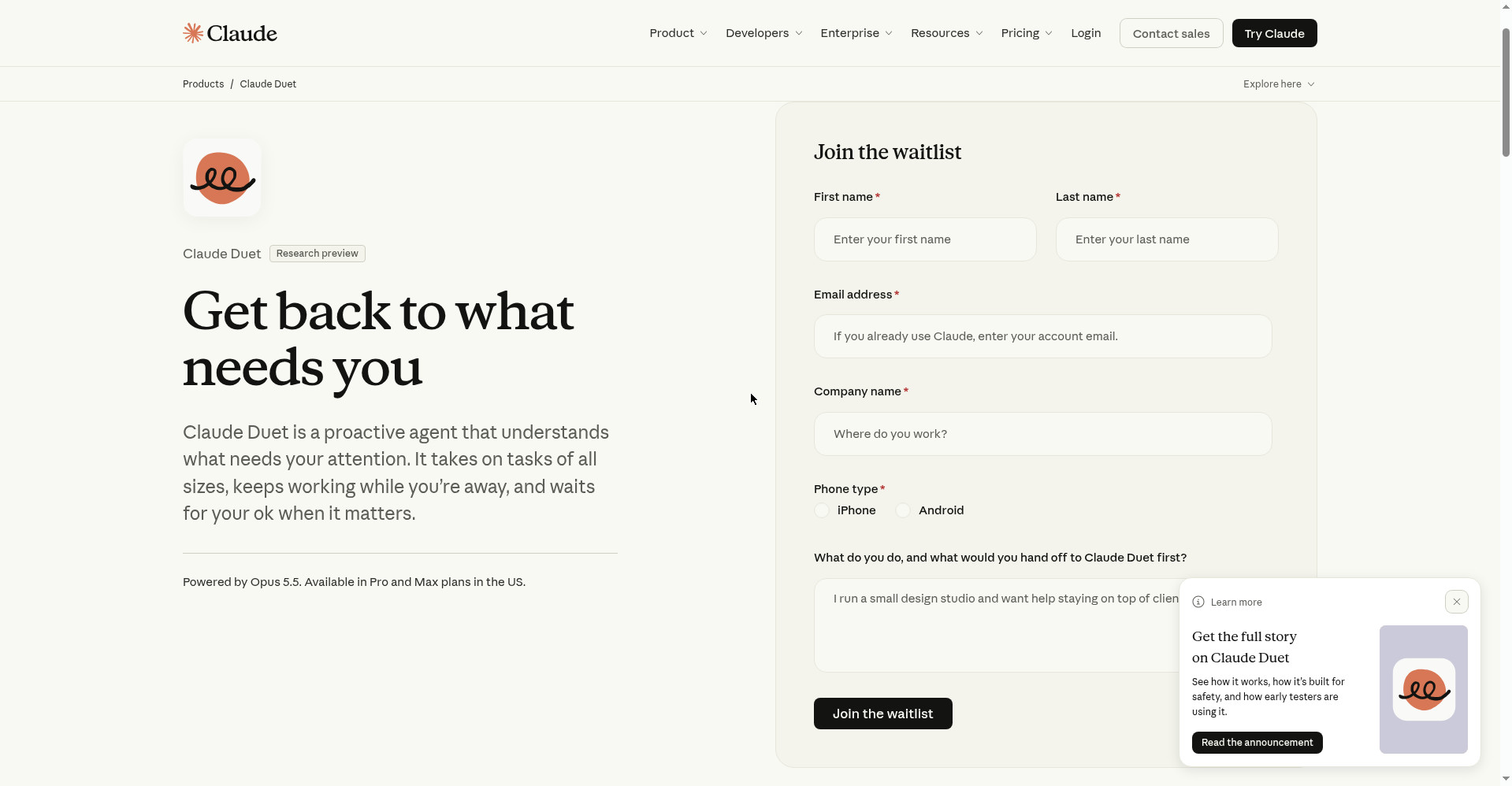
Anthropic opened Claude Duet on October 21, 2026, as a research preview with a waitlist. It is a standalone app, separate from the main Claude chat, available on iOS, Android, and the web. Access is limited to Claude Pro and Max subscribers in the United States, and its background activity counts against the subscriber's existing plan limits.
Duet runs on Claude Opus 5.5, Anthropic's top model. Each morning it sends a short brief on the most important items across a user's connected apps. Through the day it checks those apps every few hours, rather than continuously, and messages the user only when something needs attention. Anthropic says the periodic rhythm is deliberate: constant checking would burn through plan limits much faster.
Meta's Muse arrived about six weeks earlier, on September 8, 2026, as a personal agent that works toward goals instead of only answering questions. Give it a goal, Meta said, and it develops a plan, coordinates time and resources, and advances the work on its own, coming back when circumstances change or when it needs approval. It runs in its own cloud computer, called Muse Secure VM, with its own browser, and it can be reached in the Muse app, on the web, and inside WhatsApp.
The two launches frame a new contest. OpenAI joined the same race in September with its always-on Dots agents. MacRumors described Duet as Anthropic's answer to Muse and Dots alike. The question for users is no longer whether an agent can act for you, but which kind of life it is designed to act on.
Side by side
| Claude Duet | Meta Muse | |
|---|---|---|
| Launched | October 21, 2026, as a research preview | September 8, 2026 |
| Availability | United States only, waitlist | United States at launch; Canada and Japan followed |
| Who can use it | Claude Pro and Max subscribers | Free tier, plus paid plans |
| Model | Claude Opus 5.5 | Muse Spark |
| Platforms | iOS, Android, web | iOS, Android, web, WhatsApp |
| Built for | Professionals and small businesses | Personal life first, small business added later |
| Payments | Stripe Link and Shop Pay | Stripe Link; Shop Pay planned at launch |
Claude Duet: the work-first agent
Duet's pitch is a chief of staff for your work accounts. It plugs into more than 6,000 connectors and plugins in the Claude Marketplace, including Gmail, Slack, Google Calendar and Drive, Microsoft 365, Notion, QuickBooks, Stripe, HubSpot, DocuSign, Canva, Shopify, and Gusto. It carries over memory, skills, and connected apps from an existing Claude account, so there is little setup beyond choosing what it may watch.
The examples Anthropic gives are almost all business chores: finding missed messages in Gmail and Slack and drafting replies, checking QuickBooks or Stripe for unpaid invoices and preparing reminders, running payroll in Gusto for review, drafting a job post for LinkedIn, and preparing agreements for signature. It can also build dashboards, financial forecasts, prototypes, and simple web apps, and it can spend money through Stripe Link or Shop Pay.
Control is built around approval gates. Anthropic says Duet asks before it sends a message, makes a payment, signs a document, or deletes a file. It does not see passwords or sign-in tokens when given access to accounts, and a dedicated classifier and safety prompt check each message to guard against sensitive information leaking out, such as credit card numbers or government IDs.
The limits are stated plainly, which is to Anthropic's credit. The company acknowledges Duet can misjudge urgency, and that it remains less effective at personal tasks such as booking tickets. It is not a general errand-runner. Access is also narrow for now: a waitlist, US only, and paying subscribers only. And because background checks draw on the same plan limits as ordinary chats, a busy Duet could eat into the allowance a subscriber would otherwise spend on direct conversations.
Meta Muse: the personal-first agent
Muse starts from the other end of life. Meta describes it as a personal agent built for everyone, with no technical experience required. Its examples are household and personal: turning a saved recipe reel into a grocery list, suggesting a dinner-party menu that accounts for friends' dietary restrictions, lowering a bill, and selling a car. It can also send email, book travel, fill out forms, and manage schedules, and it keeps working on longer-running goals after the app is closed.
Under the hood, Muse runs on Muse Spark, Meta's model for agentic work, inside the Muse Secure VM. A separate system called Sentinel authorizes, blocks, or asks approval for actions involving websites and connected services. Meta says Muse does not see users' actual passwords or payment details, and users can review an audit trail, disconnect services, and tell the agent to forget what it learned. Shopping at launch ran through Stripe Link, which generates a one-time-use card number instead of exposing the real card; Meta says Shop Pay and 1Password support were planned but not available at launch.
Pricing is where the two diverge most. Duet rides on an existing Claude subscription. Muse is free to start, with a usage meter, and TechCrunch reported paid plans called Power at 20 dollars a month and Maximum at 100 dollars a month for larger allowances. Meta has said it expects most people to stay on the free tier.
Muse has also moved faster on availability. After the US launch, it reached Canada on September 18, and on October 23 it launched in Japan, its first market outside North America. It added a small-business version on September 29, with connectors for Instagram professional analytics, Facebook Pages, Meta ad accounts, Shopify, Stripe, QuickBooks, Notion, Slack, and others. That move narrows the gap with Duet, but the two still start from opposite directions: Muse is a personal agent learning business tasks, while Duet is a business agent that admits it is weak at personal ones.
Strengths and limits
Duet's strength is focus. Its connector list leans heavily toward the tools small businesses actually run on, and its morning-brief rhythm matches how professionals triage a workday. The approval gates and the classifier are aimed at the exact fear that stops businesses from handing an agent the keys: a payment sent, a contract signed, or a file deleted without a human looking first. Its weakness is scope. The waitlist, the US-only preview, and the shared plan limits mean most people cannot try it yet, and even those who can will find it deliberately narrow.
Muse's strength is reach. It is available to anyone in its launch countries, not just paying subscribers, and it covers personal life as well as work, with WhatsApp as an extra front door that Duet does not have. Its weakness is the opposite of Duet's: it tries to cover more ground, so its business features are newer and less proven, and its paid tiers are priced for heavy personal use rather than for a company's workflow. Meta also acknowledges Muse can make mistakes and remains susceptible to prompt-injection attacks, where malicious instructions on a website try to steer the agent.
Both agents share one honest limitation: neither company claims the agent judges urgency perfectly. Duet says so directly. Muse's approval system exists for the same reason. Anyone delegating real work to either one should expect to review its decisions, especially in the first weeks.
Which one fits you
Choose Claude Duet if your day is dominated by business operations: invoices, payroll, contracts, sales pipelines, and the inbox threads that feed them. It is the better fit for a professional or small business owner who already pays for Claude and wants one agent watching the work stack.
Choose Meta Muse if your needs are personal first: household tasks, travel, shopping, scheduling, and longer-term goals, with some business use on the side. It is also the only option of the two that most people can actually open today, since Duet remains behind a waitlist.
If you run a small business and want both, Muse's small-business version is worth a look, but expect it to be younger than Duet's business tooling. If you need an agent to watch work apps today and you are in the US with a Claude Pro or Max plan, joining Duet's waitlist costs nothing.
Bottom line
Duet and Muse agree on the future: assistants that come to you, not the other way around. They disagree on where to start. Anthropic built an agent for the workday, gated behind a subscription and a waitlist. Meta built an agent for everyday life, free to start and already spreading to new countries, with business features catching up. The right choice is not the more powerful agent in the abstract. It is the one whose daily brief reads like your actual day.
Sources
- Reuters — reuters․com
- MacRumors — macrumors․com
- Gadget Scout — gadgetscout․co․uk
- Worthview — worthview․com