
ElevenLabs Eleven v4 vs Microsoft MAI-Voice-2.1: Two AI Voice Stacks, Two Different Bets
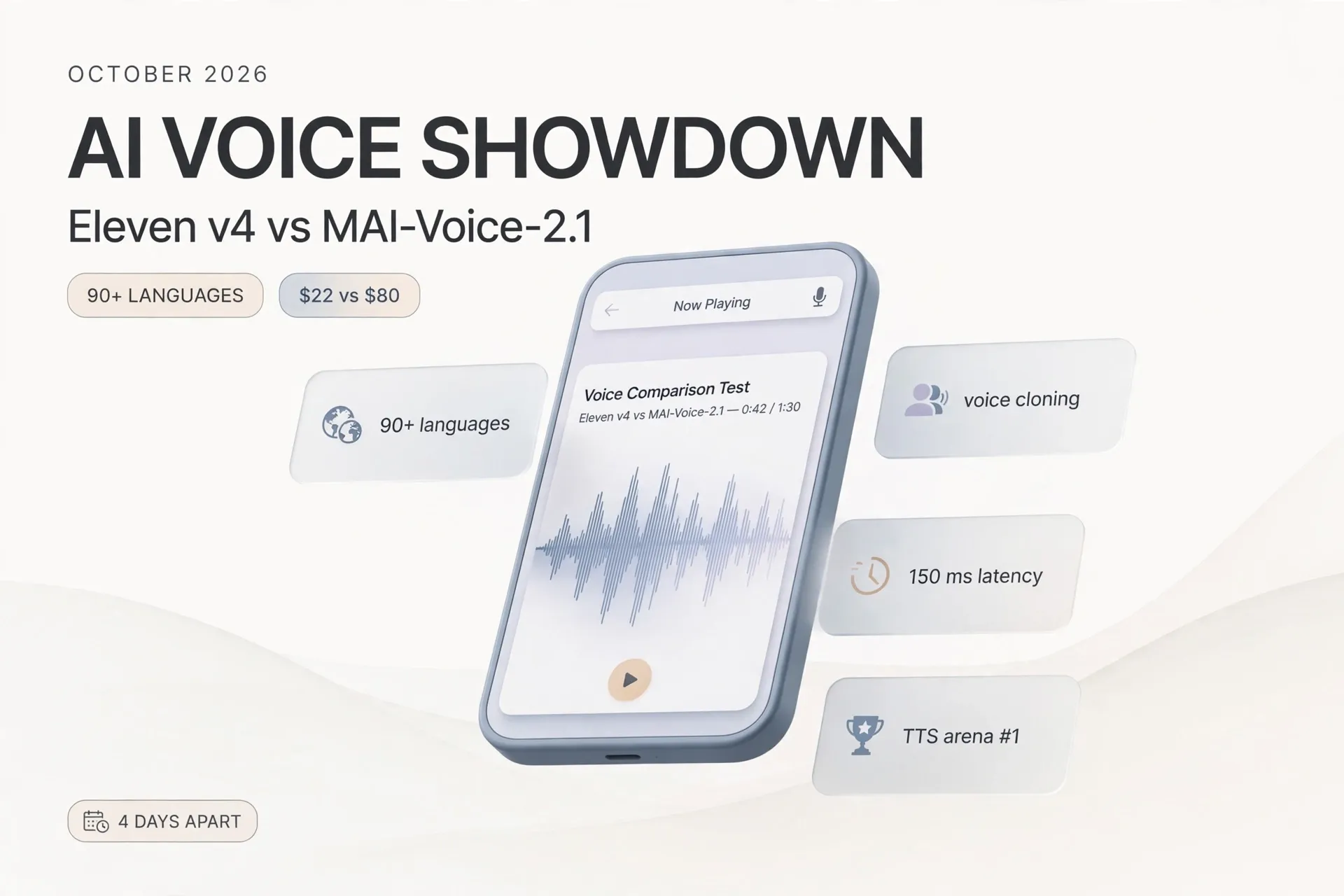
Within four days at the turn of October, the two most watched contenders in AI speech each shipped a new generation of their voice stack. On September 28, ElevenLabs released Eleven v4 and its faster sibling Eleven v4 Turbo. On October 1, Microsoft AI answered with MAI-Voice-2.1 and MAI-Voice-2.1-Flash. Both companies shipped the same pairing — one model tuned for quality, one tuned for speed — and both are pitching the same two buyers: creators producing narration and teams building voice agents.
But the products are aimed at very different kinds of users. ElevenLabs is a creator-first voice platform with an API on top; Microsoft's voices are one module inside a cloud stack you rent from Azure. Choosing between them is less about which voice sounds better in a 15-second demo and more about what you're building, how much speech you'll generate, and whether you want a tool or a platform. Here's the honest comparison.
Two Launches, Four Days Apart
ElevenLabs is the independent market leader in synthetic speech, and Eleven v4 is the first model built on what the company describes as a ground-up rebuild of its text-to-speech architecture. The headline feature is control: v4 reads tone, pacing, emotion and context from the text, and creators can steer delivery with plain-English direction or inline audio tags for laughter, whispers, accents and sound effects. ElevenLabs also reports steadier voice identity across long generations and multi-speaker dialogue — the thing that makes or breaks an audiobook or a dubbed series.
The sibling model, Eleven v4 Turbo, takes the same expressive architecture and trades some quality for speed. ElevenLabs reports a median inference latency of about 100 milliseconds, excluding network and application time, and about 150 milliseconds from request to audible speech over a WebSocket stream. Both are vendor-reported figures measured with network latency removed, so treat them as lab numbers rather than production guarantees. Still, the direction of travel is clear: ElevenLabs wants to erase the old trade-off where a voice was either fast or expressive.
Microsoft's MAI-Voice-2.1 and MAI-Voice-2.1-Flash arrived three days later as part of a bigger package: Microsoft shipped the two speech models alongside MAI-Transcribe-2-Streaming, its first real-time transcription model. The pitch is a complete voice-agent pipeline — listening and speaking — that a developer can assemble entirely from Microsoft's first-party stack. The voice models support 23 languages and 26 locales, and Microsoft says a single speaker identity can carry across all of them while adopting native accents. Voice cloning carries over from the earlier generation, working from a 5–60 second reference recording, though Microsoft gates it behind access controls and recorded consent.
For developers, the two voice models are available through Azure AI Speech, Microsoft Foundry, the MAI Playground, Vercel and OpenRouter. One important caveat runs across the whole Microsoft release: all three models are in public preview, provided without a service-level agreement and explicitly not recommended for production workloads.
Head-to-Head: The Key Differences
| ElevenLabs Eleven v4 / v4 Turbo | Microsoft MAI-Voice-2.1 / 2.1-Flash | |
|---|---|---|
| Released | September 28, 2026 | October 1, 2026 |
| Languages | 90+, up from 70+ on v3 | 23 languages, 26 locales |
| Quality-first model | Eleven v4 | MAI-Voice-2.1 |
| Speed-first model | Eleven v4 Turbo | MAI-Voice-2.1-Flash |
| Voice cloning | From 10 seconds of reference audio | From 5–60 seconds, gated access + recorded consent |
| Latency (vendor-reported) | ~150 ms to first speech over WebSocket (Turbo) | 45 seconds of audio at 150 ms end-to-end (Flash) |
| Voice pricing (list) | v4 ~$80 per million characters; Turbo $40 per million characters | 2.1 at $22 per million characters; Flash at $15 per million characters |
| Independent ranking | #1 on Artificial Analysis Provider Voice Arena (Elo 1,319) | Transcription sibling ranked #1 on Artificial Analysis streaming evaluation (vendor claim) |
| Access | ElevenLabs app, ElevenCreative, ElevenAgents, API | Foundry, MAI Playground, Vercel, OpenRouter, Azure Voice Live |
| Availability status | Generally available | Public preview, no SLA, not for production |
Where the Philosophies Diverge
The creator's studio vs. the cloud platform. This is the real fork. ElevenLabs sells a finished product: open a browser, type or paste, direct the performance with tags, download the audio. Its platform also includes ElevenAgents for conversational agents and ElevenCreative for content work, and in late September ElevenAgents was listed as a launch partner on OpenAI's new Marketplace for enterprise customers. The company is a pure-play voice business valued at $22 billion in a recent tender offer — its entire future depends on winning on voice quality.
Microsoft sells infrastructure. MAI-Voice-2.1 is a component you call from Azure AI Speech alongside a transcription model, a language model and your own application logic. If you're already on Azure, the voices slot into the stack with the same credentials and billing; if you're not, you're signing up for the cloud, not for a voice app. For teams building call centers or IVR systems inside the Microsoft ecosystem, that integration is the whole point.
Breadth vs. depth in languages. On paper, ElevenLabs wins the language count decisively: more than 90 languages against Microsoft's 23. The gap matters for dubbing houses and global content teams that need one engine for everything. But the count isn't everything: Microsoft's models handle code-switching for selected language pairs, and a voice-cloned speaker can retain identity across languages with native accents — the same capability ElevenLabs advertises, with ElevenLabs noting that performance varies by language and that target-language accent is currently applied automatically.
Pricing: a real spread. This is where Microsoft lands its punches. Microsoft lists MAI-Voice-2.1 at $22 per million characters and Flash at $15 — well under ElevenLabs' listed rates of roughly $80 per million for v4 and $40 for Turbo, according to Artificial Analysis' listing. ElevenLabs briefly softened the gap with a 72% launch discount, but that expired on October 12, so plan on the list prices. Microsoft's Mustafa Suleyman has claimed the models are "55% faster and 60% cheaper than ElevenLabs" — his words, not an independently audited comparison — but the listed prices do show a genuine cost gap of roughly two to five times depending on the pairing.
Maturity vs. momentum. ElevenLabs' models are generally available now, with an independent #1 ranking on Artificial Analysis' blind-listener Provider Voice Arena — though the arena score covers v4 with provider-supplied voices, and the Turbo variant that most voice agents would use hasn't been ranked yet. Microsoft's models are in public preview with no SLA. If you're shipping to customers today, that's not a minor footnote: previews can change, break or be retired. Microsoft's own documentation says the models are not recommended for production workloads.
Who Should Pick Which
Pick ElevenLabs if you: produce narration, audiobooks, dubbing, character voiceover or ads and need the most expressive output; work across dozens of languages from one tool; want a creator-friendly app plus API without touching cloud infrastructure; or value an independently measured quality lead. The 10,000-characters-per-request limit on v4 (about 10 minutes of audio) and steadier multi-speaker consistency are practical wins for long-form work.
Pick Microsoft's MAI voices if you: already build on Azure or Microsoft Foundry and want voice as a line item in an existing bill; are assembling a full voice-agent pipeline where the streaming transcription model — Microsoft's real differentiator this release, with first partial results in just over 100 milliseconds, vendor-reported — does half the work; care more about per-character cost at volume than maximum expressiveness; or want to call the models through OpenRouter or Vercel. Note that you cannot call ElevenLabs through OpenRouter at all.
Wait or test both if you: are building a production voice agent on Microsoft's stack. The public-preview status and missing SLA are reasons to prototype now and commit later, and Microsoft's transcription introductory price of $0.54 per audio hour is explicitly time-limited through the end of 2026.
Limitations Worth Knowing
Both vendors' best numbers need an asterisk. ElevenLabs' "~75% listener preference" comes from its own blind tests with an undisclosed number of graders, and its latency figures exclude network time. Microsoft's speed and accuracy claims — "55% faster," "most accurate real-time transcription in the world" — come from company announcements and internal tests without published methodology; the transcription model's #1 Artificial Analysis ranking is the one piece of independent evidence, and it covers transcription, not the voice models. Voice cloning on both sides carries misuse risk: Microsoft gates cloning behind consent controls, ElevenLabs restored Professional Voice Clones on v4 — neither is a substitute for your own deployment safeguards.
Pricing also moves. ElevenLabs' launch discount ended October 12. Google's rival TTS rates are promotional through December 31 and double on January 1, 2027. Budget on list prices, not launch prices.
The Verdict
Eleven v4 is the quality champion right now, with the independent benchmark to prove it — at least for produced audio. Microsoft's MAI-Voice-2.1 is the value play inside a cloud stack, with a genuinely cheaper per-character rate and a streaming transcription sibling that makes the whole package worth a serious look for voice-agent builders.
The simplest rule: if the voice is the product — an audiobook, a dub, a character — start with ElevenLabs. If the voice is infrastructure — a support agent, an IVR flow, a lecture-captioning pipeline on Azure — prototype with Microsoft's stack while it's in preview, and re-evaluate when it reaches general availability. Four days separated these launches; the real contest starts when both are fully shipped.
Sources
- Slator, "ElevenLabs Launches New Voice Models as Valuation Hits USD 22bn" — https://slator.com/elevenlabs-new-models-22bn-valuation/
- Slator, "Microsoft Adds Streaming Transcription and Upgrades Voice AI" — https://slator.com/microsoft-streaming-transcription-voice-ai/
- Digital Applied, "Eleven v4 and v4 Turbo: What Changed for Voice Agents" — https://www.digitalapplied.com/blog/eleven-v4-turbo-voice-agents-latency-pricing
- Lapaas Voice, "Microsoft Voice AI: Streaming Speech Models Explained" — https://lapaasvoice.com/microsoft-voice-ai-adds-streaming-transcription-and-speech-models/