
Gemini 3.8 Flash TTS Explained: Google's Voice-Design Speech Models — and 5 Tools for the Same Jobs
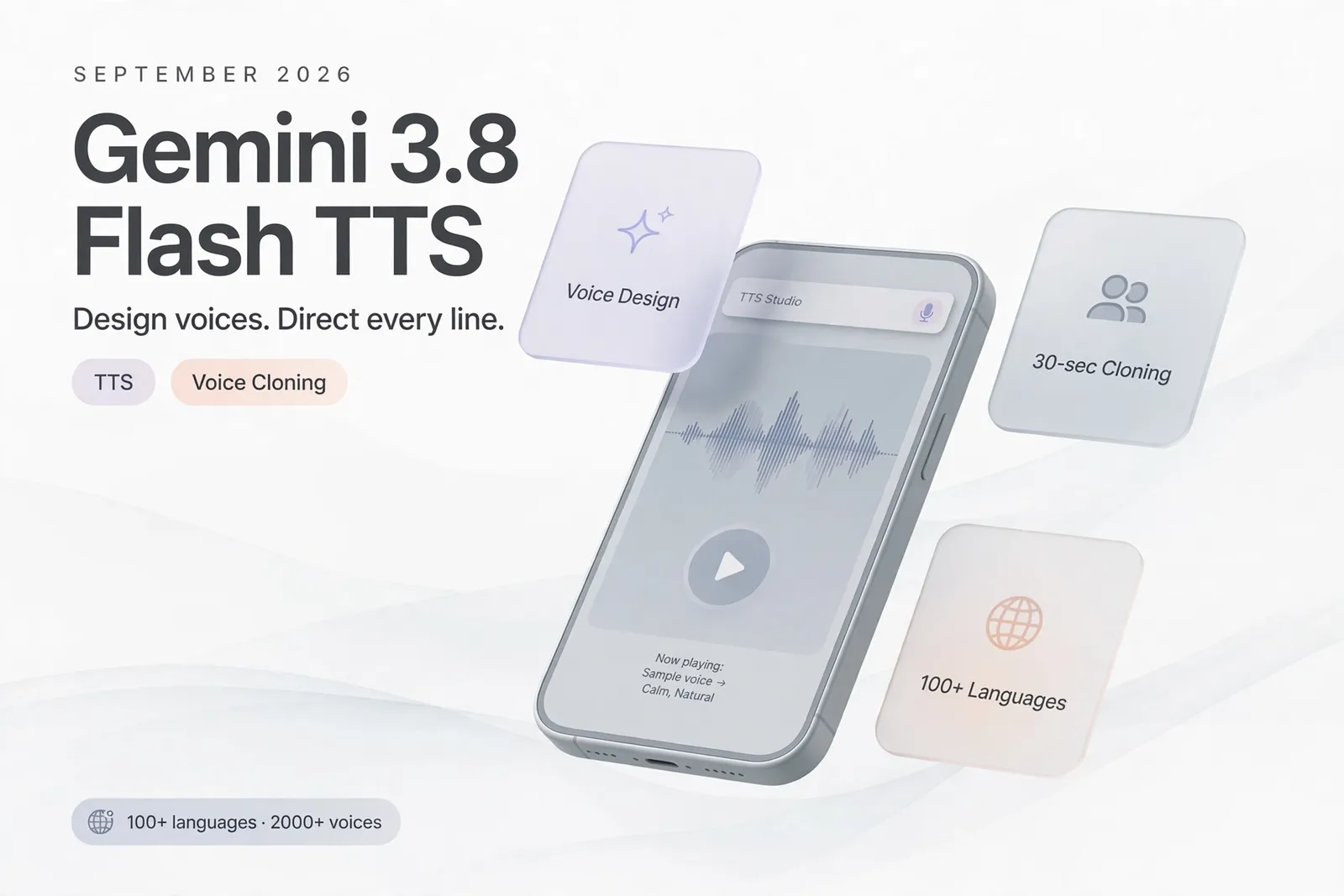
Most text-to-speech tools ask you to pick a voice. Google's new models ask you to describe one — and then direct it like an actor. On September 23, 2026, Google launched Gemini 3.8 Flash TTS and Gemini 3.8 Flash-Lite TTS, a pair of speech models that treat voice as something you design, not something you select. Tell it "a warm narrator with a slight Brazilian accent, pacing like a podcast host," clone an authorized voice from a 30-second sample, and steer individual lines with instructions for tone, pacing, and even laughter.
What follows: what Google actually released, how the voice-design system works, the honest limits, and five tools on Navs that already cover the same voice jobs today.
What Google released on September 23
Gemini 3.8 Flash TTS is Google's flagship speech model for creative direction and character design; Flash-Lite TTS is its high-volume sibling for dubbing, audio generation, and voice agents. Both are generally available through the Gemini API and Google AI Studio, share the same API schema and prompting structure, and are rolling out across Google's own products: Flash TTS to Gemini Notebook (the renamed NotebookLM) users, Flash-Lite TTS to Google Vids, with Gemini Enterprise API access planned for later.
The headline capability is natural-language voice design. Instead of scrolling a voice list, developers describe the voice they want — accent, role, vocal qualities, pacing, emotional delivery — and the model generates it. Around that core sit a custom-voice workflow and a voice-replication path in AI Studio: with the voice owner's permission, Google says a voice can be recreated from a 30-second audio sample, backed by a consent-recording requirement. For teams that don't want to design or clone at all, Google offers more than 2,000 ready-made voices plus an Extended Voice Library reachable through the API.
Both models support more than 100 languages and dialects, multi-speaker dialogue generated from a single script, and long-form audio designed to hold voice identity, timbre, volume, and room tone steady across extended narration — the properties that matter for audiobooks and podcasts, where a pipeline can fail even when individual sentences sound fine. Generated audio carries Google's SynthID watermark, and Google lists C2PA credentials as part of the provenance package.
Google also teased a voice-remixing feature coming later: start from an existing voice and modify pitch, timbre, pace, and accent through text prompts.
Voice design, not voice selection: what actually changes
The shift here is architectural, not just cosmetic. Traditional TTS stacks separate two jobs: choose the voice, then synthesize the text. Gemini 3.8 TTS collapses design and synthesis into one controllable system, through three mechanisms.
Turn-level style instructions. Developers direct individual lines of dialogue with instructions for delivery, tone, and pacing — margin notes a director gives an actor. A script can move between a tense whisper and an enthusiastic announcement without switching voices.
Inline vocal events. Scripts can include non-verbal sounds as markup: <laugh>, <sigh>, <short pause>, breaths, gasps. Google's documentation also lists inline International Phonetic Alphabet overrides, regional accents, and minority dialects — precise controls that matter when a brand name or local pronunciation has to land exactly right.
Stable identity over time. Long-form generation is where most TTS systems drift: the voice subtly changes character twenty minutes in. Google claims the Flash model holds identity and room tone across multi-minute narration and two-speaker exchanges. If that holds in production — third-party tests will be the judge — it removes one of the biggest manual QA costs in AI audiobook and dubbing pipelines.
None of this is a free-for-all. Voice replication in AI Studio is unavailable in Illinois, Texas, the EEA, the UK, Switzerland, and India, a reminder that biometric-voice regulation now shapes feature rollouts as much as model capability does. And on evaluation, Google reports strong results in its own testing — including Hume AI's Voice Design Benchmark and Overall Quality Index, plus blind human-preference tests in Japanese, Hindi, Brazilian Portuguese, and Mexican Spanish. Those are company-reported results, not independent benchmarks; Google also describes the new models as an improvement over Gemini 3.1 Flash TTS, which is the company's own framing of progress.
Flash vs Flash-Lite: two models, two jobs
| Gemini 3.8 Flash TTS | Gemini 3.8 Flash-Lite TTS | |
|---|---|---|
| Built for | Creative direction, character design | High-volume production: dubbing, audio generation, voice agents |
| Voice design | Natural-language voice creation, 30-second replication, voice remixing (coming) | Same API schema; control model shared |
| Dialogue | Turn-level direction, two-speaker scripts | Two-speaker support |
| Best fit | Podcasts, audiobooks, games, branded characters | Real-time agents, localization at scale |
| Where it ships | Gemini API, AI Studio, Gemini Notebook | Gemini API, AI Studio, Google Vids (coming) |
The practical takeaway: teams choose the model the way they'd choose a rendering tier — Flash when every line needs direction, Flash-Lite when the volume is the point. Because the API schema is shared, switching between them is a configuration change, not a rewrite.
One pricing data point exists from outside Google: Vercel added Gemini 3.8 Flash TTS to its AI Gateway at $0.50 per million input tokens and $9 per million output tokens, with $5 in credits every 30 days for unpaid users. That is third-party gateway pricing, not Google's list price — Google had not published its own per-token rates at the time of writing.
Who should use it — and the honest catches
The natural audience is developers building voice agents, dubbing pipelines, audiobook production, game dialogue, and podcast tooling — anyone whose current TTS setup involves a spreadsheet of voice IDs and a prayer that take 47 sounds like take 3. The consent-verified cloning path and watermarking also make it a cleaner choice for enterprise teams that have been avoiding voice cloning for compliance reasons.
The catches are real. Voice replication is region-restricted, as noted above. Enterprise API access is "coming later," so large buyers are waiting. All performance claims are Google's own until independent evaluations land. And voice design shifts a skill burden onto the user: writing a good voice description is prompt engineering with an aesthetic component, and teams should expect iteration before a designed voice is production-stable.
Also worth noting: the models join an already crowded Gemini Audio lineup — Gemini 3.5 Live Translate, Gemini 3.5 Transcribe, Gemini 3.8 Live, and Gemini 3.8 Live Extended Thinking. Google is assembling a full-duplex audio platform, and TTS is one module in it, not a standalone product.
5 tools on Navs that cover the same voice jobs today
Note: these tools run their own voice engines — they don't wrap the new Gemini models. They cover the same jobs the Gemini 3.8 TTS pair targets (voice cloning, voice design, long-form and multi-voice audio), and they're available right now.
FreeVoiceClone — the closest mirror of Gemini's 30-second replication. Clone a realistic voice from just 10–60 seconds of clear audio, then generate speech with it across 500+ languages. Cloning and generation are free — the zero-budget way to test whether voice cloning fits your workflow before committing to an API.
SpeechGen — a production-oriented TTS studio with 1,000+ natural-sounding voices, SSML support for fine-grained control over pauses and emphasis, and MP3/WAV/OGG export. The no-code counterpart to the Flash model for video, ad, and presentation voiceovers.
Voicemaker — a mature TTS converter with voice effects, speed/pitch/volume tuning, and a pronunciation editor for tricky words. With over 3 million registered users, it's the reliable pick for e-learning narration, IVR systems, and content pipelines that need to just work.
PodcastorAI — an AI podcast studio pairing AI hosts (including your cloned digital twin) with natural voices and script generation, in solo and two-host conversational formats. It maps directly onto the two-speaker, long-form scenarios Google is pitching — full episodes, not just sentences.
Lisen — a free Chrome extension that reads any web article aloud using your own Cartesia voices, with word-by-word highlighting and WAV export. The accessibility angle: your personal voice library, applied to everything you read.
How to start
If you want to try the new models themselves: open Google AI Studio, head to the audio playground, and either design a voice from a text description or pick from the 2,000+ prebuilt voices. Start with a short two-speaker script containing one <laugh> and one <short pause> — it will tell you more about controllability than any benchmark. Check voice-replication availability for your region before planning around cloning.
If you want the capabilities without the API: pick one of the five tools above based on the job — FreeVoiceClone for cloning experiments, SpeechGen or Voicemaker for voiceover production, PodcastorAI for full podcasts, Lisen for reading aloud.
The bottom line
Gemini 3.8 Flash TTS and Flash-Lite TTS move text-to-speech from voice selection to voice direction: describe a voice, clone an authorized one from 30 seconds, and steer every line. The technology is genuinely new; the evaluation evidence is still Google's own; and the region restrictions are a preview of how voice AI will be regulated everywhere. For builders, the sensible move is to prototype now — the API schema is shared across both tiers, so whatever you learn on Flash transfers to Flash-Lite when the volume arrives.
References
- Google's Gemini 3.8 Flash TTS launch coverage — Gadgets360: https://www.gadgets360.com/ai/news/google-gemini-3-8-flash-tts-flash-lite-tts-with-voice-cloning-roll-out-12096370/amp
- "Google Launches Gemini 3.8 Text-to-Speech Models" — Let's Data Science: https://letsdatascience.com/news/google-launches-gemini-38-text-to-speech-models-cee3c0a7
- "Google Launches Gemini 3.8 Flash TTS Models With Custom Voice Creation and Control" — ODSC: https://opendatascience.com/google-launches-gemini-3-8-text-to-speech-models-for-expressive-ai-audio/
- RuntimeWire on the launch and the Hume AI connection: https://runtimewire.com/article/google-gemini-3-8-flash-tts-alan-cowen
- Navs tool directory — AI Audio Tools: https://navs.site/ai-category/ai-audio-tools