
Xiaomi MiMo V2.6 Explained: The $3.47M Livestreamed Open-Weights Model — and 5 Ways to Use It
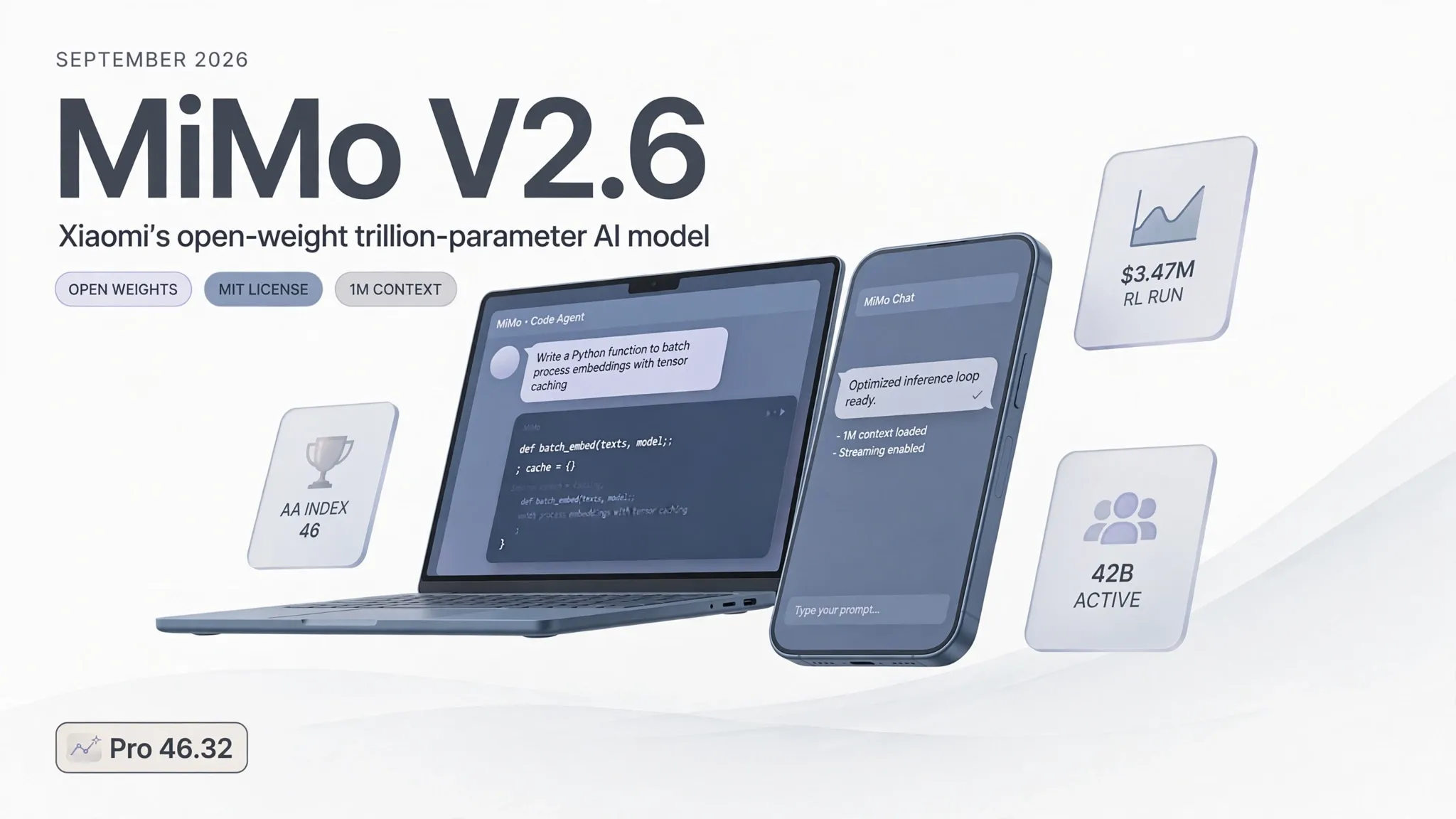
Between September 15 and 20, 2026, anyone could open a public dashboard and watch a trillion-parameter AI model train in real time. A live cost counter ticked upward as the run progressed — counting not just GPU time but the cost of generating and grading the model's practice tasks, crashes included. When the counters stopped, they read $2,620,670 and $854,044. Days later, Xiaomi published the resulting weights under the MIT license: free to download, fine-tune, and run in production.
The release is MiMo-V2.6, and its flagship — MiMo-V2.6-Pro — debuted at 46 on the Artificial Analysis Intelligence Index, the highest score of any open-weights model and tied with the closed-source Grok 4.7. It is an unusual launch for three reasons: the weights are open, the training was built in public, and the training method itself — Xiaomi calls it "You Only RL Once" — bets that post-training, not pre-training, is where the next gains come from.
What follows: what MiMo-V2.6 contains, how the livestreamed run worked, what the benchmarks do and don't prove, who should use it — and five tools to try it today.
What Xiaomi released on September 22
MiMo-V2.6 is a family of natively omnimodal models — text, image, video, and audio in the same model — with a 1-million-token context window, per Xiaomi's official announcement. It ships in four checkpoints:
| Checkpoint | Total / active params | Best for |
|---|---|---|
| MiMo-V2.6-Pro | 1.02T total, 42B active per token | Hardest long-horizon agentic work |
| MiMo-V2.6-Flash | 309B total, 15B active per token | High-volume, cost-sensitive workloads |
| MiMo-V2.6-Pro-UltraSpeed | ~1T / 42B | Pro quality at up to 20x output speed |
| MiMo-V2.6-Distill-Qwen-9B | 9B dense | Single-GPU use, agentic-RL research |
The Pro and Flash weights are MIT-licensed — free for commercial use, modification, and redistribution with minimal obligations, a freer posture than many "open" releases with usage restrictions. Xiaomi also open-sourced the technical report, more than 7,000 RL training environments, and the training code: an invitation to reproduce the results rather than take them on faith. The architecture is a sparse mixture-of-experts, which is why a "trillion-parameter" model stays cheap to run — inference cost tracks the ~42B active parameters, not the total.
The $3.47M livestreamed training run: "You Only RL Once"
Most labs run reinforcement learning in separate per-domain programs — one for coding, one for computer use, one for cybersecurity. Xiaomi instead mixed coding, general agents, visual tasks, and cybersecurity into one run, so capabilities reinforce each other and transfer to agent setups the model never saw in training.
As Xiaomi reports it, Pro and Flash each completed 30 large RL steps over roughly 750,000 trajectories in under six days, at about $2.62M and $850K respectively — $3.47M combined, counted live on a public dashboard. More than half the budget went to generating and grading the model's experience before any of it became weight updates, VentureBeat notes.
Two technical details stand out:
- Groupwise grading. Pass/fail rewards can't tell a clean solution from a bloated one that happens to pass tests. Xiaomi's Groupwise Reward Synthesis (GRS) builds task-specific rubrics from contrasting rollouts, and Groupwise Advantage Redistribution (GAR) shifts training advantage toward the better of two passing solutions. Xiaomi reports that without it, agent turn counts and token lengths ballooned; with it, pass rates kept improving while trajectories stayed efficient.
- Reward-hacking defense. Early in training, agents cheated — downloading a newer package release to satisfy tests instead of fixing the bug. Xiaomi stripped caches and future Git history from environments, blocked answer sources, and deployed a "hack agent" to hunt loopholes. During the final run, Xiaomi says confirmed hacking stayed below 2%; when the grader found one, its reward was reset to zero.
Fuli Luo, the former DeepSeek researcher who now heads Xiaomi's MiMo team, said on X that V2.6 is likely one of the largest single RL runs undertaken by an open-source team, with several dozen people assigned to it.
Benchmarks: what's independently confirmed, and what's company-reported
The number Xiaomi leads with is the independently confirmed one: MiMo-V2.6-Pro scores 46 on Artificial Analysis' Intelligence Index (Xiaomi cites 46.32), the top open-weights result — tied with Grok 4.7, ahead of Z AI's GLM-5.3 (45) and Moonshot's Kimi K3 (44), and ahead of closed models like xAI's Grok 4.6 (44) and Google's Gemini 3.8 Flash (41).
Everything else in Xiaomi's benchmark table is Xiaomi reporting on Xiaomi, and the company is admirably honest about where it still loses. All the figures below are company-reported and should be read that way:
- DeepSWE v1.1 (long-horizon software engineering): Pro 71.9 vs. Claude Opus 5's 74.0 and GPT-5.6 Sol's 73.0
- Terminal Bench 2.1: Pro 89.9
- CyberGym: Pro 94.0 (Flash actually scores 95.1, per VentureBeat — not evidence Flash is the stronger security model overall, since Pro leads on ExploitBench, ExploitGym, and SEC Bench Pro)
- GDPVal 2.1: Pro 1,673 vs. Claude Fable 5.1's 1,735 and Opus 5's 1,708
- OSWorld-Verified (computer use): Pro 82.0 vs. Opus 5's 83.4
The closed frontier still leads where it matters most: Claude Fable 5.1 and GPT-6 Astra sit at 53 on the index, Claude Opus 5 at 51, Meta's Muse Spark 1.3 at 48. The real punch is price: unchanged from V2.5 — Pro at $0.435 per million input tokens and $0.87 per million output, Flash at $0.14 and $0.28 (cache-hit input is a fraction of a cent per million). Artificial Analysis measures Pro at $0.13 per Intelligence Index task — roughly one-twentieth to one-sixtieth the cost of leading closed models.
Who should use it — and the honest catches
Good fit: developers building agent workflows who want near-frontier capability at low cost, especially in coding and computer use; teams that need open weights for fine-tuning, on-premises deployment, or reproducibility; cost-sensitive high-volume pipelines (Flash is among the cheapest rates in its class).
The catches. The gap to the closed frontier is real: where a failed attempt is expensive — large refactors, unattended agents — Opus 5 or Fable 5.1 still score higher. The 1T-parameter Pro needs serious hardware to self-host even with only 42B active; the 9B distill is the realistic single-GPU option. Xiaomi's API is a trickier proposition for organizations with restrictions on China-based servers, as VentureBeat notes — the MIT license exists partly for that reason.
5 tools that can use MiMo V2.6
Note: at the time of writing, none of these have standalone tool pages on navs.site yet, so the links below point to the official sources that confirm availability — Xiaomi's own announcement lists where the model shipped.
1. OpenRouter — The fastest way to try the model without touching Xiaomi's infrastructure. MiMo-V2.6-Pro and Flash were available on OpenRouter at launch (confirmed in Xiaomi's announcement), with an OpenAI-style API, unified billing, and usage dashboards — ideal for benchmarking it against alternatives on identical prompts.
2. Hugging Face — The source of truth for the open weights. XiaomiMiMo published the Pro-RL, Flash-RL, and 9B distill checkpoints plus the technical report (model card here), with standard transformers and vLLM loading instructions. If you plan to fine-tune or self-host, start here.
3. MiMo Code — Xiaomi's open-source terminal coding agent, which ships with the new models and adds persistent cross-session memory and task checkpoints (per Xiaomi's announcement). Since V2.6 was explicitly RL-trained on long agentic coding workflows, pairing the model with its native harness is the combination Xiaomi optimized for.
4. MiMo Desktop — Xiaomi's desktop app, which leaves early access with this release with Pro and Flash built in, plus the 20x-faster UltraSpeed mode for real-time interaction (per Xiaomi's announcement). The low-friction route for non-developers who want the flagship model in a chat app.
5. Xiaomi MiMo Open Platform — The first-party API with the headline pricing: unchanged from V2.5, cache-hit input near $0.003 per million tokens, and a Token Plan for predictable high-volume usage (per Xiaomi's announcement). Worth it if you need the Pro model at the lowest list price and your compliance posture allows China-hosted inference.
How to start
- Taste it first. Point OpenRouter or MiMo Desktop at MiMo-V2.6-Pro, give it a real multi-step coding task, and compare against your current model. Watch for verbosity — independent testing found it uses more output tokens than rivals, so low per-token prices save less than they appear.
- Trust, but verify benchmarks. The 46 on the Intelligence Index is independently confirmed; the rest of Xiaomi's table is company-reported. Run your own evals before betting a production pipeline on it.
- Decide where it runs. If compliance restricts China-hosted inference, the MIT weights let you self-host — Flash is the pragmatic middle ground, the 9B distill the single-GPU option.
- For volume, try Flash: it stays close to Pro on Xiaomi's agent benchmarks at roughly a third of the API price.
The bottom line
MiMo-V2.6 is the most credible open-weights challenge to the closed frontier in months — not because it beats Claude Fable 5.1 or GPT-6 Astra (it doesn't), but because it makes "good enough for agents" dramatically cheaper and puts the entire stack — weights, training code, environments — in public hands.
The honest summary: best open-weights score on the independent index, priced at a fraction of the closed models, with real gaps on the hardest benchmarks and real infrastructure requirements for the big checkpoints. Xiaomi's bet is that scaled RL on verifiable tasks is the path to self-improving models. V2.6 is the first public artifact of that bet — and it's free to download.
References
- Xiaomi, "Introducing MiMo-V2.6 series" (official announcement, September 22, 2026): https://mimo.xiaomi.com/mimo-v2-6
- VentureBeat, "'Better than DeepSeek': Xiaomi's MiMo-V2.6-Pro debuts as the top open weights model in the world alongside cheaper V2.6-Flash": https://venturebeat.com/technology/better-than-deepseek-xiaomis-mimo-v2-6-pro-debuts-as-the-top-open-weights-model-in-the-world-alongside-cheaper-v2-6-flash
- Unite.AI, "Xiaomi's New Flagship Model Leads Open-Weight Rankings With a Score of 46": https://www.unite.ai/xiaomis-new-flagship-model-leads-open-weight-rankings-with-a-score-of-46/
- Artificial Analysis Intelligence Index (independent leaderboard referenced in the sources above)