
GLM-5.3 vs GLM-5.3 Flash: Same Family, 9x Price Gap — When Is the Flagship Worth It?
Z.ai sells two models from the same family at prices roughly nine times apart. GLM-5.3, the flagship, costs $1.40 per million input tokens and $4.40 per million output tokens on Z.ai's own API. GLM-5.3-Flash, its smaller sibling, costs $0.15 and $0.50 for the same work. Both launched in August 2026, both carry open weights, and both share a one-million-token context window — so the price gap, not the spec sheet, is the real story.
The question is not which model is smarter — on independent testing the flagship leads by about four points. It is whether that margin is worth paying nine times more for. The answer depends on what you run, how much you run, and whether you plan to host the weights yourself.
Scope and method: what we compared, and what we did not test
We compared published specifications, Z.ai's list prices, licence terms, and two kinds of benchmark evidence: scores measured independently by Artificial Analysis, and scores reported by Z.ai itself. We ran no experiments of our own, and nothing in this article is a hands-on test result.
One consistency rule matters: Artificial Analysis has rebased its Intelligence Index since these models launched, and older scores still circulate. Every Artificial Analysis figure here comes from one version — Intelligence Index v5.0.1, as published on 20 November 2026. Where we quote Z.ai's own figures, we say so, and prices are Z.ai's list prices checked on the same date.
The two models at a glance
| GLM-5.3 | GLM-5.3-Flash | |
|---|---|---|
| Released | August 2026 (API 14 August, weights 28 August) | 26 August 2026 |
| Parameters | 753B total, 40B active | 320B total, 18B active |
| Input | Text only | Text, image, video |
| Context window | 1,048,576 tokens | 1,048,576 tokens |
| Licence | Custom GLM-5.3 License | MIT |
| Z.ai API price, per 1M tokens | $1.40 in / $4.40 out | $0.15 in / $0.50 out |
| Artificial Analysis Intelligence Index v5.0.1 | 31.7 | 27.8 |
GLM-5.3: the flagship reasoning model
GLM-5.3 is Z.ai's flagship, a 753-billion-parameter mixture-of-experts model with 40 billion active parameters per token. Some trackers list 744 billion total parameters; Artificial Analysis and Hugging Face list 753 billion, and we use that figure. It builds on the same base model as GLM-5.2, with Z.ai crediting post-training for the gains, and it is text-only, with no image or video input. It supports two reasoning-effort levels, low and max, with max as the default.
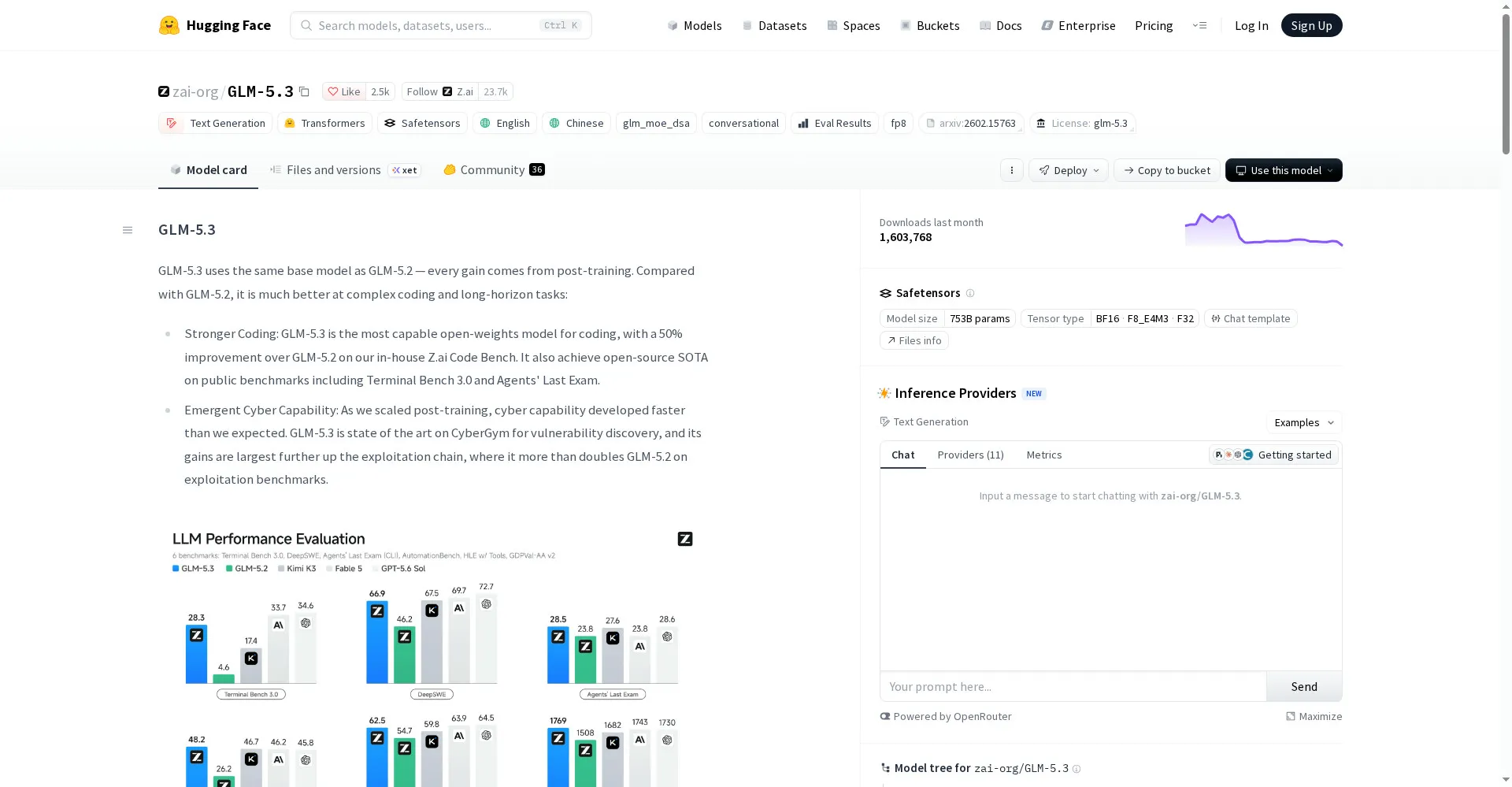
Z.ai calls it its most capable open-weights model for coding, citing a 50% improvement over GLM-5.2 on its in-house Code Bench — a vendor claim, not an independent measurement. Its weights are public on Hugging Face, but under a custom licence rather than a standard open-source one, covered below.
GLM-5.3-Flash: the cheap, multimodal sibling
Flash is not a distilled or quantised flagship. Z.ai describes it as a newly trained base model, its architecture redesigned around hybrid sparse and linear attention plus Manifold-Constrained Hyper-Connections, cutting attention compute to roughly a third of the flagship's. It is also the first natively multimodal model in the GLM-5 family, accepting text, image and video input.
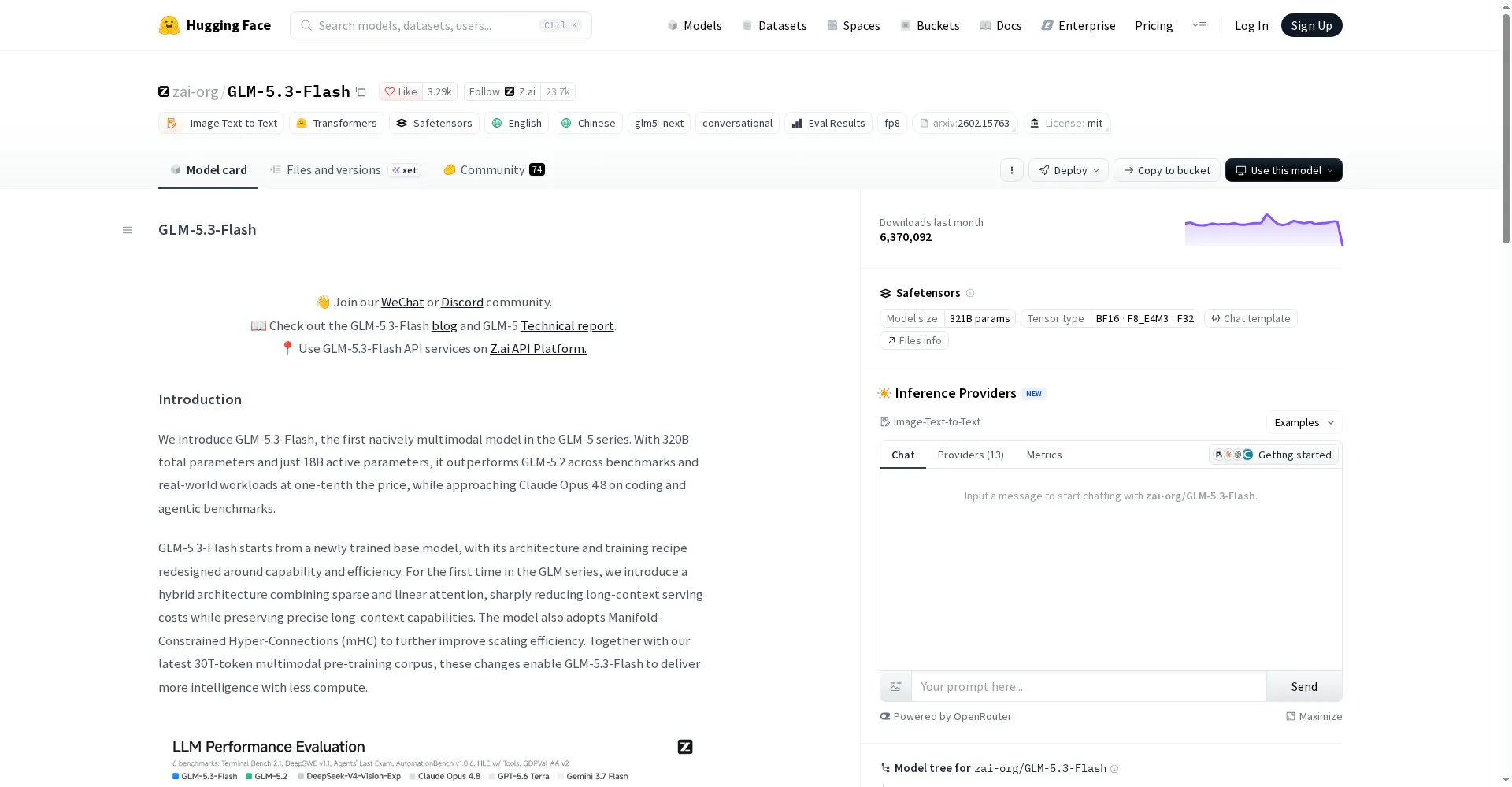
That combination has made it the widely adopted of the pair: on Hugging Face, Flash recorded 6.37 million downloads in the previous month, against 1.60 million for the flagship, according to the counters shown on 20 November 2026. A faster serving tier, GLM-5.3-FlashX, exists at $0.37 in and $1.25 out per million tokens, but it runs the same weights, so it has no separate benchmark score.
Independent benchmarks: a small gap, measured one way
Artificial Analysis evaluates both models on its Intelligence Index, a composite of nine evaluations covering coding, terminal use, science, knowledge work and document reasoning. On version 5.0.1, GLM-5.3 at maximum effort scores 31.7 and Flash scores 27.8 — a gap of 3.9 points. For calibration, the median open-weights model of similar size scores 23, so both sit well above the field.
| Artificial Analysis, Index v5.0.1 | GLM-5.3 (max) | GLM-5.3-Flash |
|---|---|---|
| Intelligence Index | 31.7 | 27.8 |
| Terminal-Bench 4.0 | 41.9% | 32.8% |
| SciCode | 59.0% | 51.6% |
| Cost per Index task | $5.01 | $0.58 |
The gap is uneven. On Terminal-Bench 4.0, which tests agents working through real terminal tasks, the flagship completes 41.9% of tasks against Flash's 32.8% — a 9.1-point lead. On SciCode, a scientific coding evaluation, the lead is 7.4 points. But the cost of each Index task tells the other half of the story: $5.01 for the flagship against $0.58 for Flash, an 8.6x difference.
Two details qualify the headline. First, the flagship only beats Flash at maximum effort: at low effort it scores 23, below Flash's 28 — so its advantage is inseparable from its most expensive mode. Second, neither model is fast: 27.1 minutes per Index task for the flagship at max effort and 40.0 for Flash, with time to first answer token of 75.9 and 92.9 seconds — both among the slowest in their size class on Z.ai's API. If you need interactive latency, neither is the right pick.
Vendor-reported scores: Z.ai's own numbers agree on the shape
Z.ai publishes its own benchmark tables, and they should be read as the vendor's claims, not independent verification. On those tables the shape of the gap matches the independent picture: close on coding, with the flagship ahead on the hardest tasks.
| Z.ai-reported benchmark | GLM-5.3 | GLM-5.3-Flash |
|---|---|---|
| DeepSWE v1.1 | 66.9 | 63.4 |
| Terminal-Bench 2.1 | 88.2 | 84.3 |
| Toolathlon-Verified | 73.0 | 78.4 |
| Humanity's Last Exam | 62.5 | 55.3 |
DeepSWE v1.1, a long-horizon software engineering benchmark, shows a 3.5-point gap, and Terminal-Bench 2.1 a 3.9-point gap — both small. The exceptions run in opposite directions: Flash leads on Toolathlon-Verified, an agent tool-use benchmark, at 78.4 against 73.0, while the flagship leads on Humanity's Last Exam, a hard reasoning test, at 62.5 against 55.3. Z.ai also claims Flash approaches Claude Opus 4.8 on coding and agentic benchmarks — again, the vendor's own framing, and the independent index does not support reading that as parity.
Across both evidence types, the message is consistent: the gap is small and task-dependent, and no benchmark shows a dramatic flagship advantage except Terminal-Bench 4.0.
Price and total cost: the 9x gap in practice
Token prices are only half the bill. What matters is what a fixed amount of work costs, and the ratio holds at every scale: $1.40 against $0.15 in, $4.40 against $0.50 out, $0.26 against $0.03 cached.
A small job — 100,000 input tokens and 10,000 output tokens, no caching — costs $0.184 on the flagship and $0.020 on Flash. A heavy month of agent work — 50 million input tokens and 10 million output tokens — costs $114.00 on the flagship and $12.50 on Flash. With 80% of input served from cache, the same month costs $68.40 against $7.70. Caching shrinks the absolute bill a lot, but barely moves the ratio: about 8.9x either way.
| Workload, Z.ai list prices | GLM-5.3 | GLM-5.3-Flash |
|---|---|---|
| 100K in + 10K out, uncached | $0.184 | $0.020 |
| 50M in + 10M out, one month, uncached | $114.00 | $12.50 |
| Same month, 80% cache hit on input | $68.40 | $7.70 |
One more cost: the flagship generates more output tokens per task — 135 million across the Index evaluations against 124 million for Flash — because maximum-effort reasoning is verbose. Output tokens are the expensive kind, so the real-world premium can exceed 9x on reasoning-heavy work. Both models are also available through OpenRouter and other hosts, where third-party prices vary; Z.ai's list is the reference point. One rate to ignore: the 50% launch discount on Flash ended on 9 September 2026, so any $0.075 input price you still see quoted is out of date.
Licences and self-hosting: the split that changes the answer
The two models also carry different licences, and that changes the self-hosting answer more than any benchmark does.
Flash's weights are published under the plain MIT licence: permissive, familiar, and free of extra conditions on commercial use. The flagship's weights carry a custom GLM-5.3 License, which requires a prior security review from Z.ai for model-as-a-service operators above $10 billion in trailing revenue. Most small teams will never hit that threshold, but any company planning to serve the model commercially should read the licence first — and the MIT option is simply simpler.
Size points the same way: unofficial quantised builds put Flash at about 100 GB in 1-bit form, against more than 220 GB for the flagship. Self-hosting the flagship is a workstation-class commitment; Flash is still heavy, but materially easier. With native image and video input the flagship lacks entirely, Flash is the more flexible model to build around — the flagship is the one to rent by the token for a specific job.
Verdict: who should pick which
Default to GLM-5.3-Flash. It is nine times cheaper, multimodal, MIT-licensed, easier to self-host, and within about four points of the flagship on the independent index. For everyday coding assistance, high-volume automation, document work with images, and anything where you pay per token, Flash is the rational choice, and its download numbers suggest most users have already reached that conclusion.
Pick GLM-5.3 only with a specific, validated reason. The strongest case is terminal-heavy agent work, where the Terminal-Bench 4.0 lead — 41.9% against 32.8% — is the largest real gap here. The second is hard reasoning, where it leads on Humanity's Last Exam and SciCode. In both cases run it at maximum effort: at low effort it scores below Flash, so the premium buys nothing. Before committing, test it on your own workload — a 9.1-point lead on one benchmark is a reason to trial it, not a guarantee.
The rule is clean. If the work touches images or video, if you self-host, or if you pay per token at volume, the answer is Flash. If the work is long-horizon terminal agents and you have measured the flagship winning on your own tasks, pay the 9x — and only then.
Sources
- Artificial Analysis — artificialanalysis․ai
- Hugging Face — huggingface․co
- Apidog — apidog․com
- ModelCompare — modelcompare․ai
- Inference360 — inference360․ai
- ToolStep — toolstep․top