
Meta Muse Wonder Explained: Meta's New Frontier Model — and 5 Ways to Use It
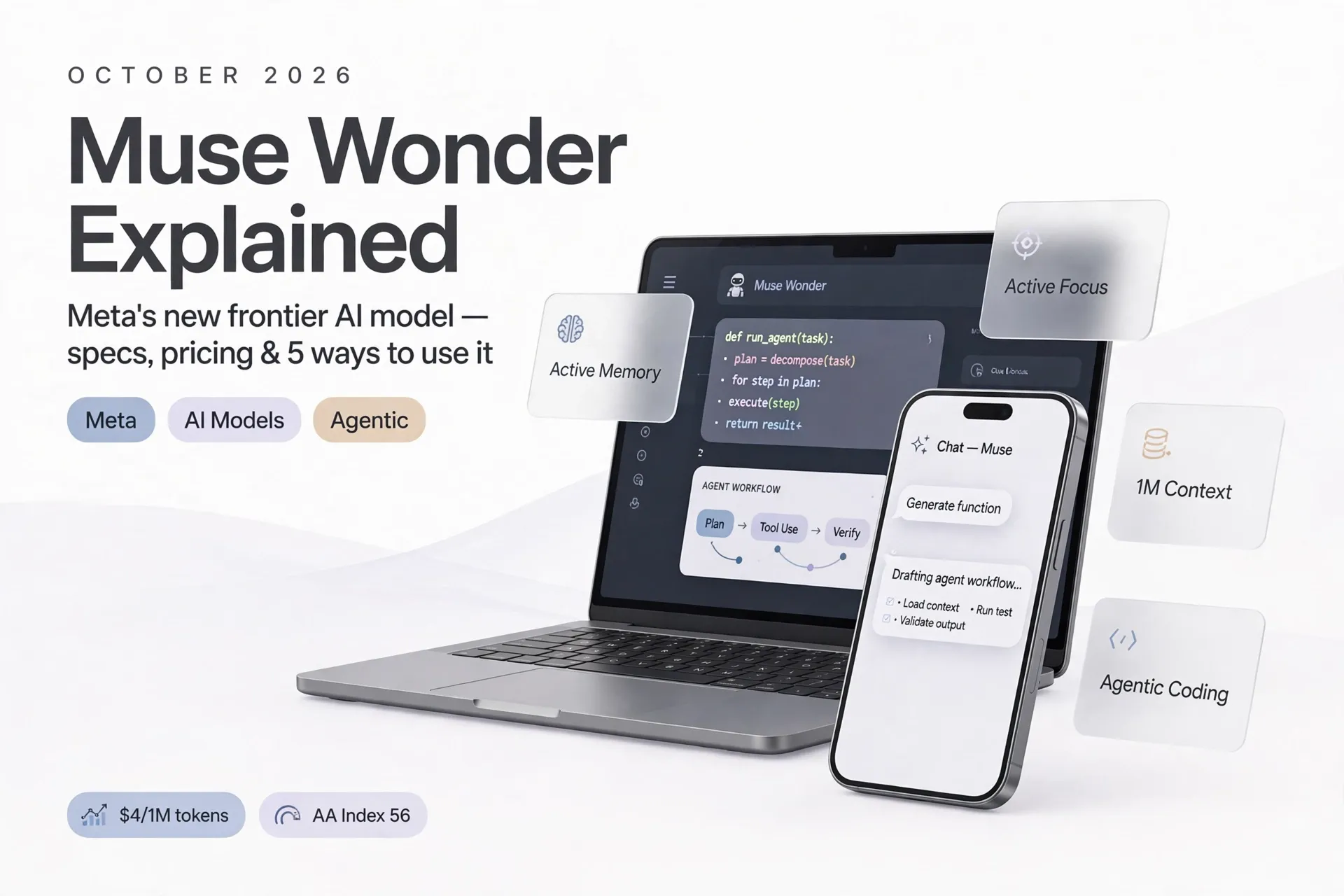
On Monday, October 12, 2026, Meta's Superintelligence Labs introduced the most capable models it has ever shipped: Muse Wonder and Muse Wonder Full. For a company that spent the last fourteen months rebuilding its AI stack from scratch, this is the moment the strategy meets the leaderboard — both models land near the top of the Artificial Analysis Intelligence Index, the independent benchmark suite that has become the industry's default scoreboard.
This guide breaks down what Meta actually shipped, what the two variants cost and where they differ, how to read the benchmark claims with appropriate skepticism — and five places you can already put Muse Wonder to work.
What Meta shipped
Muse Wonder and Muse Wonder Full are two distinct models, not two settings on the same model. Setting the reasoning effort to "max" on Muse Wonder does not turn it into Muse Wonder Full — the Full variant is a separately trained, larger system. Both were trained at Prometheus, Meta's gigawatt-scale data center, and Meta says they build on "larger, stronger base models" than the Muse Spark family that preceded them. Alexandr Wang, who leads Meta's AI effort, introduced them on social media as "our largest and most capable model yet."
The launch is the payoff of a rebuild Meta started about fourteen months ago, when it began reconstructing its AI stack from first principles. The company's stated direction is what it calls "personal superintelligence" — persistent, capable personal agents — and the Wonder pair is explicitly positioned as the next step on that ladder.
Two capabilities anchor the launch messaging. Active Memory is how the model carries important context about a user across conversations and retrieves the details relevant to the task at hand. Active Focus describes how it sustains effort toward a difficult goal — trying alternative approaches, working through blockers, and checking in before consequential actions. Both are properties of the training, not toggles you switch on.
The spec sheet
| Muse Wonder | Muse Wonder Full | |
|---|---|---|
| Released | October 12, 2026 | October 12, 2026 |
| API model ID | muse-wonder-1.0 | Not on the API |
| Where to use it | Meta Model API, all Muse Code plans, OpenRouter | Muse Code Power ($50/mo) and Maximum ($200/mo) only |
| API price / 1M tokens | $4 input, $0.20 cached, $20 output | Subscription only |
| Context window | 1,048,576 tokens | 1M tokens |
| Inputs → output | Text, image, video, audio, PDF → text | Text, image, video, audio → text |
| Reasoning effort | Six levels: minimal to max | Same family; run at max |
| Weights | Closed | Closed |
A few notes on the fine print. The $4/$20/$0.20 price card is identical to what Anthropic charges for Claude Opus 5.5 — Meta is pricing at the frontier, not undercutting it. One secondary source cautions the API figures are widely reported but not yet confirmed in Meta's own published pricing pages, so treat them as Meta's stated plan rather than independently verified fact. Neither model's weights are downloadable: like Claude, Muse Wonder is a closed model you access through Meta's channels.
The six reasoning-effort settings (minimal, low, medium, high, xhigh, max) let you trade thinking time against cost and latency, and the API speaks three familiar dialects — OpenAI Responses, OpenAI Chat Completions, and Anthropic Messages — so existing clients can switch models with minimal code changes.
Benchmarks: Meta's claims, read carefully
Everything below comes from Meta's own launch materials, reproduced and cross-checked by independent coverage. Treat these as the company's claims, not independent results — though there is one genuinely encouraging sign: Artificial Analysis's independent runs of its Intelligence Index v4.3, Terminal-Bench 4.0, and the Harvey legal benchmark reportedly match Meta's published figures exactly.
| Benchmark | Muse Wonder Full | Muse Wonder | Claude Opus 5.5 |
|---|---|---|---|
| AA Intelligence Index v4.3 | 56 | 52 | 58 (Meta's chart) |
| Terminal-Bench 4.0 | 57.1 | 52.0 | 59.6 |
| DeepSWE 1.1 | 79.0 | — | — |
| SWE-Marathon | 57.5 | — | — |
| ProgramBench | 59.0 | — | 70.5 |
| MemoryBench (Meta internal) | 85.5 | 85.6 | — |
The headline is real: Full at 56 and Wonder at 52 on the AA Index puts Meta's models in the frontier tier for the first time since the rebuild. The interesting columns are the agentic ones — DeepSWE, SWE-Marathon, MemoryBench — where the Wonder family leads, which is exactly the long-horizon agent work Meta is selling.
Read the table with four caveats. First, Meta's chart shows Opus 5.5 at 58 on the AA Index but omits Claude Sonnet 5.5 at 56 — on the full independent leaderboard, Wonder Full is third, not second. Second, the DeepSWE lead is only against the models in Meta's table; Google's Gemini 4 Argon reportedly scores 77.9% on the same test. Third, the SWE-Marathon figure was compared against scores from a public leaderboard rather than a controlled common harness, so treat cross-vendor deltas as directional. Fourth, "MemoryBench" is Meta's own internal, LLM-judged recall test — not the public academic benchmark of the same name, a confusion at least one major outlet fell into. And the honest weak row: on factual-knowledge tests like AA-Omniscience, Wonder Full scores around 30, well behind its rivals. This is a model built for sustained agent work and coding, not trivia.
Five ways to use Muse Wonder today
1. Muse Code: the developer entry point
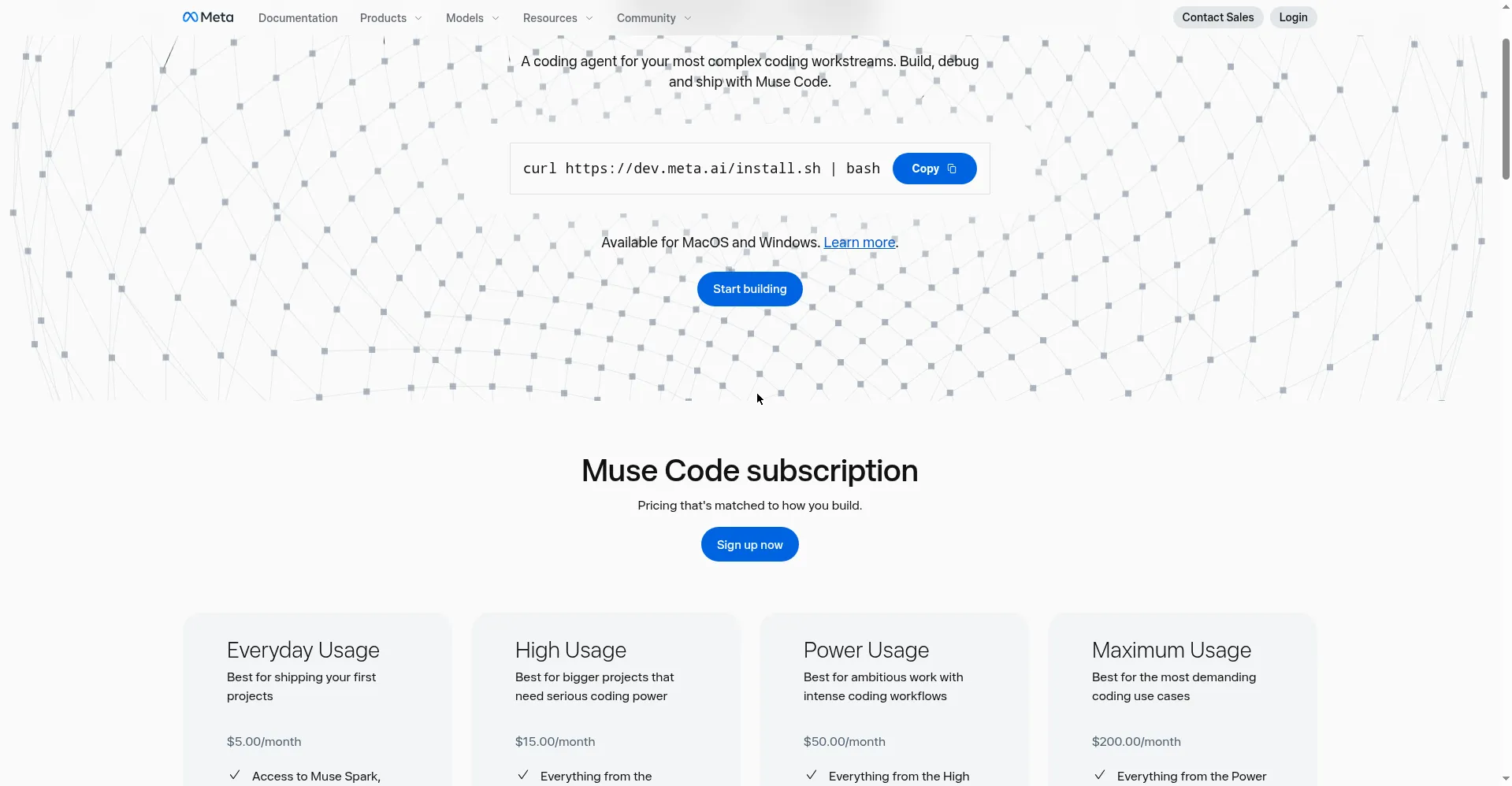
Muse Code is Meta's terminal-based coding agent, launched in beta in August 2026 and now the primary home of the Wonder models. Every subscription plan — Everyday ($5/month), High ($15/month), and Power ($50/month) — includes Muse Wonder, making the agent the most straightforward way for most developers to work with the model. Meta describes it as multi-agent by default: it plans changes, writes code, validates results across large repositories, keeps specialized background agents alive through a session, and records every action in an auditable local event log. If you already live in a terminal, this is the most natural way to meet the model.
2. Muse Code Power and Maximum: the only way to run Wonder Full
The stronger variant is deliberately gated. Muse Wonder Full has no public API — it is available only inside Muse Code on the Power ($50/month) and Maximum ($200/month) plans. If the benchmark rows that matter to you are the ones where Full leads (DeepSWE, SWE-Marathon, MemoryBench), the subscription is currently the only door.
3. Meta Model API: build with it directly
For developers, the official route is the Meta Model API with model ID muse-wonder-1.0, currently in self-serve preview. The practical advantage is compatibility: the API accepts OpenAI Responses, OpenAI Chat Completions, and Anthropic Messages formats, so switching an existing agent or application from another frontier model is mostly a matter of changing the model string. Set the reasoning effort to match the workload — minimal for quick calls, max for long agentic runs.
4. OpenRouter: try it without a Meta account
OpenRouter lists the model as meta/muse-wonder (endpoint meta/muse-wonder-20261012), served by Meta itself at the same $4 input / $20 output / $0.20 cached per-million-token rates. For anyone who already routes through OpenRouter, this is the fastest way to benchmark Wonder against the rest of the frontier class in one playground — same prompts, same harness, no new account.
5. Meta Muse app: coming to subscribers first
Meta says the Wonder models "will soon power experiences inside Muse," rolling out to subscribers first, with artifact generation and higher-intelligence processes named as the first use cases. No free-tier date has been given. If you are a Muse subscriber, this is the one to watch rather than the one to use today.
Strengths and limits
Where it shines. Frontier-tier scores on long-horizon coding and agent benchmarks, a genuine 1M-token context window, broad multimodal input, and API formats that make migration cheap. For teams already building agents on OpenAI- or Anthropic-shaped APIs, Wonder is a credible new option at the same price as Opus 5.5.
Where to be careful. The price card tripled versus the previous Muse Spark 1.3 generation ($4/$20 against $1.25/$4.25; Artificial Analysis measures $4.52 average cost per task against $1.60 before). Wonder Full — the version behind most of the winning benchmark rows — is locked behind $50 and $200 subscriptions with no API. Weights are closed. Factual knowledge lags rivals. And the benchmark story, while partly corroborated by independent runs, still leans on Meta's own tables with the caveats listed above.
One more practical caution: a model trained to never give up will also keep trying things you might not want it to try. Meta's own model card recommends asking for human confirmation before any action that cannot be undone — follow that advice, especially in agentic coding sessions.
How to start
- Developers: get a key from the Meta Model API (self-serve preview), call
muse-wonder-1.0from your existing OpenAI-compatible client, and start with themediumeffort setting. - Terminal coders: install Muse Code with
curl https://dev.meta.ai/install.sh | bash, pick the Everyday or High plan, and let the agent route to Muse Wonder. - Comparers: open
meta/muse-wonderon OpenRouter next to your current frontier pick and run the same prompts. - Muse subscribers: keep an eye on the app — the Wonder rollout lands there first.
Bottom line
Muse Wonder is Meta's first model that belongs in the frontier conversation on independent numbers — with the emphasis on long-horizon agent work and coding, and with a pricing and access strategy aimed squarely at Claude Opus 5.5. The benchmark claims deserve the usual careful reading, Wonder Full's best scores sit behind a $50 paywall, and the consumer rollout is still pending. But for developers, the model is available today through three working doors — Muse Code, the Meta Model API, and OpenRouter — which is more than most frontier launches manage on day one.
References
- Kie.ai — "What Is Muse Wonder? Meta's Frontier Agent Model": https://kie.ai/blog/what-is-muse-wonder
- O-Mega — "Meta Muse Wonder: Benchmarks, Pricing and Access (2026)": https://o-mega.ai/articles/meta-muse-wonder-benchmarks-price-and-access-2026
- Complete AI Training — "Meta unveils Muse Wonder series for personal and professional AI agents": https://completeaitraining.com/news/meta-unveils-muse-wonder-series-for-personal-and/
- CellCog — "Muse Wonder: Meta's Frontier Model, Price and Benchmarks": https://cellcog.ai/blog/muse-wonder/
- Michael Leung — "Meta Muse Wonder vs Claude Opus 5.5: Is It Really Better?": https://www.michaelleung.info/latest-news/meta-muse-wonder-vs-claude-opus-5-5
- Oossa — "Meta launches Muse Wonder models, hitting top AI benchmark scores": https://oossa.com/en/meta-launches-muse-wonder-models-hitting-top-ai-benchmark-scores
- dev.to — "Meta Muse Wonder: Benchmarks, Pricing, API, and How to Use It": http://dev.to/agent-one/meta-muse-wonder-benchmarks-pricing-api-and-how-to-use-it-4jhh
- Meta — Muse Code product page: https://developer.meta.com/ai/products/muse-code/