
OpusClip vs SupoClip vs PeakCut: Which AI Clipper Deserves Your Footage?

Every podcast, stream and interview is hours of raw footage, and every platform wants it cut into vertical clips. That gap built a small industry of AI clippers, and this month three of them tell the whole story at once: the polished incumbent, the self-hosted challenger with a licence twist, and a newcomer that is two products sharing one name.
OpusClip is the tool most creators already know. SupoClip is the open-source alternative that changed its licence on November 19. PeakCut is the new arrival betting on game streams and the GTA VI launch window, with its desktop app due out on November 27. All three promise the same thing — paste a long video, get a week of Shorts — but they charge, licence and clip it very differently. We compared them on pricing, feature gates and licensing, using each company's own pages as of November 24, 2026; no independent benchmark of clip quality exists and we ran no head-to-head tests.
Scope and method: what we compared, and what we did not test
We checked three things per tool: the cost of a realistic monthly workload, what the plan gates block, and what the licence allows. Prices come from each company's own pricing page and star counts from GitHub, both read on November 24, 2026. The demand backdrop is Content Rewards, whose own count put the median listed rate at about $1.09 per 1,000 views across 707 live campaigns on November 10, 2026.
Nobody has published an independent test of which picks better moments or renders better captions, so virality scores and "10x faster" slogans stay labelled as vendor claims. If clip quality decides it for you, run the same footage through each tool yourself.
The three contenders at a glance
| OpusClip | SupoClip | PeakCut (hosted) | |
|---|---|---|---|
| Starting point | Free plan, $0 | Self-host free; hosted from $9.99/mo | Basic Access $25 once; Desktop Free $0 |
| How you pay | 1 credit = 1 minute of source video | Hours of source video per month | Clipping minutes per month |
| Free tier | 60 credits/mo, watermark, 9:16 only | Self-host only; no free hosted plan | Desktop Free: clipper only, watermarked |
| Watermark | Free plan only | Never, on any plan | Gone from Creator up |
| Licence | Proprietary | Source-available, noncommercial | Proprietary; open-source twin is MIT |
| Posting | Scheduler from Pro | Shorts and TikTok; scheduling on Creator | Shorts, TikTok, Reels and X |
| Best for | Teams and a production pipeline | Self-hosters and budget creators | Early adopters and game streamers |
OpusClip: the incumbent that grew into an editor
OpusClip, founded in 2022 in Mountain View, is the reference point the other two are measured against. Its ClipAnything engine reads visual, audio, text and sentiment cues, or follows a plain-language prompt, to find moments worth posting, then scores each clip, adds animated captions and reframes to vertical. Version 4.0, released on November 2, 2026, adds editing for whole raw takes: timeline editing, AI B-roll, voice-over, dubbing and eye-contact correction.
Pricing is built on credits: one credit covers one minute of source video processed, so cost depends on the footage you feed in, not on how many clips you keep. Free gives 60 credits a month with a watermark, 9:16 only, and exports that stop working after three days. Starter, $15 a month, gives 150 credits, removes the watermark and posts directly to Shorts, TikTok and Reels. Pro, $29 a month or $174 a year, gives 300 credits per pack, a scheduler, 1:1 and 16:9 reframing, two seats, 100GB and XML export to Premiere Pro and DaVinci Resolve. A Max plan, $129 a month for 1,500 credits, is sold through Agent Opus, the company's video generator, and its credits also work in OpusClip.

SupoClip: the self-hosted challenger with a new licence
SupoClip does the same core job — transcribe, pick the moments that stand on their own, score them, reframe to 9:16 and add captions — but its pitch is ownership. Run it on your own machine with Docker, bring your own transcription and language-model keys, and pay nothing for the software. Hosted starts at $9.99 a month for 10 hours of source video; Creator, $24.99 a month, raises that to 25 hours and adds 1080p clips and scheduling. There is no free hosted plan, and clips never carry a watermark, on any plan.
Every clip opens in a built-in studio: trim on a timeline, fix a misheard word, restyle captions and export per-platform presets. Publishing to YouTube Shorts and TikTok is live, Instagram is coming soon, and Creator adds scheduling. It supports 99+ languages, has an iPhone app, and ships an MCP server.
Then the licence, the part most coverage has not caught up with. On November 19, 2026, the project switched from AGPL-3.0 to its own SupoClip Noncommercial Source License v1.1, licensor Shiori LLC. Self-hosting is free for noncommercial use and for individual creators clipping for their own monetised channels; companies, agencies, client work and paid hosting need prior written permission. The GitHub repository now shows 4,133 stars and lists its licence field as "Other". Earlier releases keep the licence they shipped under, but the current code does not.

PeakCut: two products, one name
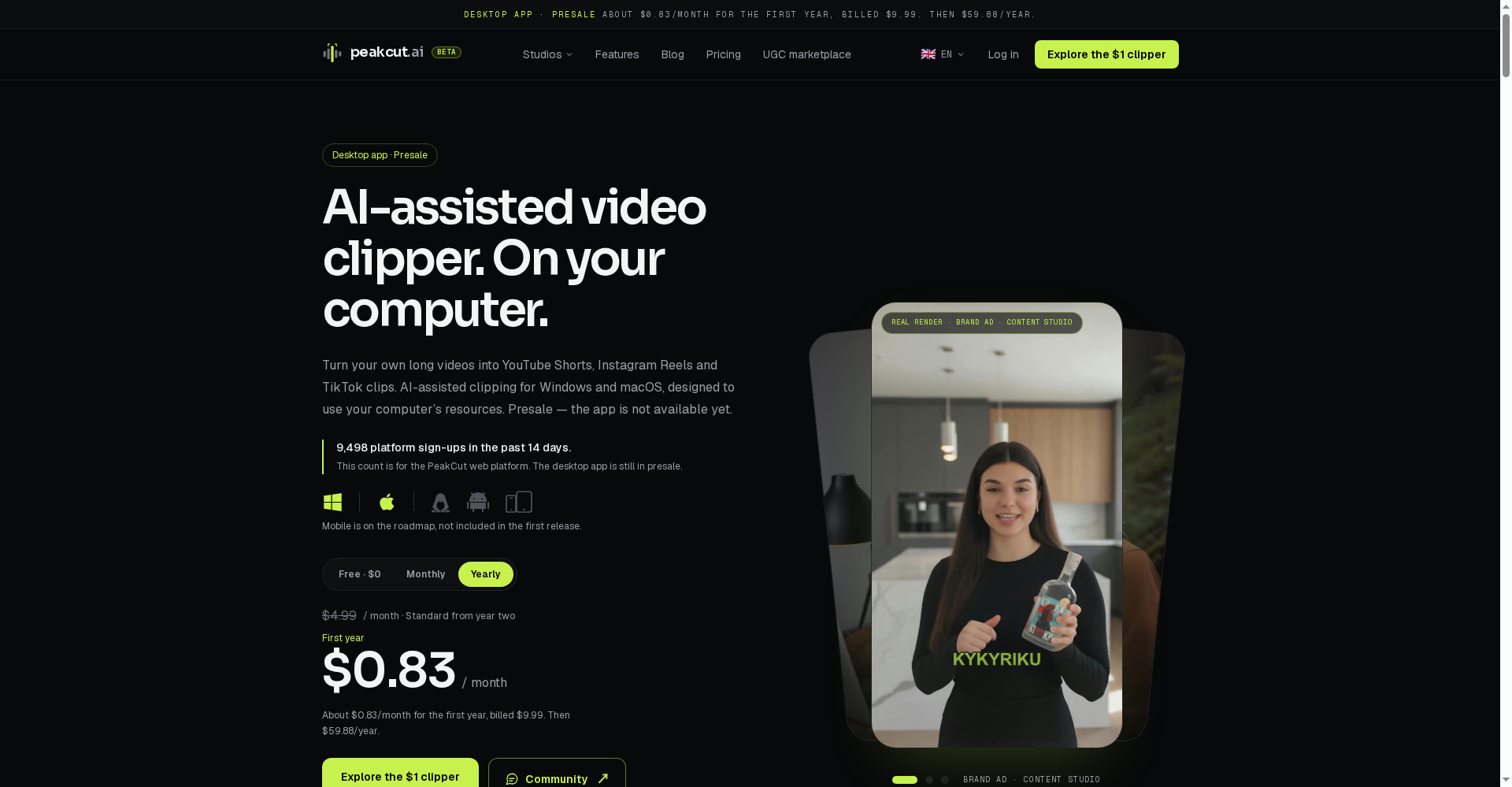
PeakCut is the newcomer, and the first thing to get straight is that the name covers two products. The hosted platform is in public beta, with about 9,500 sign-ups in two weeks, and its desktop app is in presale with an estimated first release of November 27, 2026. The site warns the date may change, some beta features are paused, and the $25 presale payment is non-refundable. The open-source PeakCut on GitHub is a separate MIT-licensed project, created November 14, 2026, with over 1,800 stars: a self-hosted clipper that runs with your own AI key, or with no key at all, picking clips by loudness.
The hosted product's idea is that generic clippers only listen. PeakCut scores four signals together — chat spikes, audio energy, on-screen game events and the transcript — and its detectors are tuned for GTA VI from week one. Beyond clipping it runs a content studio: AI presenters, faceless story videos, voice cloning and scheduled publishing.
Hosted pricing is the most complicated of the three. Basic Access costs $25 once and includes 120 clipping minutes a month. Creator is $29 a month for 10 hours of clipping, $20 of generation credit and one voice clone; Pro is $79 a month and Studio $199 a month. Desktop Basic, a separate app subscription, is $1 a month or $9.99 for the first year, and Desktop Free costs $0 for the clipper only. The open-source twin costs nothing but your own API key, and it can clip a live stream while it is still running.
Official claims vs independent checks
| Claim | Whose words | What we could verify |
|---|---|---|
| OpusClip 4.0 edits whole raw takes | OpusClip | Announced Nov 2, 2026; pricing page matches |
| Virality Score predicts performance | OpusClip | Vendor claim; no independent validation |
| SupoClip is free to self-host | SupoClip | Licence text verified |
| PeakCut has about 9,500 sign-ups | PeakCut | Vendor counter, November 24, 2026 |
| Clipping pays about $1.09 per 1,000 views | Content Rewards | Vendor's own count, November 10, 2026 |
| One clipper picks better moments | Nobody | No head-to-head quality test exists yet |
Price, plan limits and licences are checkable; quality is a claim.
Pricing math: what 300 source minutes a month really costs
Take a creator feeding in 300 minutes of source video a month at list price.
OpusClip Pro at $29 a month covers exactly 300 credits, or 300 source minutes; yearly billing cuts that to $14.50 a month. Starter at $15 covers only half the workload.
SupoClip hosted Pro at $9.99 a month covers 10 hours, so 300 minutes uses half the allowance, at an effective $0.017 per source minute against OpusClip Pro's $0.097. Creator at $24.99 covers 25 hours. Self-hosted, the software is free; only your own API keys cost money.
PeakCut Creator at $29 a month covers 10 hours, but the $25 one-time Basic Access only includes 120 minutes a month, so it cannot carry this workload alone. Desktop Basic at $0.83 a month for the first year is only the app licence: AI selection still bills to your own API key.
So SupoClip is the cheapest hosted route at this volume by a wide margin, OpusClip the most expensive per minute, and PeakCut sits between them. Self-hosting either open option beats all three on price and loses on convenience.
Verdict: who should pick which
Pick OpusClip if you run a pipeline. The scheduler, the NLE export, the API and the team seats are things the other two cannot match yet, and version 4.0 makes it a plausible editor for whole takes. You pay the highest per-minute rate here, and the free plan's three-day export window is a trap for casual users.
Pick SupoClip if you want the cheapest route or you want to own the tool. Self-hosted it costs nothing but API keys and never watermarks a clip; hosted, its $9.99 plan undercuts both rivals per minute. Read the licence first: since November 19, agencies, client work and paid hosting need written permission from Shiori LLC.
Pick PeakCut if you are an early adopter betting on the newcomer, especially if you stream games. Its four-signal detection and GTA VI tuning are a genuine difference, not a rebrand, and the open-source twin is usable today. But the hosted app launches on November 27 as a public beta, and the $25 presale payment does not come back. If you need a tool this week, the open-source version is the only PeakCut you can run.
None of the three has proven it picks better moments than the others. Until someone tests that, choose on price, licence and workflow.
Sources
- OpusClip pricing — opus․pro
- SupoClip official site — supoclip․com
- PeakCut official site — peakcut․ai
- Content Rewards — contentrewards․com
- GitHub — github․com