Open-source agentic workbench for scientists — an IDE with papers, code, notebooks, and 3D viewers where an AI agent plans and runs research experiments.
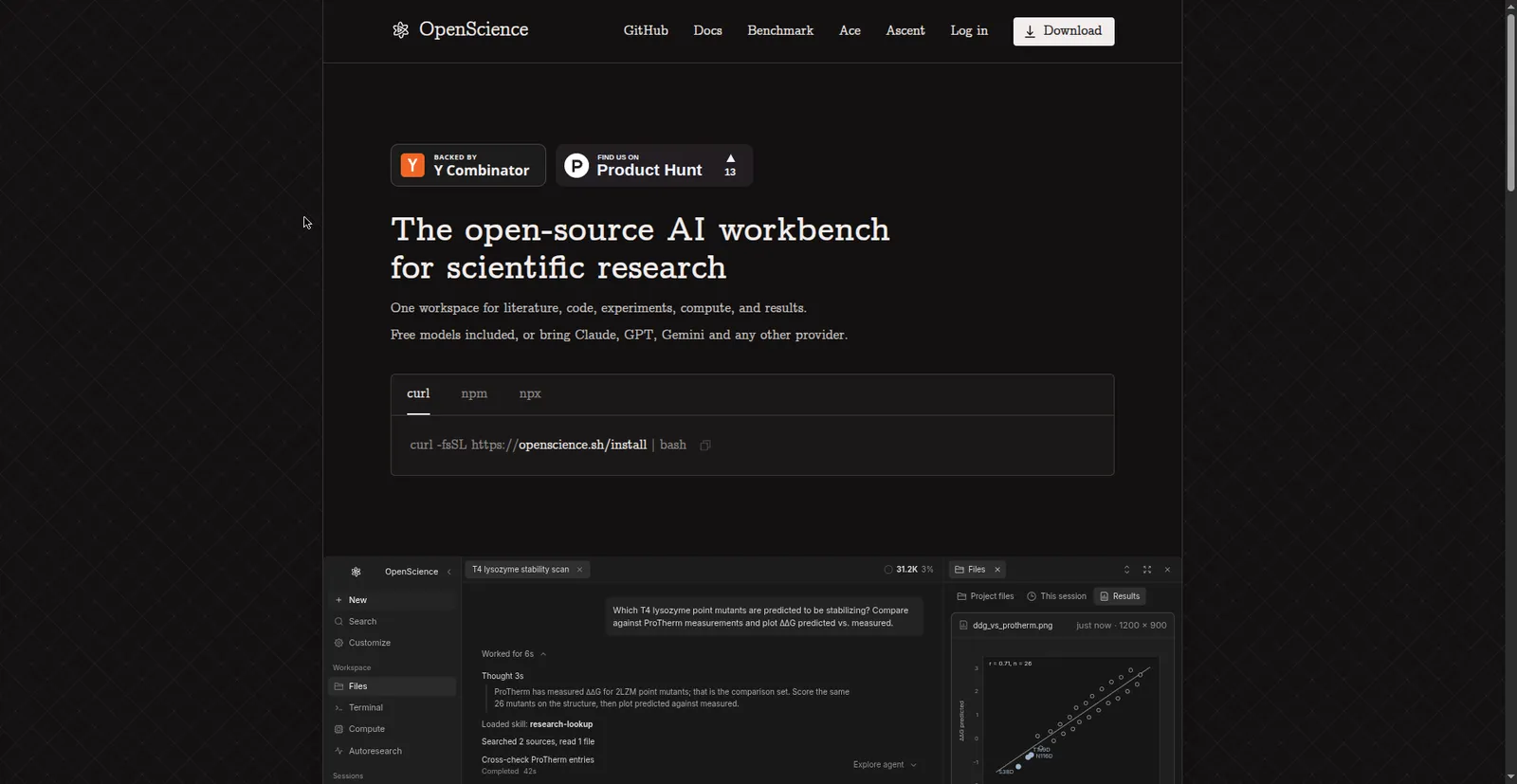
OpenScience homepage hero
Overview
What is OpenScience?
The open-source AI workbench for scientific research
OpenScience is an open-source (Apache-2.0) agentic workbench for scientific research. It combines a full IDE — papers, code, notebooks, a LaTeX editor, a terminal, and 3D protein and genomics viewers — with an AI agent that plans, executes, and logs every research step.
It is model-agnostic: free models are included, or bring your own API keys, sign in with ChatGPT/Codex, run a local model (Ollama/LM Studio), or use OpenScience Ace — 30+ frontier models (GPT-6 Astra, Claude Opus 5.5, Kimi K3, GLM-5.3) through one pay-as-you-go wallet. 300+ bundled research skills and 50+ scientific databases and tools (UniProt, PDB, ChEMBL, PubChem, arXiv) serve as agent tools, with NVIDIA BioNeMo support for BYOK adapters. The Autoresearch feature runs experiment loops — give it a metric and it hill-climbs until results improve — on Modal GPUs, your own servers, or Slurm/PBS clusters, fully logged and reproducible.
The workbench is free and open source; Ace credits are pay-as-you-go (e.g. ~$2/1M input, $10/1M output) with no subscription. PH launch offer: $5 in free Ace credit for .edu signups. It ranks #1 on agentic scientific research benchmarks (Terminal Bench Science, BiomniBench) per the maker. Docs: openscience.sh/docs. FAQ: openscience.sh/docs/#/openscience/faq.
Platforms and languages
OpenScience Availability
Platforms
Languages
Capabilities
OpenScience Key Features
Scientific research IDE
Papers, code, notebooks, LaTeX editor, terminal, and 3D protein/genomics viewers next to an AI agent that plans, executes, and logs every step.
Model-agnostic
Free models included, BYO API keys, ChatGPT/Codex sign-in, local models, or Ace: 30+ frontier models via one pay-as-you-go wallet.
Autoresearch experiment loops
Give it a metric and it runs experiments until results improve — on Modal GPUs, your own servers, or Slurm/PBS clusters, fully reproducible.
300+ skills, 50+ databases
300+ research skills plus UniProt, PDB, ChEMBL, PubChem, arXiv and 50+ more scientific databases and tools as agent tools.
NVIDIA BioNeMo support
BYOK adapters for BioNeMo NIM endpoints (Boltz-2, DiffDock, OpenFold, RFdiffusion).
Best for
Who uses OpenScience?
Computational researchers in ML, biology, chemistry, physics, and data science
Run agentic research workflows with papers, code, and experiment logging in one workspace
Universities and labs
Run autonomous experiment loops on institutional clusters (30+ used the beta)
Plans and access
OpenScience Pricing
Freemium
Workbench free & open source; Ace credits pay-as-you-go (~$2/$10 per 1M tokens). $5 free credit for .edu signups.
Common questions
OpenScience FAQs
Is OpenScience free?
Yes — the workbench itself is free and open source (Apache-2.0). You only pay for model usage and compute via the Ace wallet.
Is Ace a subscription?
No — Ace is a pay-as-you-go wallet, not a subscription. Activation is $0 with optional $20 auto-reload below $5.
Which models can I use?
Free models are included, or bring your own API keys, sign in with ChatGPT/Codex, or run a local model via Ollama/LM Studio.
How does Autoresearch work?
Autoresearch runs experiment loops: give it a metric and it executes experiments, logs each one, and keeps hill-climbing until the metric improves — on Modal GPUs, your own servers, or Slurm/PBS clusters.
Can I trust its citations?
Treat agent outputs as drafts and verify citations — the FAQ advises verifying anything you publish or submit.
Reviews
See what the community thinks and share your experience.
—
Based on 0 ratings
Rating distribution
Community reviews
No reviews
No written reviews yet.