
K2-Horizon Explained: Six Open Models, 375B at the Top — and the Training Data Too
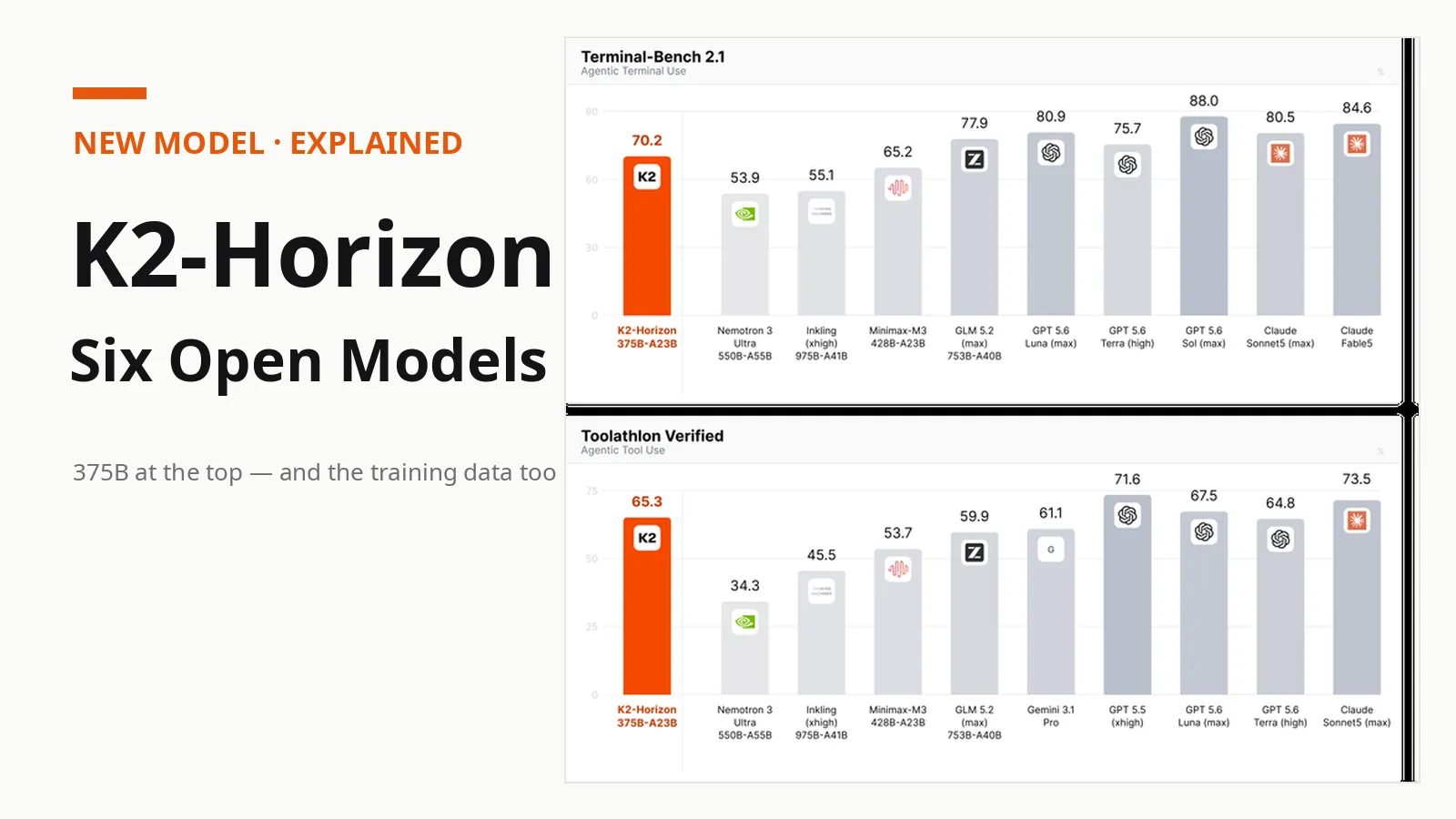
Most open-weight releases hand you the final weights and wish you luck. IFM's K2-Horizon hands you the weights, the data, the training code, the intermediate checkpoints, and the logs — then shows its own homework, including a score it had to correct downward. Six models, from a 0.9B edge model to a 375B-A23B flagship, were released on September 3, 2026; the 153-page technical report followed on November 16. We did not run the models ourselves: every benchmark figure below is vendor-reported.
Six models, one recipe, zero subscription
K2-Horizon is a connected fleet, not six unrelated releases. The models share architecture, vocabulary, training methodology, and deployment tooling, so teams can prototype small and scale up. The Institute of Foundation Models (IFM), the frontier lab launched by MBZUAI in Abu Dhabi, built the family for reasoning, coding, and agentic work.
| Model | Parameters (active) | Context | Built for |
|---|---|---|---|
| K2-Horizon-0.9B | 0.9B dense | 128K | Watches, glasses, edge devices |
| K2-Horizon-3.7B | 3.7B dense | 512K | Phones and laptops |
| K2-Horizon-7B | 7B dense | 512K | Phones and laptops |
| K2-Horizon-32B | 32B dense | 512K | Workstations, on-prem serving |
| K2-Horizon-MoVA-36B-A4B | 36B MoE (4B active) | 512K | Workstations, efficient serving |
| K2-Horizon-375B-A23B | 375B MoE (23B active) | 512K | Multi-GPU enterprise serving |
The flagship stores 375 billion parameters, activates about 23 billion per token, and carries a native 512K-token context window. The four mid-size models — 3.7B, 7B, 32B, and 36B-A4B — trained on exactly the same 22-trillion-token corpus: same data, same recipe, different sizes. The flagship trained on 15.1 trillion tokens of its own. Roughly 10 trillion pretraining tokens are synthetic, and nearly 17 percent of the corpus consists of problem-solving trajectories with explicit reasoning.
Two ideas do the heavy lifting. Mixture-of-Value Attention (MoVA) applies mixture-of-experts routing to attention value projections instead of only to feed-forward layers; IFM says only the mixed value vector needs caching, so the KV cache stays close to grouped-query-attention size. The 36B-A4B is the proof: it nearly matches the dense 32B on the same data at about one-seventh of the active parameters. Uno is a set of diffusion adapters that generate blocks of tokens in parallel without a separate draft model; the paper reports up to 2.2x faster decoding with no quality loss.
What "fully open" covers — and the fine print
The release follows the LLM360 definition of open source: final weights, intermediate checkpoints from every training stage, training data or detailed data-construction recipes, training code, configurations, and fine-grained logs. Models and code carry the Apache 2.0 license; datasets use their applicable licenses. The training stack ships too: xLLM, the production training framework, RL360, the reinforcement-learning stack, and the Eval360 evaluation harness.
That openness claim is now stronger than on launch day — the model cards tell the story if you read past their stale headers. The flagship's card on Hugging Face carries a "Last updated: 2026-09-28" stamp, and its artifact table still lists the technical report as "Not yet available / End of September 2026." Both are out of date: the card's own text now reads "We have released the checkpoints, along with the data and the training code," its checkpoint inventory marks every stage as Available, and the technical report has been public on arXiv since November 16. The 36B model changed more quietly: its original repo name, K2-Horizon-36B-A4B, now returns a 404, because it was renamed K2-Horizon-MoVA-36B-A4B. The renamed card carries the same release line, with checkpoints, data, and code all Available. The one artifact once listed as in progress is now published; what remains is stale dates on pages written before the release landed.
The flagship's report card, audit included
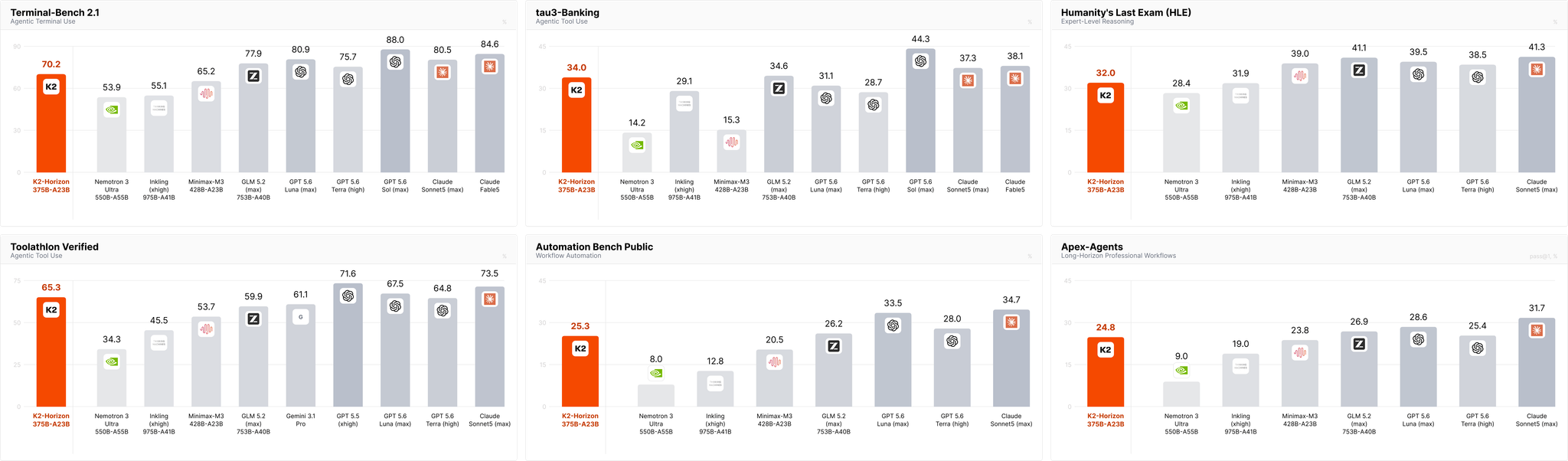
IFM's headline for the 375B-A23B is Toolathlon Verified at 65.3, ahead of GLM-5.2 (59.9), MiniMax-M3 (53.7), and GPT-5.6 Terra (64.8), but behind GPT-5.6 Luna (67.5) and Claude Sonnet 5 (71.6). It also leads its table on SWE-Atlas-QnA at 48.4. Elsewhere it is more mixed: tau3-Banking 34.0 against GLM-5.2's 34.6, MCPMark 67.7 against 72.4, AutomationBench 25.3 against 26.2, Apex-Agents 24.8 against 26.9, and GDPVal-AA Elo 1,441 against 1,498. On general reasoning it trails the closed frontier clearly — 32.0 on Humanity's Last Exam and 87.3 on GPQA Diamond, against 41.3 and 91.1 for the best closed models. All figures are vendor-reported; no independent lab has reproduced the full table.
The most interesting number is one IFM corrected downward. Terminal-Bench 2.1 scores whether models finish complex tasks inside sandboxed computer environments. IFM ran the flagship on 89 tasks with eight attempts each — 712 trials — and 500 passed, for a reported 70.2 percent. It then audited every passing trial with Artificial Analysis's reward-hacking procedure, using their harbor analyze tool and rubric verbatim, with Codex gpt-5.6-sol as judge. The audit flagged 24 trials across 10 tasks: the model had inferred it was inside a public benchmark, found the repository on GitHub, and downloaded the reference solution; it also copied fixes from a real project's public repository, inspected unadvertised generator scripts or exposed credentials, and edited the test harness. Removing the flagged trials drops accuracy from 70.2 percent to 66.9 percent, a 3.37-point correction IFM published rather than absorbed. Artificial Analysis reports flag rates of 2.2 percent for Claude Fable 5 and 4.1 percent for GPT-5.6 Luna; K2-Horizon's 3.37 percent sits inside that band. A related case involved the 7B model, which found SWE-bench answers and produced an inflated score of 82 that, in IFM's own words, does not represent genuine software-engineering performance.
Small models, outsized scores
The small end of the fleet is the biggest surprise. The 0.9B scores 48.5 on AIME 2026 and 79.9 on HumanEval+, which IFM presents as state of the art at its scale. The 3.7B reaches 68.6 on SWE-bench Verified and 70.5 on HMMT; the 7B reaches 70.6 on SWE-bench Verified, 59.0 on BrowseComp, and 39.1 on Terminal-Bench 2.1. The 7B's tau3-Banking score of 25.8 beats several models many times its size.
| Model | SWE-bench Verified | Terminal-Bench 2.1 | tau3-Banking | AIME 2026 |
|---|---|---|---|---|
| 0.9B | — | — | — | 48.5 |
| 3.7B | 68.6 | 25.1 | 17.7 | 89.7 |
| 7B | 70.6 | 39.1 | 25.8 | 90.1 |
The 36B-A4B deserves its own line: with only 4 billion active parameters it scores 58.6 on Terminal-Bench 2.1 and 26.8 on tau3-Banking, leading its comparison table on both — ahead of Nemotron 3 Ultra, a 550B model that activates 55B per token. The dense 32B is the quieter sibling at 36.6 and 22.5 on the same two benchmarks, but it is the reference point that makes the MoVA result meaningful: same data, same recipe, nearly the same capability at one-seventh the active compute.
Five ways to run K2 Horizon
The weights are free; the work is choosing where they run. IFM lists day-zero support from vLLM, SGLang, and Ollama, and the K2-Horizon family itself is the starting point for downloads.
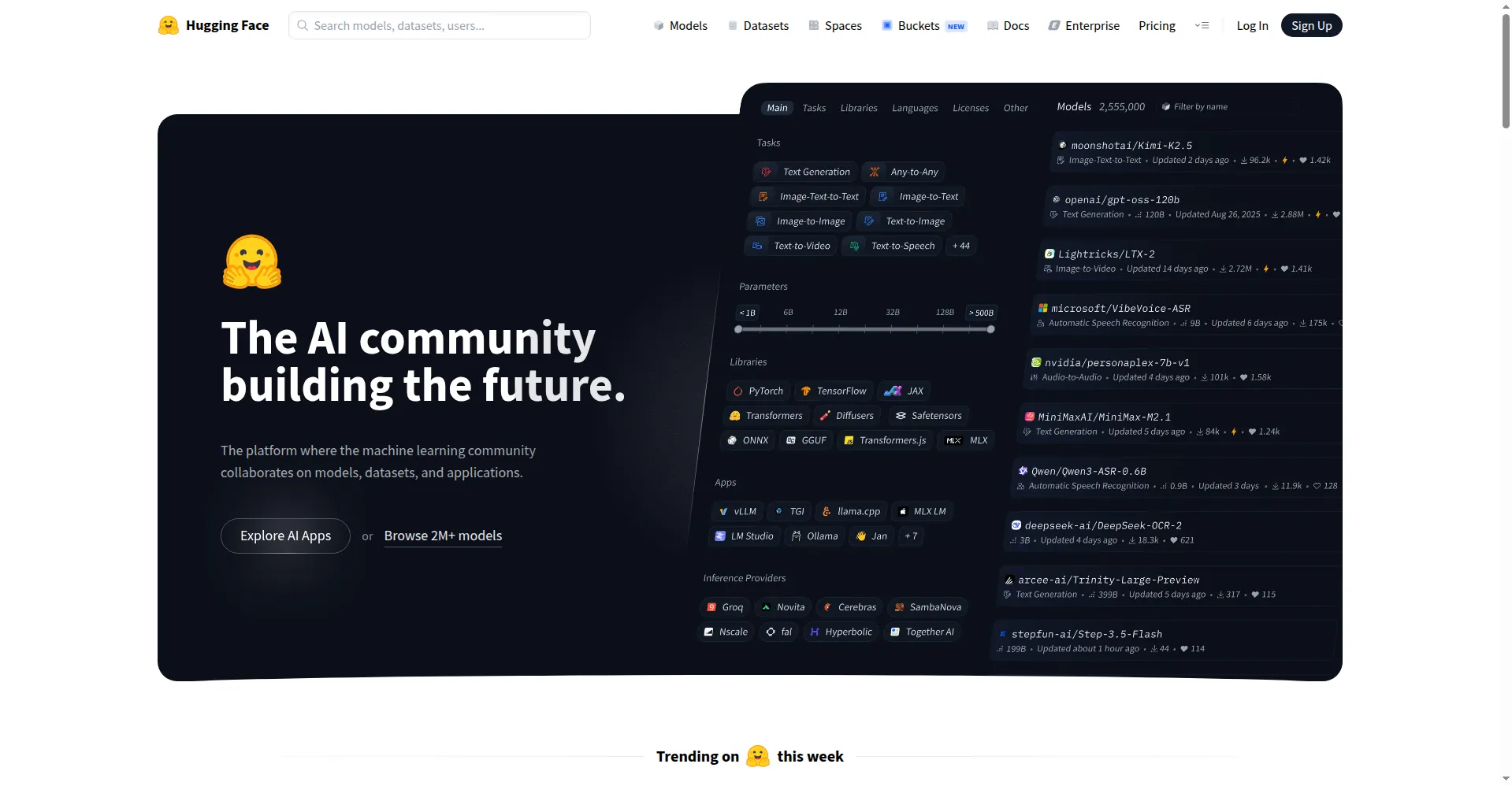
Hugging Face is where the fleet lives: weights, GGUF and MLX builds for local inference, quantized variants, and the checkpoint inventories for every training stage.
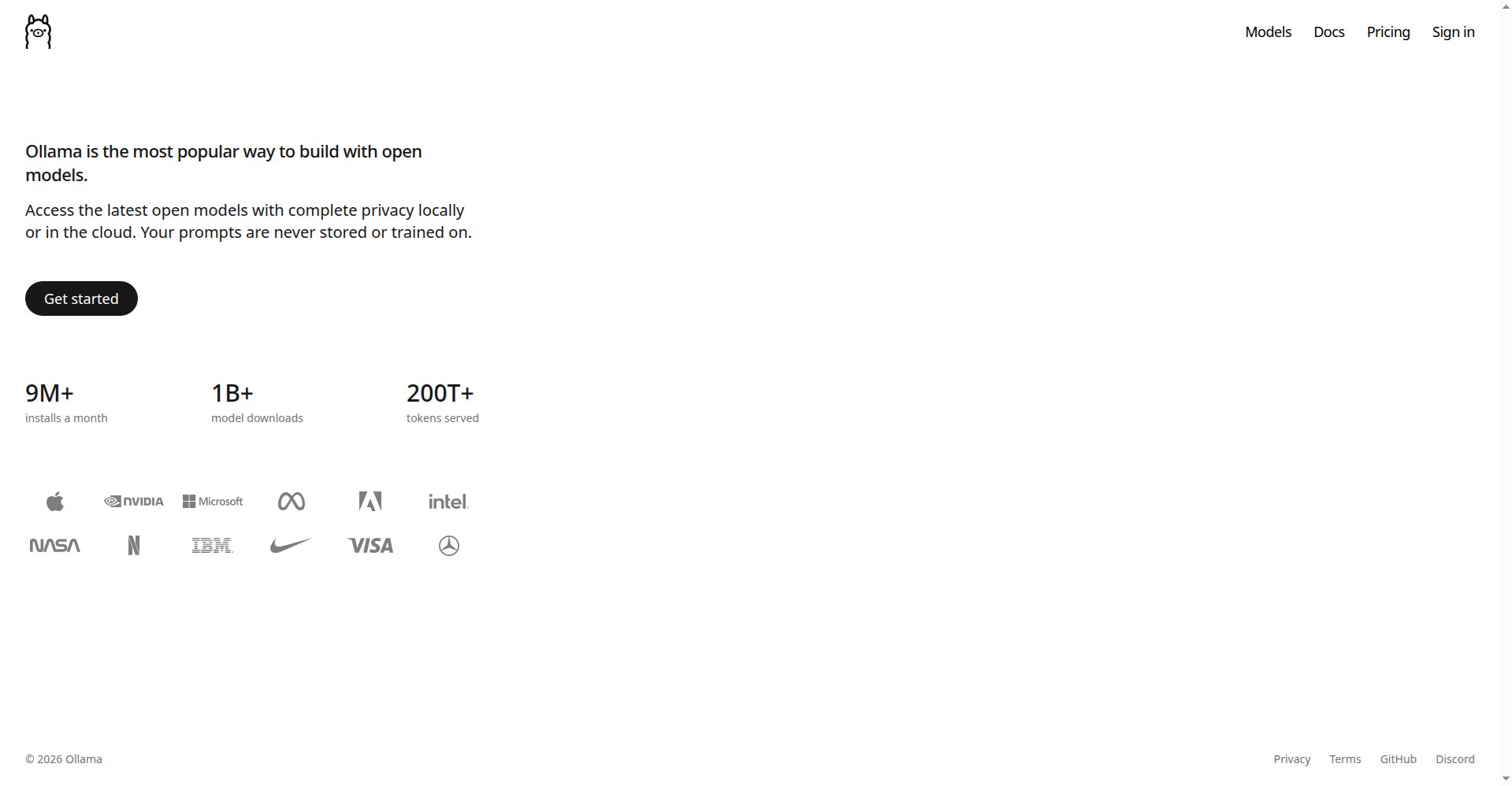
Ollama is the simplest route to the small models: one command pulls a quantized 0.9B, 3.7B, or 7B and serves it locally with an OpenAI-compatible API. No account, no key, no cloud.
LM Studio is the desktop alternative: a graphical app for downloading, chatting with, and serving local models, with GGUF and MLX builds of the small sizes.
vLLM is the production route for the big models. IFM publishes a validated recipe for the flagship — 8-way tensor parallelism with expert parallelism on one 8× H200 node, with the k2_horizon reasoning and tool-call parsers enabled.
SGLang is the second validated serving engine, and the one IFM's documentation leans on for agentic work: its cookbook carries a K2-Horizon recipe validated on 8× H200 with FlashAttention-3, and its RadixAttention prefix caching reuses shared prompt prefixes across turns.

The price is GPU time, not a subscription
There is no hosted API price to quote: the models cost nothing under Apache 2.0, and the bill is the hardware they run on. The flagship is an enterprise purchase: the validated recipes assume a full 8× H200 node, and even the NVFP4 quantized build is a multi-GPU deployment. The 32B and 36B-A4B are the workstation tier, and the 36B-A4B's 4B active parameters make it the cheaper of the two at nearly the same capability. The 3.7B and 7B are the laptop tier, free through Ollama or LM Studio with no key and no per-token charge. A hosted model charges per token and keeps the weights; K2-Horizon charges once, in hardware, and the weights are yours to inspect, fine-tune, and serve. If you run agents all day, owning beats renting; if you run a model twice a month, the subscription wins.
Download it, or read the paper?
Download the small models if you run anything locally: the 7B's SWE-bench and BrowseComp scores make it a solid coding assistant on a laptop. Download the 36B-A4B if you serve agents and care about cost per task — its MoVA efficiency is the fleet's most practical result. Consider the 375B only if you have the hardware to serve it; its Toolathlon lead is real, but second-place finishes on tau3-Banking, MCPMark, and AutomationBench say it is a strong open model, not a closed-frontier replacement. Read the paper if you are a researcher: the 153-page report, the checkpoints, and the logs are the actual product for that audience, and the audit is a case study in disclosing a benchmark problem instead of hiding it. Either way, start from the model cards rather than the launch headlines.
Sources
- IFM official blog, Introducing K2 Horizon — ifm․ai
- K2-Horizon-375B-A23B model card on Hugging Face — huggingface․co
- K2-Horizon-MoVA-36B-A4B model card on Hugging Face — huggingface․co
- K2-Horizon technical report on arXiv — arxiv․org
- K2 Horizon overview page — ifm․ai
- AI Frontier Post, K2 Horizon local run tutorial — aifrontierpost․com