
Qwen4-Max vs Kimi K3.1 Pro: Alibaba's New Flagship Is Cheaper per Task, but Kimi Still Scores Higher
Alibaba's new flagship arrived on November 16, and it walked straight into a comparison Moonshot would rather avoid. Qwen4-Max is cheaper than Kimi K3.1 Pro on every price that matters — per token, per cached token, and per benchmark task — yet the independent scoreboard still puts Kimi ahead. That tension is the whole story: this is not a coronation for either model, but a genuine trade-off between cost and capability, and between an API you rent and weights you can own.
The two models are closer in design than their makers admit: both are giant sparse mixture-of-experts systems with roughly a million-token context, built for long agentic work. The differences are in the details: what they cost, how they score when someone other than the vendor measures them, and whether you can download the model at all.
The two contenders at a glance
Qwen4-Max is Alibaba's most capable model to date, released on November 16, 2026, five days after a Token Plan preview opened on November 11. It has 2.4 trillion total parameters with 71 billion active per token, plus a separate 328-billion-parameter N-gram embedding layer. Its hybrid architecture mixes three Gated DeltaNet layers, which compress prior context into a compact state, with sparse attention layers that pick out only what matters — 25% fewer active parameters per token than Qwen3.8-Max, according to Alibaba. The model accepts text, image, and video input, offers a 1-million-token context window, and is available through QwenCloud, the Qwen apps, and OpenRouter.
Kimi K3.1 Pro is Moonshot's flagship, released on October 23, 2026. It is a heavily post-trained version of Kimi K3, keeping the same 2.8-trillion-parameter mixture-of-experts backbone with 104 billion parameters active per token, and the same 1,048,576-token context window. Where Qwen is a brand-new architecture, Kimi is a refinement: Moonshot applied substantially more post-training compute to the K3 base, and the payoff shows up in long coding runs and agentic tasks. It is live on the Kimi apps, Kimi Work, Kimi Code, and the Kimi API.
| Qwen4-Max | Kimi K3.1 Pro | |
|---|---|---|
| Maker | Alibaba | Moonshot AI |
| Released | November 16, 2026 | October 23, 2026 |
| Total parameters | 2.4 trillion | 2.8 trillion |
| Active per token | 71 billion | 104 billion |
| Context window | 1 million tokens | 1,048,576 tokens |
| Input | Text, image, video | Text, image |
| Open weights | No, API-only | Yes, since November 4 |
| Input price | $1.50 per million tokens | $2.00 per million tokens |
| Output price | $4.50 per million tokens | $10.00 per million tokens |
The scoreboard: where each model actually leads
The cleanest independent read comes from Artificial Analysis, whose Intelligence Index v5.0.1 combines nine evaluations covering coding, knowledge work, and scientific reasoning. On that index Qwen4-Max scores 43, Kimi K3.1 Pro scores 46, and Claude Opus 5.5 scores 59. Qwen is nine points up on its predecessor Qwen3.8-Max at 34, and ranks 38th of the 81 models Artificial Analysis lists — a solid mid-pack flagship, not a frontier leader.
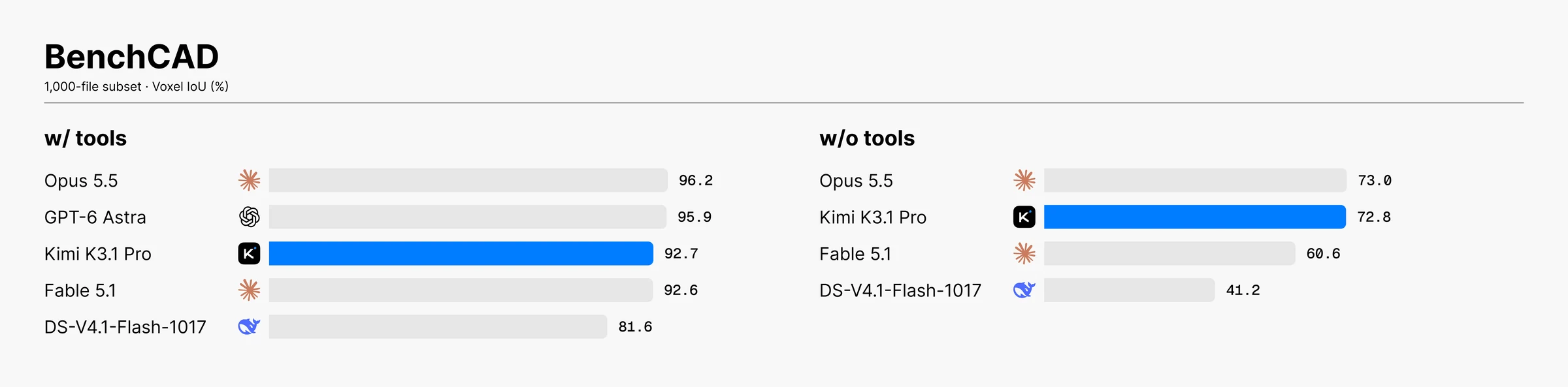
The gap widens on the hardest agentic test. On Terminal-Bench 4.0, Artificial Analysis puts Qwen4-Max at about 48.5% and Kimi K3.1 Pro at about 67% — a gap of roughly 19 points, and the most important number here for anyone buying a model to run coding agents. Moonshot's own launch figures tell a similar story from the other side, claiming 65.7% for Kimi against 66.4% for Claude Opus 5.5, which would put Kimi within a point of Anthropic's best.
Not every benchmark favors Kimi: on FrontierCode 2.0, a coding benchmark from Cognition, the two tie at 26%. Alibaba's own launch figures — vendor claims, not independent results — put Qwen4-Max ahead in places: 75.7 against 74.2 for Claude Opus 5.5 on DeepSWE v1.1, 46.7 on Agents' Last Exam v1.1, sixth place on the Code Arena leaderboard, and 52.69 against 47.74 for Qwen3.8-Max on its own Work360 benchmark of industry tasks across 721 fields.
The honest summary is that Kimi leads where independent measurement exists and the task is long and agentic, while Qwen's best numbers are the ones Alibaba measured itself. Until an independent lab reruns Qwen's vendor benchmarks, treat the DeepSWE and Work360 figures as Alibaba's word, and the Artificial Analysis and Terminal-Bench figures as the common ground.
Pricing: cheaper per token, cheaper per task
This is where Qwen wins outright, and the margin is large enough to change budgets. On QwenCloud in Singapore, Qwen4-Max costs $1.50 per million input tokens and $4.50 per million output tokens, with cached input at $0.075. Kimi K3.1 Pro costs $2.00 and $10.00 on the Moonshot API, with cached input at $0.20. Output tokens — the ones an agent burns most — cost less than half as much on Qwen, and cache hits cost nearly two-thirds less. A faster Highspeed variant of Kimi exists at $4.00 input and $20.00 output, but that moves it further from Qwen, not closer.
The token-price gap understates the real difference, because Qwen also uses fewer tokens to finish the same work. Artificial Analysis estimates the cost of one Intelligence Index task at $3.27 for Qwen4-Max, against $3.68 for Kimi K3.1 Pro and $10.02 for Qwen3.8-Max — roughly 11% cheaper than Kimi per task, and about a third of its predecessor's cost. Alibaba's own figures point the same way: on Work360, the average cost per task falls from $4.43 to $1.67, a 62% cut, with about 35% fewer tokens used at high reasoning effort.
For heavy API users, that math compounds: an agent loop that re-reads a long context on every turn pays the cache rate most of the time, and Qwen's $0.075 against Kimi's $0.20 is the difference that shows up on the monthly bill. New QwenCloud users also get a 1-million-token free quota valid for 90 days. The caveat is that Qwen's per-task advantage is measured on benchmark tasks; run both on a real job before switching a production pipeline.
Open weights vs API-only: the real dividing line
Price is not the only axis where the two models point in opposite directions. Kimi K3.1 Pro is open-weight: Moonshot published the full weights on Hugging Face on November 4, 2026, as moonshotai/Kimi-K3.1-Pro, a 1.56 TB download under the Kimi K3.1-Pro License. That license permits commercial use and serving, with extra conditions for very large services — a model-as-a-service business above $20 million in annual revenue, or products above 100 million monthly users, need a separate agreement with Moonshot. Self-hosting a 2.8-trillion-parameter model is not cheap — it needs serious GPU hardware — but the option exists, and with it comes data privacy, no vendor lock-in, and the freedom to fine-tune.
Qwen4-Max is API-only. Its weights are not public, fine-tuning and self-deployment are not offered, and the model runs only on Alibaba's servers. Alibaba says smaller open-weight Qwen4 models will follow, but no date has been given, and the flagship itself is expected to stay closed. That constrains teams with data-residency rules, researchers who need to inspect or modify a model, and anyone wary of a vendor changing prices or retiring an API — the Qwen4-Max preview itself retires on November 25.
There is a safety footnote worth one line. Alibaba says it filtered training data to remove offensive cyber capabilities and added datasets to mitigate chemical, biological, radiological, and nuclear risks; Moonshot did something similar for Kimi, stripping cyber-related data from the open-weight training stages and accepting a lower score on its own exploit test as a result.
Where to try them today
Both models are easy to reach without changing your stack. Qwen4-Max is on QwenCloud through the Token Plan and the pay-as-you-go API, and on OpenRouter as qwen/qwen4-max at the same $1.50 and $4.50 rates, so one key covers both models if you already use OpenRouter. It also appears in Alibaba's own apps, QwenWork and QwenStudio.
Kimi K3.1 Pro is available in the Kimi chat app and on the Kimi API under the model ID kimi-k3.1-pro, with the Highspeed variant alongside it. If you prefer to run it yourself, the weights are on Hugging Face, and the model is also listed on OpenRouter and Vercel's AI Gateway.
A practical way to decide is to run the same real job on both — a multi-file refactor, a long document review, a research agent run — through OpenRouter on each model. Watch whether the task completes, how many tokens it burns, and what the bill says. The tables above predict Kimi will finish more hard jobs and Qwen will bill less for the ones both finish; your own task is the tiebreaker.
Verdict: who should pick which
There is no single winner here, because the two models optimize for different buyers. Pick Qwen4-Max if you run high-volume API workloads and the bill is the constraint: it is cheaper per token and per task, a big step up from Qwen3.8-Max, and the cache pricing rewards the long-context agent loops that dominate real usage. Heavy Qwen3.8-Max users should switch — the upgrade is cheaper and better on every independent measure available so far.
Pick Kimi K3.1 Pro if you need the strongest agentic coding available outside Anthropic's top tier, or if you need open weights at all. Its Terminal-Bench lead is large, its weights are already downloadable, and it is the only one of the two you can self-host, fine-tune, or run behind your own firewall. The higher token price is the cost of that capability and that freedom.
Neither model dethrones the frontier: both sit well behind Claude Opus 5.5 on the independent index, and the gap to the top is larger than the gap between them. For most teams, the right move is to route by job: Qwen for high-volume work where cost dominates, Kimi for the hard agentic jobs and anything that needs to run on your own hardware.
Sources
- Alibaba Cloud — alibabacloud․com
- The Decoder — the-decoder․com
- Artificial Analysis — artificialanalysis․ai
- Kimi K3.1 Pro tech blog — kimi․ai
- Hugging Face — huggingface․co