
Claude Opus 5.5 vs Fable 5.2: Which Model Should You Actually Run?
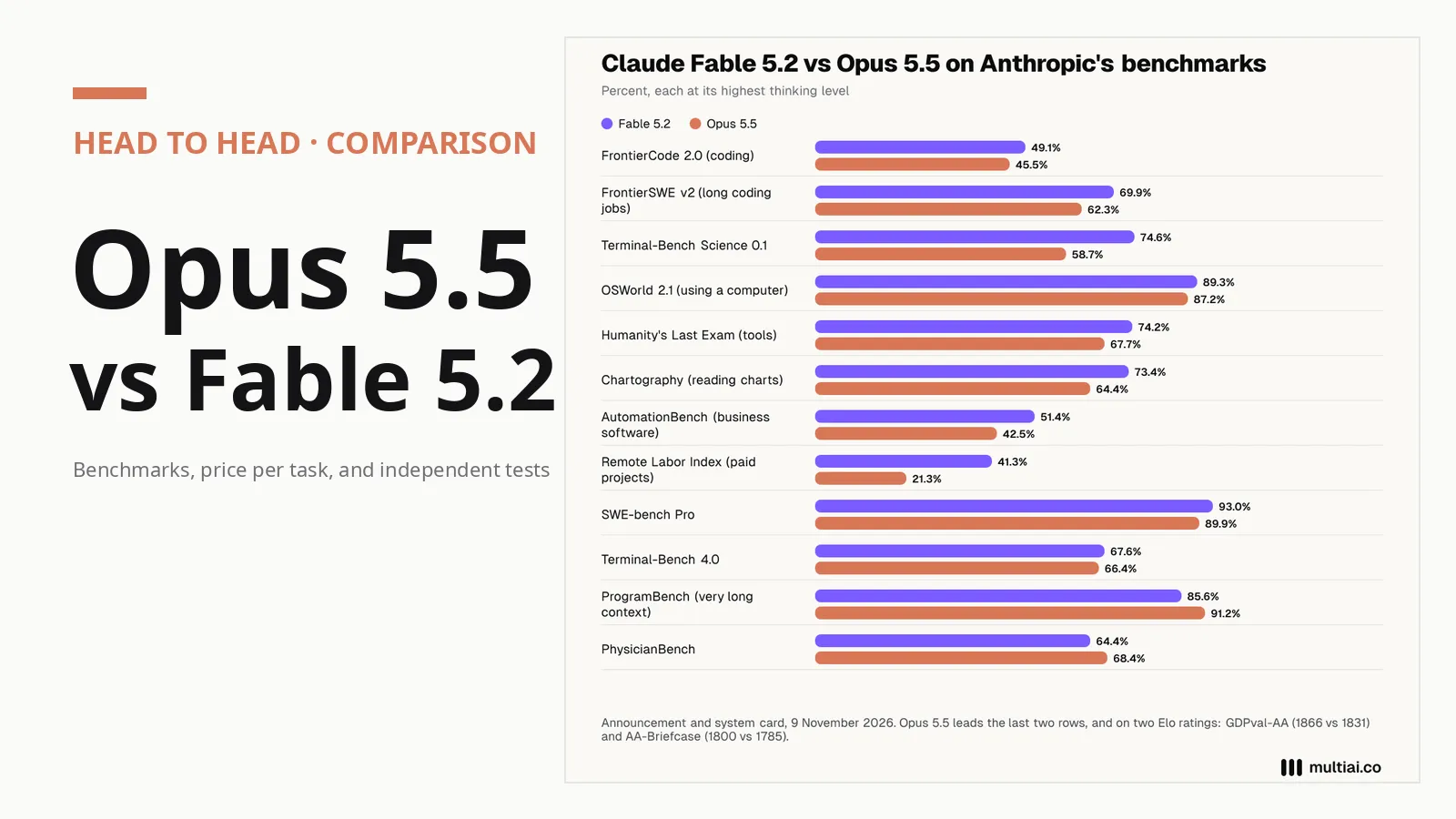
Anthropic released Claude Fable 5.2 on November 9, 2026. The headline writes itself: the new flagship costs exactly twice as much per token as Claude Opus 5.5 — $8 and $40 per million tokens in and out, against $4 and $20 — and beats Opus on most of Anthropic's own benchmarks. The same launch post tells most people to start with Opus anyway. Both can be true, because the honest comparison is not price per token. It is price per task, at the thinking level each job actually needs — and on that measure, the cheaper model sometimes wins outright.
Two kinds of evidence sit behind it: Anthropic's own benchmark table — one vendor grading its own models, labeled as such wherever it appears — and independent testing. MultiAI ran everyday tasks, hard problems, and a 892,000-token document on November 9 and 10, and ContextBolt ran three same-task jobs on November 9. Their charts and screenshots appear below, credited to them. Navs ran no benchmark lab of its own.
The two models at a glance
Opus 5.5 arrived on September 22, 2026, a cheaper Opus that Anthropic said matched Fable 5.1 — then beat it on every benchmark the two shared. Fable 5.2, released November 9, restores Fable's lead. Anthropic calls Opus 5.5 its "strongest daily driver" and recommends starting there for most coding and knowledge work, then moving up to Fable as the job demands.
Both share the same shape: a 1M-token context window, 128,000 tokens of maximum output, adaptive thinking always on, a June 2026 knowledge cutoff. What differs is the default effort and the price: the API starts Fable 5.2 at High and Opus 5.5 at Medium, so the same request with no setting runs one level deeper, and costs more, on Fable.
| Claude Fable 5.2 | Claude Opus 5.5 | |
|---|---|---|
| Released | November 9, 2026 | September 22, 2026 |
| Input / output, per million tokens | $8 / $40 | $4 / $20 |
| Cache read, per million tokens | $0.20 | $0.20 |
| Fast mode, per million tokens | $16 / $80 | $8 / $40 |
| Context / longest reply | 1M / 128K tokens | 1M / 128K tokens |
| Default thinking level (API) | High | Medium |
Both ship inside Claude, so switching is a setting, not a new account.
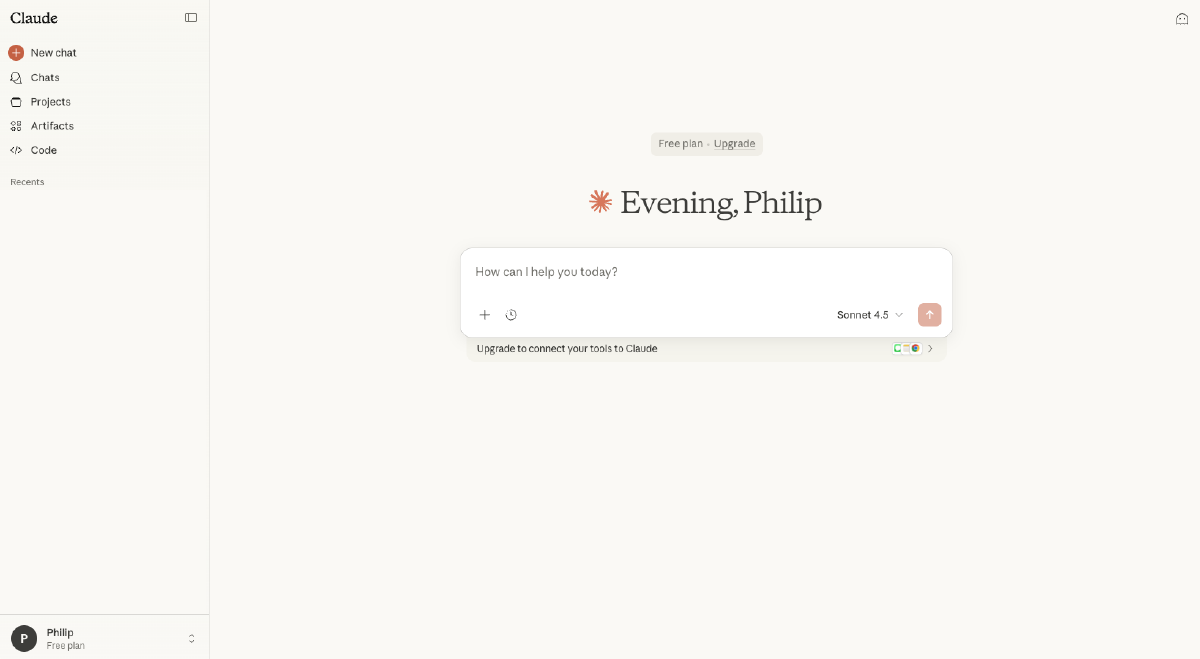
Benchmarks: Fable leads almost everywhere, Opus wins four rows
From Anthropic's launch post and system card, each model at its highest level — one vendor grading its own models. Treat it as a reason to run your own comparison, not as the comparison.
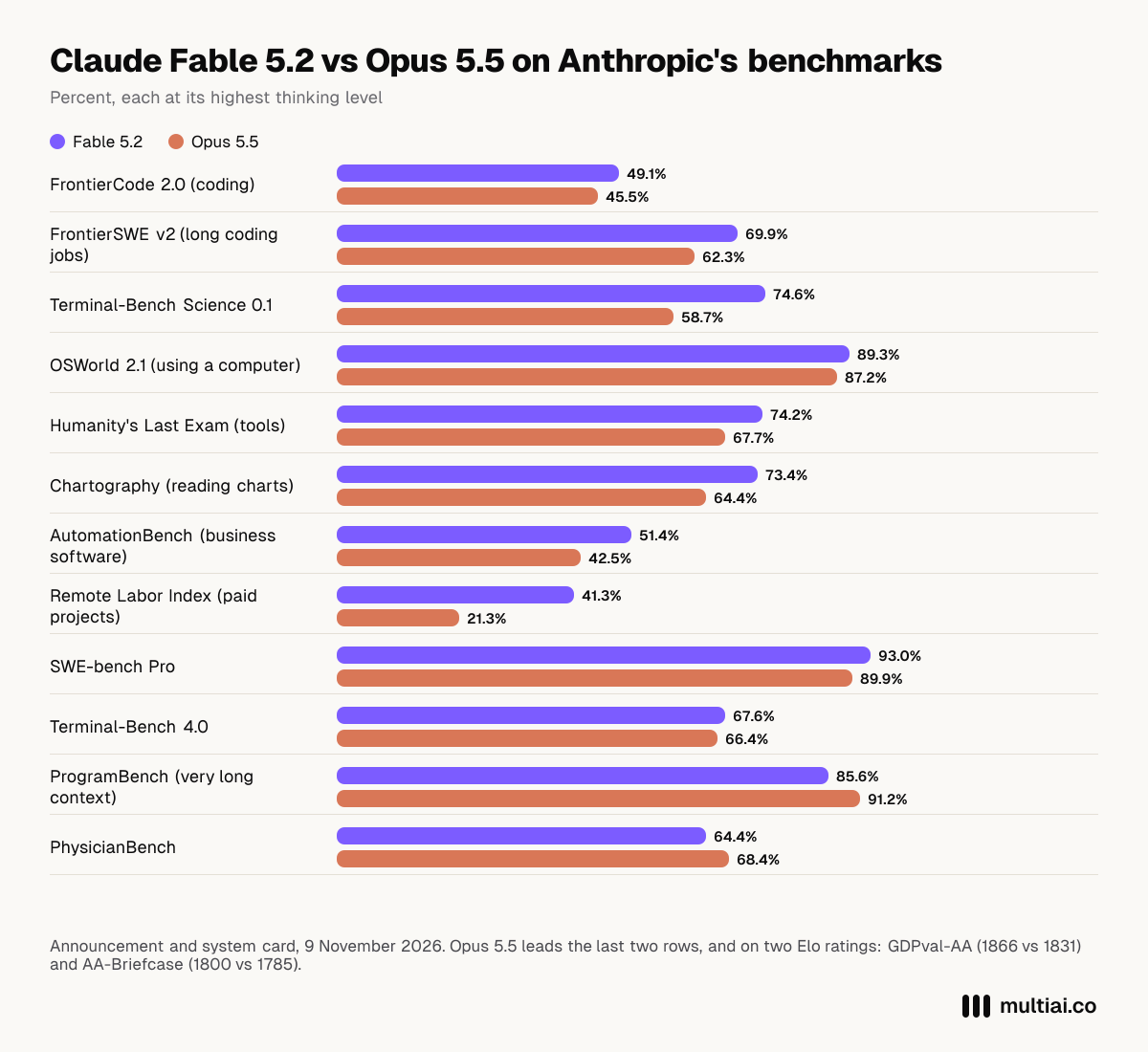
Chart: MultiAI.
Fable 5.2 leads on 14 of the 16 headline results, by the widest margins where the work is long and open-ended. FrontierCode 2.0, whether generated code changes get accepted, reads 49.1% against 45.5%. FrontierSWE v2, long coding jobs up to 20 hours, reads 69.9% against 62.3%. Terminal-Bench Science, unattended terminal research, reads 74.6% against 58.7%. The Remote Labor Index, paid freelance projects, nearly doubles: 41.3% against 21.3%. AutomationBench, business workflows, reads 51.4% against 42.5%.
Opus 5.5 wins four rows, and they are not trivial. On ProgramBench, work across a whole 1M-token codebase, Opus scores 91.2% against Fable's 85.6% — though Fable ran out of context on 68% of tasks, scoring 91.6% against 91.1% once shown how much it had left. On PhysicianBench, clinical questions, Opus leads 68.4% against 64.4%; on HealthBench every recent Claude scores above Fable 5.2. On the two Elo ratings of professional knowledge work, judges slightly preferred Opus: GDPval-AA 1866 against 1831, AA-Briefcase 1800 against 1785.
Independent results agree on the order: Artificial Analysis scores Fable 5.2 at 65 and Opus 5.5 at 59 on its Intelligence Index, and Vals.ai ranks Fable first at 71.3% and Opus fourth at 70.1%. On Vals's tests Opus still beats Fable on SWE-bench Multimodal, legal research, and tax work, and the two tie on Terminal-Bench 4.0 at 65.2%.
Price per task: the thinking level matters more than the model
Per token, the arithmetic is simple: Fable costs twice Opus on everything except cached input, where both charge $0.20 per million; cache writes are $10 against $5, Fast mode doubles both, and long prompts carry no surcharge.
The interesting comparison is score per dollar, where the thinking level matters more than the model name.
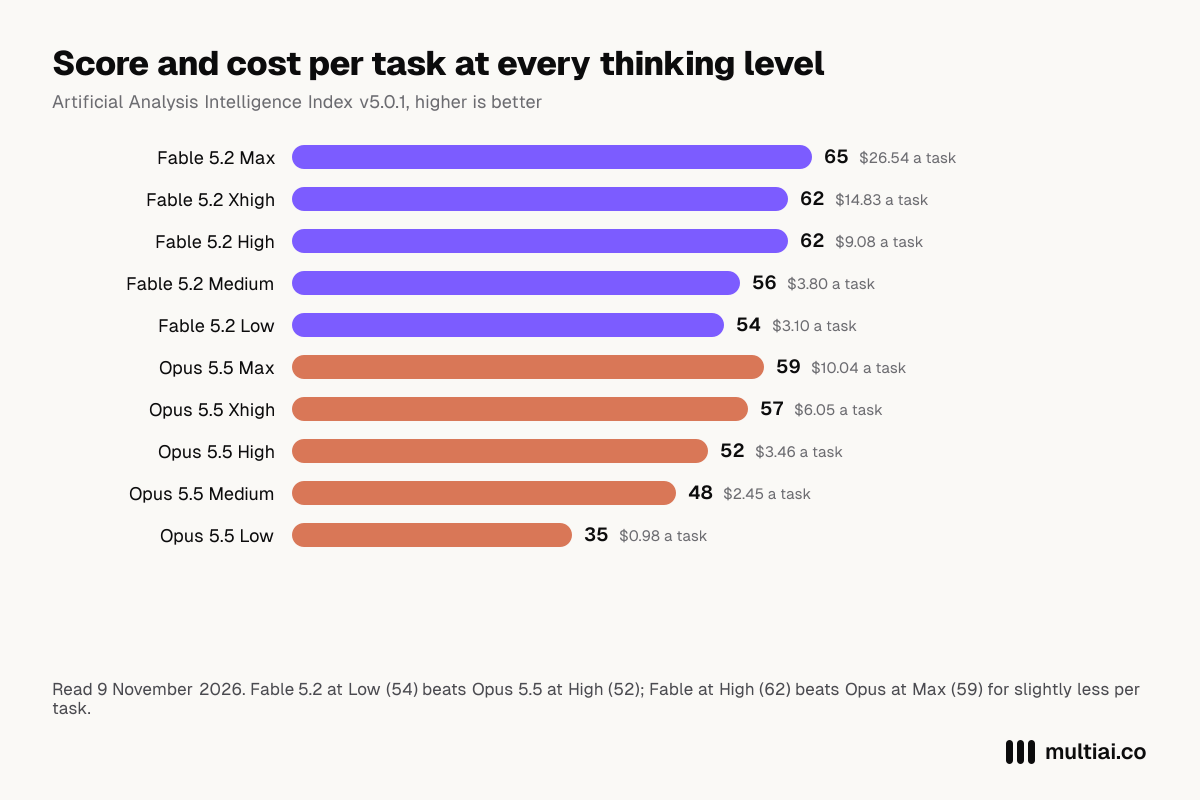
Chart: MultiAI.
Fable 5.2 at High scores 62 for $9.08 a task, beating Opus 5.5 at Max (59 for $10.04); Fable at Low scores 54 for $3.10, beating Opus at High (52 for $3.46). At the bottom Opus is far cheaper — under a dollar a task at Low — but scores 35 there. Anthropic's own charts show the same pattern: on FrontierCode, Fable at High roughly matches Opus's best, 45.3% against 45.5%, for about half the cost per task, and on Humanity's Last Exam, Fable at Low matches Opus's best for under a tenth of the cost.
So the honest comparison is not Fable against Opus at the same setting, but Fable at a lower setting against Opus at a higher one — and there, Fable often wins. Two catches: the API default means an unset request spends more on Fable, so set the level deliberately; and Fable 5.2 needs 30-day data retention on the API, erroring under zero retention unless Anthropic authorized it.
What independent tests actually found
Benchmarks are one vendor's story. Two independent teams ran the same jobs on both models in launch week, and their results are more useful for everyday decisions, including how the models fail.
ContextBolt gave both models three jobs in Claude Code on November 9, at medium effort: a sales dashboard from a 48-row CSV, four planted bugs in billing code, and a keyword research job with live SEO data. Both reached the same answers every time, and Fable cost 1.7 to 6.5 times as much per job. The dashboard job is the one to look at:
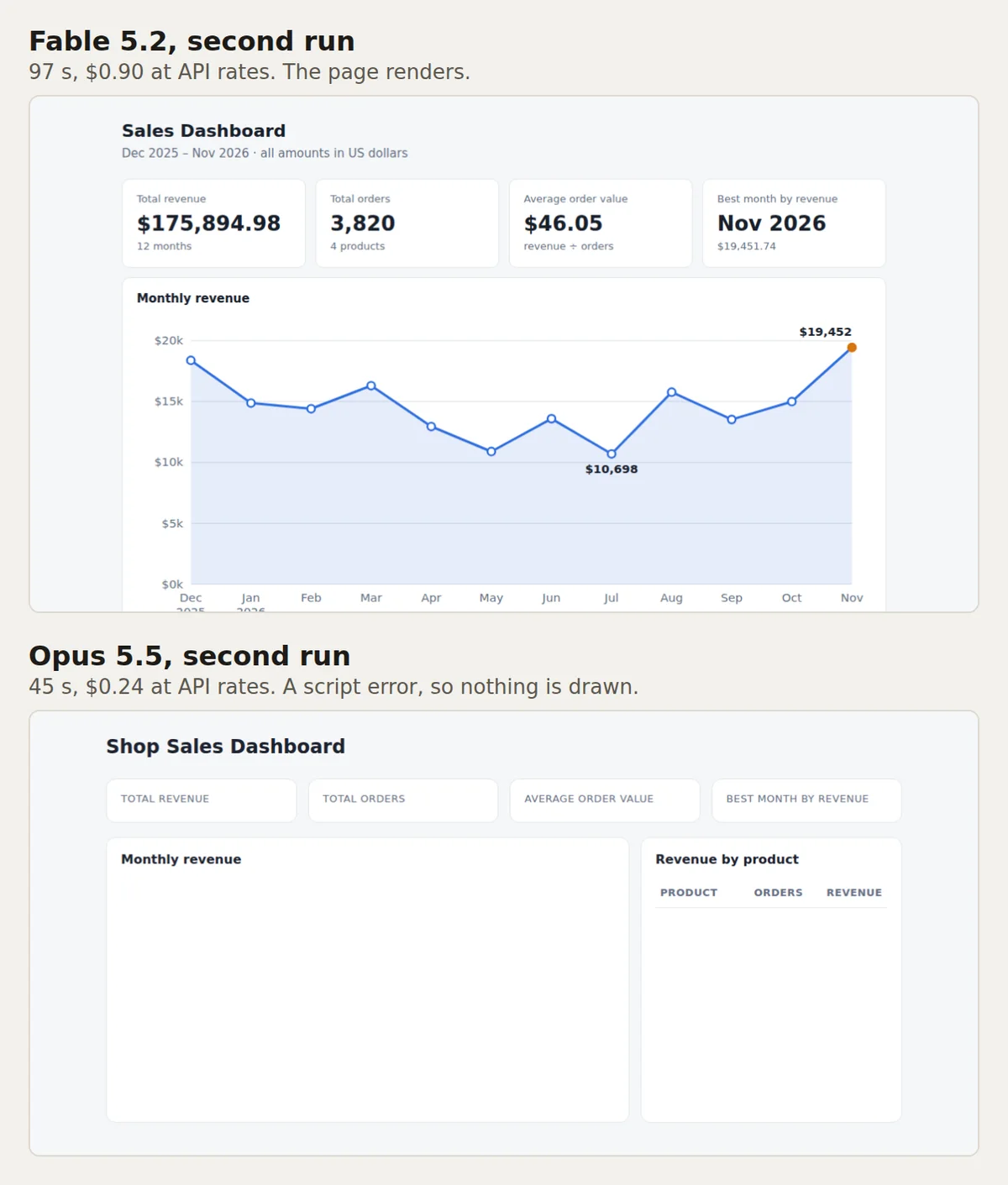
Screenshot: ContextBolt.
Fable built a working page in both runs, labeling the best and worst months unasked, at $0.90 to $1.23 and 74 to 97 seconds. Opus built one working page and one blank one: its second run named a variable top, a name every browser already uses for the window, so its script stopped before drawing anything — while still reporting the right numbers. Both fixed all four planted bugs in about 22 seconds and found a fifth bug nobody had planted. The keyword job ended in the same verdict: $0.80 for Fable, $0.17 for Opus.
MultiAI's runs, on November 9 and 10, tell the same story at larger scale. On eight everyday tasks — an invoice total, a bug fix, meeting notes, a seating puzzle — all 120 answers were right. Opus finished first — a median of 3.1 seconds against 4 to 4.5 for Fable — and cost about $9 to $10 per thousand answers against $13 to $20. On six hard problems, Opus was right 18 of 18 at both levels; Fable was right 18 of 18 at Low and High, and missed twice at Medium, both times by one on a counting problem. Fable at Low cost about the same as Opus at High and answered faster: a median of 20 seconds against 32. On a 892,000-token server log, both answered every question right, including counting 13 matching errors among decoys. The first question pays to store the document — $8.93 on Fable against $4.46 on Opus — and after that the price nearly evens out on cached reads. Opus was much quicker: 6 seconds against 17 on the first question, and 6 against 124 where Fable thought for two minutes.
Like for like at Medium, Fable cost 1.3 times as much on hard problems, 1.6 times on everyday tasks, and 1.8 times on the long document.
The honest limit of both test sets: the jobs were short. They cannot judge Anthropic's case for Fable — long work nobody watches. Anthropic says 1,000 Fable 5.2 copies formalized Fermat's Last Theorem in 30 hours, while Opus 5.5 finished about a quarter of it in 18 hours — the vendor's claim, not an independent result, and short tests cannot confirm or refute it.
Who should pick which
Start with Opus 5.5 — Anthropic's own advice, and both test sets support it: on routine work the answers are the same, Opus is quicker, and it costs roughly half, sometimes far less. Move up to Fable 5.2 when the work changes shape: runs of several hours, migrations across a codebase, many subagents, or a job that keeps failing on Opus at high effort. When you move up, drop the thinking level first — Fable at High or even Low often matches Opus at Max for less.
On a subscription the choice spends your limits as well as your bill; Opus sits inside every paid plan's limits. Fable runs on usage credits on Pro, except during launch week through November 16, when Pro and standard Team seats include it up to half their weekly limits; on Max and Ultra it can take at most half the weekly limit and uses it faster.
| If your work is | Start with |
|---|---|
| Everyday questions, writing, and analysis | Opus 5.5 at Medium |
| Hard problems with a right answer | Opus 5.5 at Medium, or Fable 5.2 at Low |
| A page or dashboard nobody will check | Fable 5.2 — or Opus 5.5, and open the page |
| Questions about very long documents | Opus 5.5: as accurate, quicker, half the price to load |
| Long, unsupervised jobs: research, big code changes | Fable 5.2 at High |
| Medical questions | Opus 5.5 |
| The best score whatever it costs | Fable 5.2 at Xhigh |
In Claude Code, /model fable switches to Fable 5.2 (2.1.321 or later), and the /model picker switches back.
Both are also on the API — OpenRouter lists them side by side at list prices, the quickest way to run the same prompt on both and compare the bill.
Sources
- MultiAI — multiai․co
- ContextBolt — contextbolt․com
- Anthropic — anthropic․com