Open-source Python framework for building autonomous multi-agent AI systems that run as a self-organising peer mesh with zero-trust credential handling.
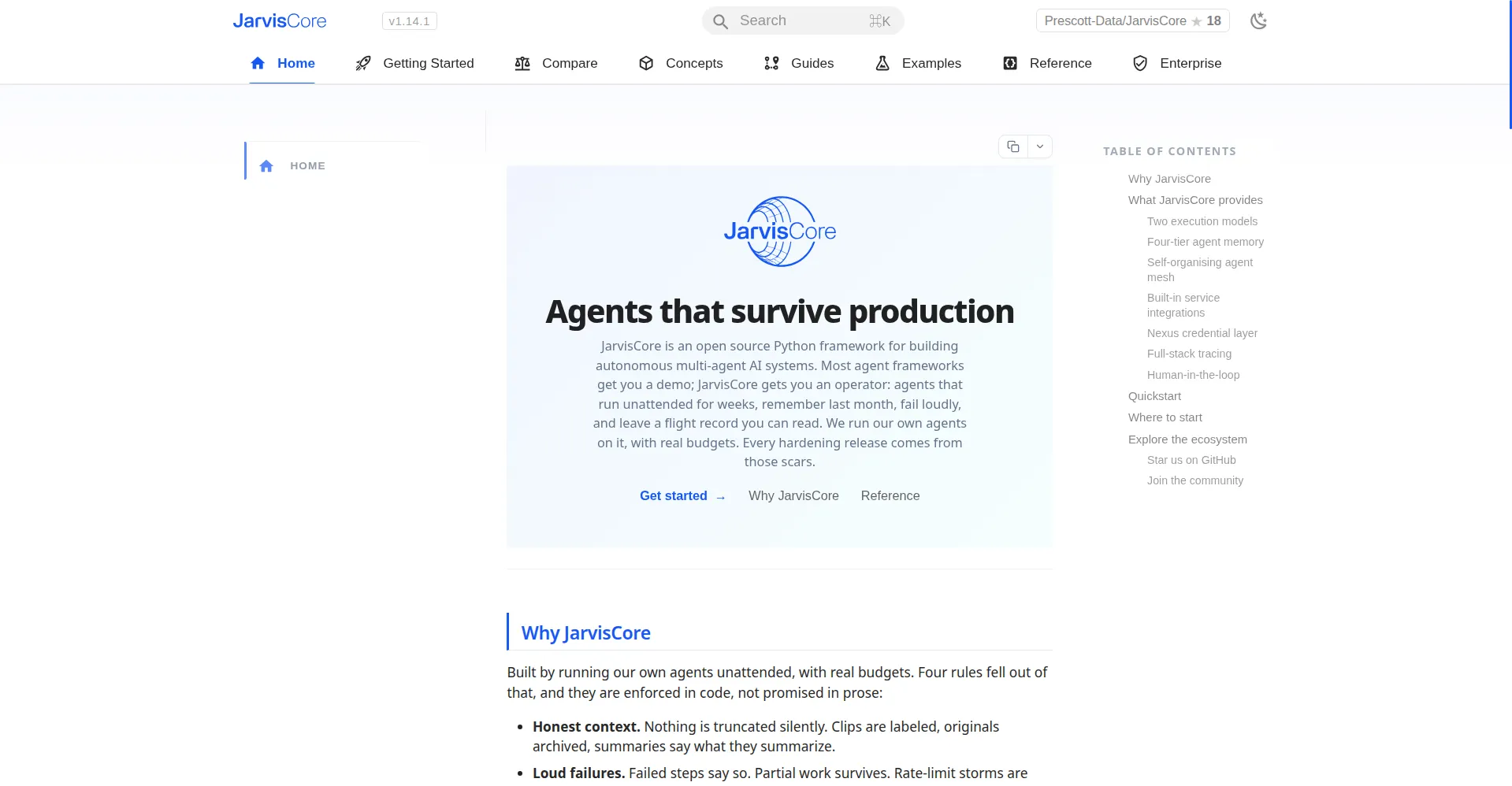
JarvisCore documentation homepage
1 / 2Overview
What is JarvisCore?
Agents that survive production
JarvisCore is an open-source Python framework for building autonomous multi-agent AI systems that actually survive production. Instead of agents orbiting a central orchestrator, JarvisCore runs agents as a fleet of equal peers: they discover one another by capability, execute tasks from a shared ledger, and authenticate to every external service through a zero-trust broker - never with their own keys.
It offers two execution models on one infrastructure: AutoAgent, with a full observe-orient-decide-act cognitive loop, and CustomAgent for deterministic control. Agents get a four-tier memory system (working scratchpad, episodic ledger, LLM-compressed long-term memory summaries, and optional cross-session memory), full-stack tracing of every agent turn, tool call and LLM request, and a human-in-the-loop queue that routes low-confidence decisions to a review inbox.
Built-in service integrations cover Slack, GitHub, Zoom, SAP, NetSuite, MS Graph, Salesforce and more, and it interoperates with LangChain, LlamaIndex, CrewAI and the Model Context Protocol. Install via pip (current release 1.14.1), scaffold with the CLI, and deploy locally, on Docker or Kubernetes.
The framework is Apache 2.0 licensed: self-host it and use it in commercial products with no revenue or user-count cap. JarvisCore Enterprise adds commercially licensed capabilities (agent access control, AI cost efficiency, workflow improvement, deployment assistance and support from Prescott Data), priced per project on request.
Platforms and languages
JarvisCore Availability
Platforms
Languages
Capabilities
JarvisCore Key Features
Two execution models
AutoAgent with a full observe-orient-decide-act cognitive loop, and CustomAgent for deterministic control - both share the same infrastructure and can be mixed as needed.
Four-tier agent memory
Working scratchpad, episodic ledger, LLM-compressed long-term memory summaries, plus optional cross-session memory.
Self-organising agent mesh
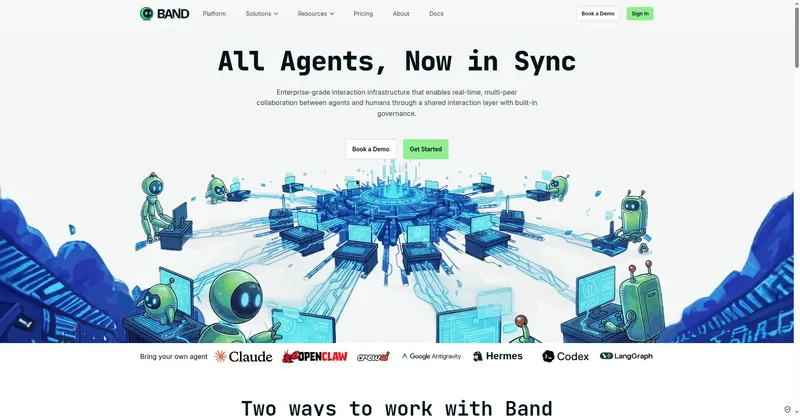
Agents discover and communicate with each other by capability via peer APIs, SWIM gossip and ZMQ - no central orchestrator required.
Built-in service integrations
Pre-built integrations for Slack, GitHub, Zoom, SAP, NetSuite, MS Graph, Salesforce and more, plus interop with LangChain, LlamaIndex, CrewAI and MCP.
Nexus zero-trust credential layer
Agents call third-party APIs without ever touching raw credentials, supporting OAuth2, API keys and basic auth.
Full-stack tracing and human-in-the-loop
Every agent turn, tool call and LLM request is traced automatically with a real-time stream; low-confidence decisions are intercepted and routed to a human review inbox.
Best for
Who uses JarvisCore?
Software and engineering teams
Build and run multi-agent AI systems in production rather than as demos
Plans and access
JarvisCore Pricing
Free
Open source (Apache 2.0) free to self-host incl. commercial use; Enterprise modules priced per project on request
Common questions
JarvisCore FAQs
What is JarvisCore?
An open-source Python framework/runtime for building autonomous multi-agent AI systems. Agents operate as equal peers in a self-organising mesh network, discovering each other by capability and authenticating to external services through a zero-trust credential broker - they never hold raw credentials.
How do I get started?
pip install jarviscore-framework, then scaffold with the CLI (jarviscore init / run / inspect / validate / doctor). About 50 lines of code builds a 3-agent formation; deploy locally, on Docker or Kubernetes.
What is the license?
Apache 2.0. You can self-host it and use it in commercial products with no revenue or user-count cap. Enterprise modules and services are under a separate commercial agreement.
How does it differ from other agent frameworks?
Per its README: two execution models on one infrastructure, a four-tier memory system, a peer mesh with no central orchestrator, a zero-trust credential layer, built-in enterprise integrations, and full-stack tracing with a human-in-the-loop queue.
Where do I get help?
Open-source support runs through GitHub issues/PRs and the Discord community; docs are on the documentation site. Enterprise customers contact Prescott Data for deployment assistance and support.
Reviews
See what the community thinks and share your experience.
—
Based on 0 ratings
Rating distribution
Community reviews
No reviews
No written reviews yet.