
GLM-5.4 Explained: Z.ai's Loop Transformer Flagship — Thinks Longer, Costs Less, Ships Slower
On November 23, 2026, Z.ai released GLM-5.4, its flagship model and the first flagship built on what the company calls a Loop Transformer. Instead of training a bigger model, Z.ai took the GLM-5 base and made 28 of its 78 layers run twice per forward pass, reusing the same weights. The pitch: a model reported at 750 billion parameters that, according to Z.ai, reasons like a model with 2 to 3 trillion parameters — while burning about a third fewer credits than its predecessor in the Coding Plan.
The honest story is thinner: no benchmark scores for GLM-5.4 itself at launch, no per-token API price, no open weights. The only independent test says it thinks four times longer than its fastest rival for a mid-table score. Try it inside a plan you already pay for; do not switch plans for it.
Scope and method: what we did and did not test
Navs did not run GLM-5.4. This launch-week explainer draws on Z.ai's announcement and documentation, independent coverage, and the one published third-party test available as of November 26, 2026. We label each number's source. With no model card, official benchmark table or public weights at launch, treat every performance claim as provisional.
The loop, in plain English
A standard transformer runs each layer once per forward pass. A looped transformer runs a block of weight-shared layers several times, each pass refining the last one's hidden states. GLM-5.4 loops 28 middle layers twice, gaining roughly a third of effective depth without adding parameters beyond small gates.
The idea dates to the 2018 Universal Transformer; November 2026 is the month it went mainstream at flagship scale, with Inkling 2 Mini shipping three days earlier. Z.ai's twist is commercial: rather than training a looped model from scratch, it converted an already-trained base through continued training. One caveat on size: coverage reports roughly 750 billion parameters, but Z.ai has not confirmed that total, and it has published no active parameter count. The "comparable to 2T–3T models" line is the company's own claim, with no published benchmark behind it yet.
Beyond the loop, GLM-5.4 adds vision input for the first time in the mainline flagship — it works from screenshots and images, alongside text, video and files. Context is 1 million tokens, output up to 128,000. Z.ai quotes up to 200 tokens per second off-peak and 70 to 80 under peak load — vendor figures, not independent measurements.
The evidence so far: official claims vs one independent run
The evidence table is short, and its shortness is the story.
| Claim or measurement | Source | What it says |
|---|---|---|
| Intelligence comparable to 2T–3T models | Z.ai (company claim) | No published benchmark yet |
| KingBench 4: 33.2 of 60, 7th of 19 | AICodeKing (independent) | Best open model; Fable 5.2 leads at 42.0 |
| KingBench 4 runtime: 431 min, 1,128 steps, ~1.04M tokens | AICodeKing (independent) | Gemini 4 Neon: 109 min, 244 steps, ~70K tokens |
| Beats GLM-5.3 in 51.1% of 200 tasks | Z.ai (company-run) | Not an independent benchmark |
| 30B ablation: AIME25 19.17% to 30.42%, GPQA 47.58% to 56.26% | Z.ai (research ablation) | Tests the architecture, not GLM-5.4 itself |
KingBench 4 is the only independent evidence in existence this week: six one-prompt app builds at maximum effort. GLM-5.4 scored 33.2 out of 60, seventh of 19 and the highest open model. The leaders were Claude Fable 5.2 (42.0), Gemini 4 Neon (37.9), GPT-6.2 Sol (37.0) and Claude Opus 5.5 (34.7); GLM-5.3 scored 27.5 on a partial run.
The cost was time: 431 minutes — about 7.2 hours — against 109 for Gemini 4 Neon, with 1,128 reasoning steps against 244 and roughly 1.04 million tokens against about 70,000. Z.ai itself warns of overly long "marathon thinking" loops, while saying the extra self-correction still lifts accuracy. At 70 to 200 tokens per second, the bottleneck is how many tokens the model decides it needs, not how fast it emits them.
Read the score with its caveats: two tasks were rerun with clarified prompts, four were graded by Gemini 4 Neon and two by GLM-5.4 itself, and the same-prompt total was 31.8, not 33.2. One reviewer is not a benchmark consensus.
Two details from the same test matter more than the headline score. The model is unusually careful: AICodeKing calls it the most careful model he has used, saying it surfaced bugs and security flaws that Claude Fable 5.2 and others missed. And it fails more often but gives up less — a 1.56% tool-call failure rate, 11th of 17, with 66% of failures recovered on retry, more than any Claude or Codex model tested.
The cleanest evidence for the architecture is Z.ai's 30B ablation, where only the looping differed: with about 10% more training compute, the looped version gained most on math, science and long-context tasks, and output length dropped 10 to 14% — reasoning moved from written tokens into the loop's implicit depth. At 750B on real agentic work, the marathon thinking shows up anyway.
What it costs: the credit math
There is no per-token API price, because there is no standard API yet. Z.ai says API access follows a safety evaluation, and open weights follow what it calls safety hardening — no date or licence for either. For now, GLM-5.4 is subscription-only.
| Plan | Monthly | Per month, billed yearly | Credits every 5 hours | Credits a week |
|---|---|---|---|---|
| Lite | $18 | $12.60 | 2,000 | 10,000 |
| Pro | $80 | $56 | 12,000 | 60,000 |
| Max | $168 | $117.60 | 28,000 | 140,000 |
Yearly billing is 30% off and quarterly 20% off; all tiers include GLM-5.4, as do Team plans and the Start trial. Subscriptions are non-refundable once purchased.
The real price story is the credit rate. GLM-5.4's multipliers are 4.6, 1.1 and 16 on input, cached input and output tokens, against 6.9, 1.7 and 24 for GLM-5.3 — about a third lower — with a weekly quota 50% larger and off-peak hours at half the standard rate. That is why it is cheaper to run than its predecessor even though it thinks longer. But the KingBench gap cuts the other way: 1.04 million tokens against 70,000 is a 15x gap, and on a credit budget that is real money.
GLM-5.3 stays available and is never auto-swapped for 5.4; there is no GLM-5.4 Flash yet. The cheaper, faster multimodal option remains GLM-5.3 Flash, at a third of GLM-5.3's credit rate.
Five ways to run GLM-5.4 today
ZCode: the home turf
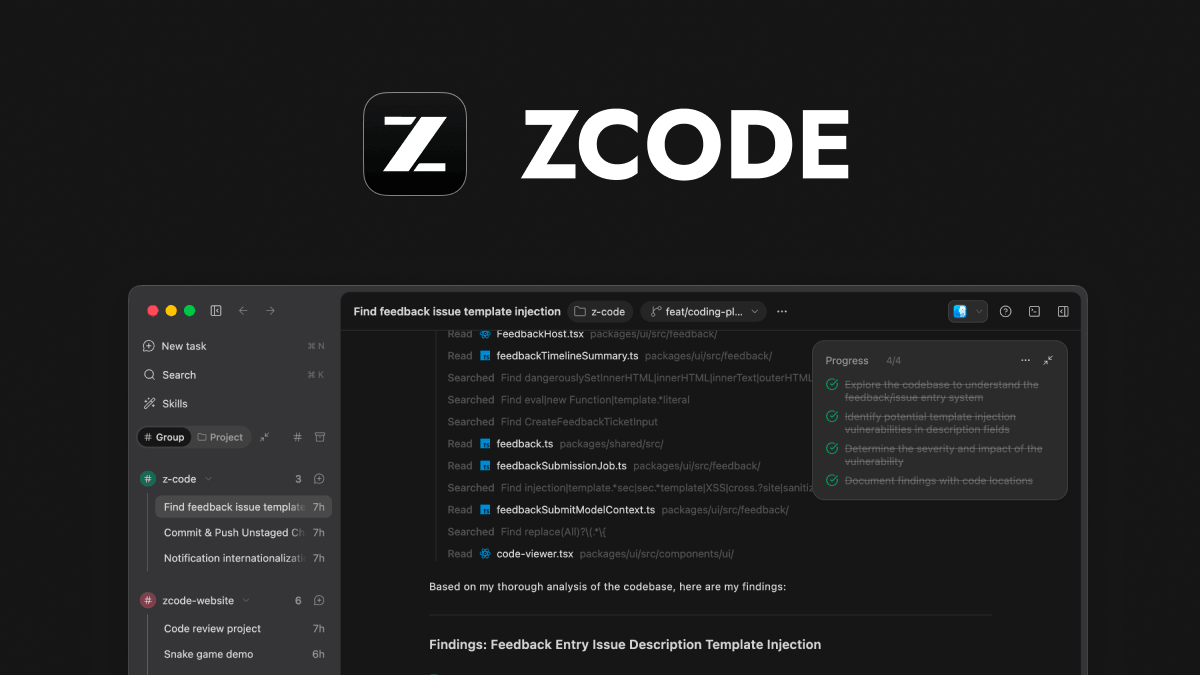
ZCode is Z.ai's own Agentic Development Environment, deeply tuned for GLM-5.4. It puts AI agents at the center of the workflow: describe the task in natural language and the agent drives coding, debugging, testing, preview and review. Goal Mode keeps long tasks running until the objective is verified, and multi-agent workflows split work across subagents. The app is completely free on macOS, Windows and Linux — you pay only for the model plan you connect — and Z.ai open-sourced it under Apache-2.0 in September 2026.
Claude Code: the familiar harness, with one oddity
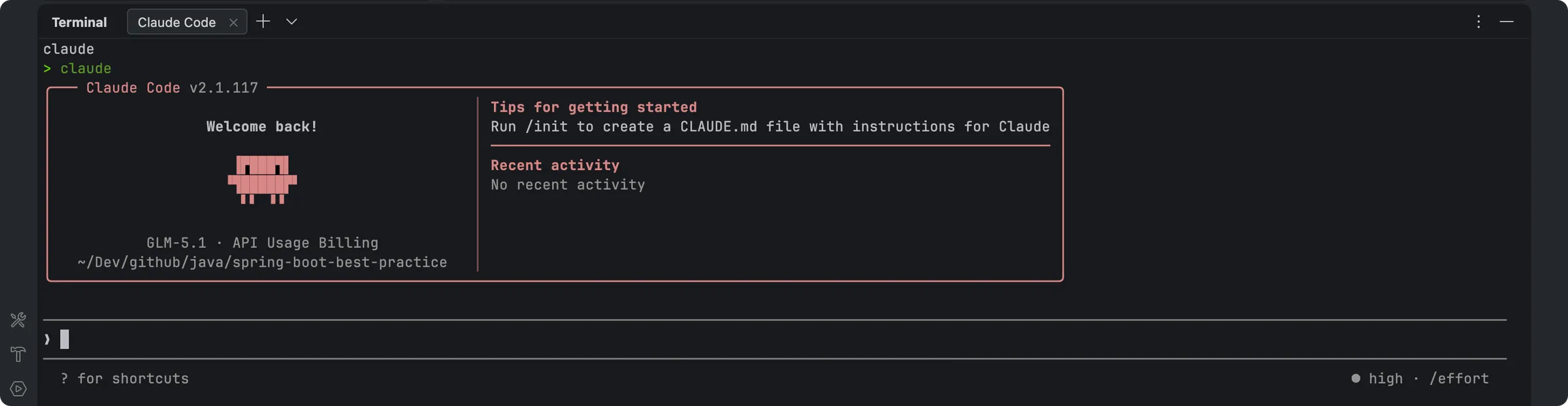
Claude Code is the most direct way to compare GLM-5.4 against the model it is meant to challenge: point it at the GLM Coding Plan and set the model to glm-5.4[1m]. Two settings matter: the plan maps requests onto three real effort levels — Low, High and Max — a Medium request lands on High, and unset runs at Max. Z.ai's docs also recommend a 512,000-token client context window for better coding results, though the model supports 1M. Start at High and give Max a generous timeout: in independent testing the top settings timed out mid-reasoning while a mid-level setting finished.
Cline: the editor-native route
Cline brings GLM-5.4 into VS Code and JetBrains as an autonomous coding agent, keeping your editor, extensions and keybindings. Connect the GLM Coding Plan, select glm-5.4, and it works through Cline's plan-and-act loop of file edits, terminal commands and checkpoints.
OpenCode: the free, model-agnostic route
OpenCode is a free, MIT-licensed coding agent that runs in the terminal, as a desktop app, on your phone or through an SDK, and connects to more than 200 model providers. A set of free models works with no account, and the optional OpenCode Go subscription starts at $10 a month. To run GLM-5.4, add the Coding Plan as the zai-coding-plan provider and select glm-5.4 in your config.
Codex: the OpenAI-side door
Codex also runs GLM-5.4 — select glm-5.4 after connecting the Coding Plan. It is most useful as a second opinion: Codex's agent loop and sandboxing differ from the other harnesses, so a model that behaves one way in ZCode may behave differently here, particularly on long tasks where the marathon thinking shows up.
Verdict: worth trying, not worth switching for
GLM-5.4 is the most interesting architecture release of the month and the least proven flagship of the month. The loop is elegant and genuinely cheaper: a third fewer credits than GLM-5.3, a 50% larger quota, and a cheaper path to depth than training a bigger model. The 30B ablation says the architecture works. The one independent test says the flagship is the best open model on that board, the most careful reviewer of code, and four times slower than its fastest rival.
That points to a specific role. Do not make GLM-5.4 your default coding agent — not until a second independent benchmark, a published model card and a per-token API price exist. Do try it inside a plan you already pay for, at the High effort setting, as a second reviewer on security-sensitive code and for long, dependent tasks where patience is a feature. On Lite at $18 a month, the cheapest way to meet GLM-5.4 is already in your pocket. Z.ai has said benchmark scores are coming later, and the moment a second harness publishes numbers, the "thinks longer" question gets an answer instead of an anecdote.
Sources
- Z.ai official blog — z․ai
- ZCode docs — zcode․z․ai
- DataCamp — datacamp․com
- Decrypt — decrypt․co
- Technology.org — technology․org
- OpenCode official site — opencode․ai