Self-hosted, MIT-licensed routing layer that decides which tool an agent should call — fast path for obvious calls, Jev-backed MCTS for ambiguous ones.
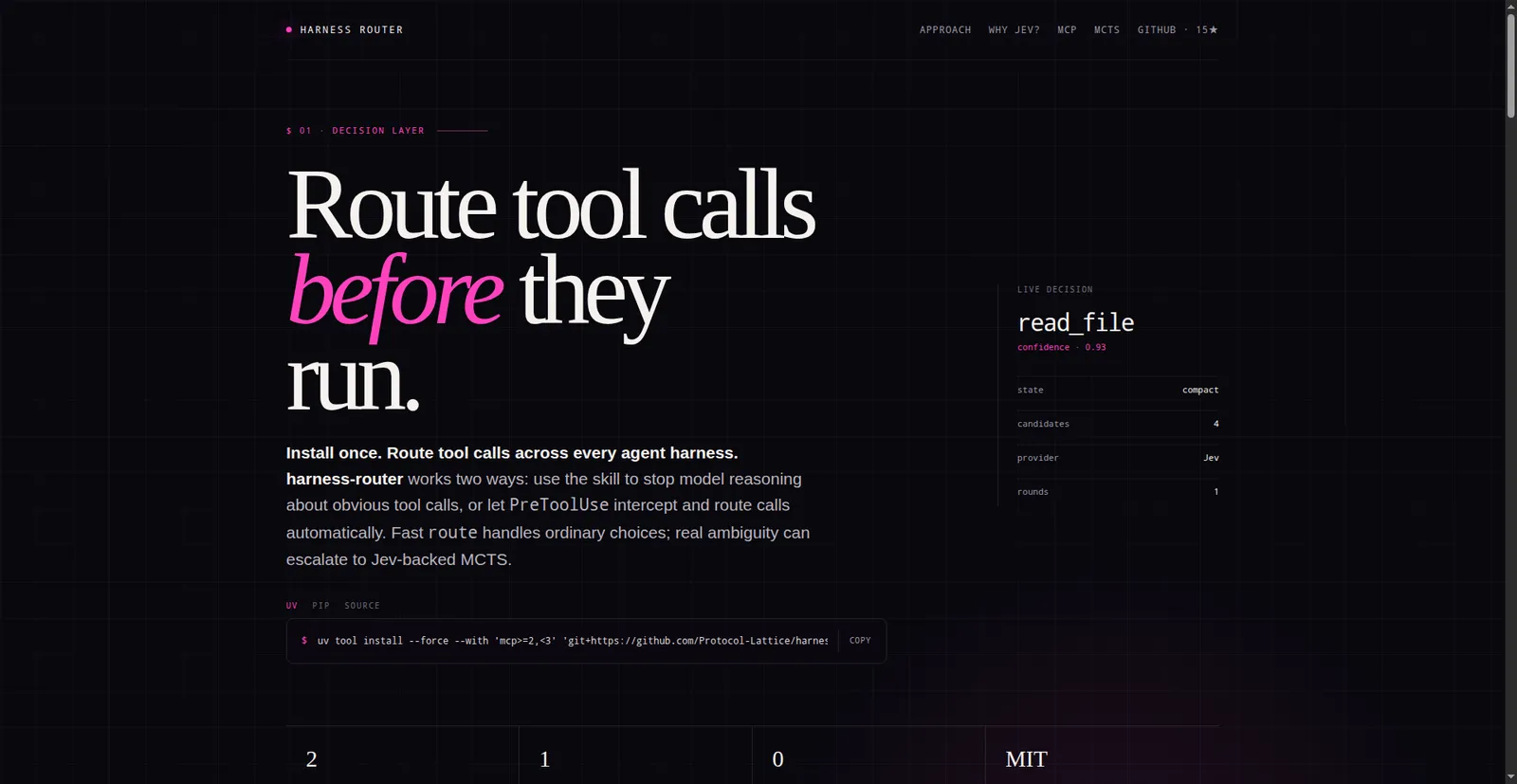
Harness Router homepage — install once, route tool calls across every agent harness
1 / 2Overview
What is Harness Router?
Fast AI tool routing powered by Jev.
Harness Router is the fast decision layer for agent harnesses: an MIT-licensed, self-hosted routing layer that decides which tool an agent should call. Obvious calls take the fast route path — about 9.5x faster than a full Codex reasoning step while matching Codex's choice in 24 of 24 tested decisions. Ambiguous calls escalate to route_mcts, a bounded MCTS search (4,096 simulations, depth 3) seeded with a Jev prior, which reached the optimal choice in 100% of benchmark cases. Integrate it as an MCP skill, expose both tools (route, route_mcts) through the native stdio MCP server, or install the project hooks so tool selection is checked automatically before execution in Codex, Claude Code, ohmypi, Antigravity, and DeepSeek Harness.
It is free and open source (MIT) with no account or subscription — you self-host it and bring your own OpenRouter key. Jev routing costs about $0.042 per million input tokens with free output, roughly 238x cheaper than a flagship model's input tokens. Routing is fail-open: uncertain, fallback, timeout, or error outcomes let the original call continue, sandbox and approval rules stay untouched, and MCTS simulations never execute side effects.
Platforms and languages
Harness Router Availability
Platforms
Languages
Capabilities
Harness Router Key Features
Fast route for ordinary choices
Observed 9.5x faster than a full Codex reasoning step (404.5ms vs 3,842.1ms mean decision time), matching Codex's tool choice in 24 of 24 paired decisions with 4 to 16 candidates.
route_mcts for the hard calls
Uncertain decisions escalate to a bounded MCTS search (4,096 simulations, depth 3) seeded once with a Jev prior — 12.3x faster than Codex with 100% optimal choices in benchmarks.
Two ways in: skill or hook
Use the MCP skill when you want explicit control, or let the PreToolUse hook intercept and route every tool call automatically before execution — no model reasoning needed.
Project hooks for five harnesses
One installer wires Codex, Claude Code, ohmypi, Antigravity, and DeepSeek Harness so the agent discovers its tool inventory once at session start and routes every call through Harness Router.
Fail-open and side-effect-free
Uncertain, fallback, timeout, or error outcomes let the original tool call proceed untouched. MCTS explores a side-effect-free state graph and never executes simulated writes, shell commands, or network mutations.
Best for
Who uses Harness Router?
Developers building coding agents and agent workflows
Stop models wasting full reasoning steps on obvious tool choices; route every tool call through one fast decision layer
Plans and access
Harness Router Pricing
Free
MIT open source, self-hosted. Bring your own OpenRouter key; Jev routing about $0.042/MTok input, output free.
Common questions
Harness Router FAQs
Is Harness Router free to use?
Yes — it is MIT-licensed open source that you self-host with uv tool or Docker, with no HarnessRouter account or subscription. You only pay for your own OpenRouter key usage; Jev input costs about $0.042 per million tokens and Jev output is free.
Does it replace my agent's planner?
No. Jev handles only the narrow closed-choice routing step — which tool to call. Codex (or Claude Code and the rest) keeps the broader reasoning and execution loop; the router just makes the obvious picks cheap and fast.
Which agents and harnesses does it work with?
It integrates with Codex, Claude Code, ohmypi, Antigravity, and DeepSeek Harness — as an MCP skill the agent invokes, or as a PreToolUse hook that checks every tool call automatically before execution. It is framework-agnostic.
Can the router break my workflow or run dangerous tools?
No. It is fail-open: if routing is uncertain, times out, or errors, your original tool call proceeds unchanged and sandbox or approval rules remain untouched. The MCTS path only searches a side-effect-free state graph and selects the first real action — it never executes simulated writes or shell commands.
Compare similar tools
Harness Router Alternatives
 Opencontroller by lyzrUnified control plane to discover, govern, and monitor AI agents and models across your infrastructure.AI Security ToolsAI Infrastructure ManagementAI Monitoring Toolsagent governanceai securitycontrol plane
 Zerg RouterZerg Router is a single OpenAI-compatible endpoint that routes your coding agents to the right model, with per-key budgets and failover.AI Development InfrastructureAI Integration AutomationAI Coding AssistantsAI routerDeepSeekCodex
Reviews
See what the community thinks and share your experience.
—
Based on 0 ratings
Rating distribution
Community reviews
No reviews
No written reviews yet.